Event submissions
Published
This submission belongs to the session S1. Rivers, Dams and Reservoirs of the event The 8th International Electronic Conference on Water Sciences
Published date
11 Oct, 2024
Academic Editor
'%3e%3cpath%20d='M12.6657%2010.9104C12.4185%2010.325%2012.0599%209.79327%2011.6097%209.34482C11.1609%208.89508%2010.6293%208.5365%2010.0442%208.28888C10.0389%208.28626%2010.0337%208.28495%2010.0285%208.28233C10.8446%207.69279%2011.3752%206.73249%2011.3752%205.64904C11.3752%203.8542%209.92103%202.39999%208.1262%202.39999C6.33136%202.39999%204.87715%203.8542%204.87715%205.64904C4.87715%206.73249%205.40774%207.69279%206.22393%208.28364C6.21869%208.28626%206.21345%208.28757%206.20821%208.29019C5.62129%208.5378%205.09463%208.89284%204.64265%209.34613C4.1929%209.79493%203.83432%2010.3266%203.58671%2010.9117C3.34345%2011.4845%203.21226%2012.0987%203.20023%2012.7209C3.19988%2012.7349%203.20233%2012.7488%203.20744%2012.7619C3.21255%2012.7749%203.22022%2012.7867%203.22998%2012.7968C3.23975%2012.8068%203.25142%2012.8147%203.26431%2012.8202C3.2772%2012.8256%203.29105%2012.8284%203.30504%2012.8284H4.09109C4.14874%2012.8284%204.19459%2012.7825%204.1959%2012.7262C4.2221%2011.7148%204.62823%2010.7676%205.34617%2010.0497C6.08899%209.30683%207.0755%208.89808%208.1262%208.89808C9.17689%208.89808%2010.1634%209.30683%2010.9062%2010.0497C11.6242%2010.7676%2012.0303%2011.7148%2012.0565%2012.7262C12.0578%2012.7838%2012.1037%2012.8284%2012.1613%2012.8284H12.9474C12.9613%2012.8284%2012.9752%2012.8256%2012.9881%2012.8202C13.001%2012.8147%2013.0126%2012.8068%2013.0224%2012.7968C13.0322%2012.7867%2013.0398%2012.7749%2013.0449%2012.7619C13.0501%2012.7488%2013.0525%2012.7349%2013.0522%2012.7209C13.0391%2012.0947%2012.9094%2011.4855%2012.6657%2010.9104ZM8.1262%207.9024C7.52486%207.9024%206.9589%207.6679%206.53312%207.24211C6.10733%206.81633%205.87283%206.25037%205.87283%205.64904C5.87283%205.0477%206.10733%204.48174%206.53312%204.05596C6.9589%203.63018%207.52486%203.39567%208.1262%203.39567C8.72753%203.39567%209.29349%203.63018%209.71927%204.05596C10.1451%204.48174%2010.3796%205.0477%2010.3796%205.64904C10.3796%206.25037%2010.1451%206.81633%209.71927%207.24211C9.29349%207.6679%208.72753%207.9024%208.1262%207.9024Z'%20fill='%235D1EE1'/%3e%3c/g%3e%3c/svg%3e) Luis Garrote
Luis GarroteCitation
Kennedy O. Ouma, Agabu Shane, Concillia Monde Monde, Stephen Syampungani, Distribution and aquatic ecotoxicological risks of metal(loid)s in surface sediments of headwater streams on the Central African Copperbelt, in Proceedings of The 8th International Electronic Conference on Water Sciences, 14 October–16 October 2024, MDPI: Basel, Switzerland
Share
Email
Facebook
Twitter
LinkedIn
Distribution and aquatic ecotoxicological risks of metal(loid)s in surface sediments of headwater streams on the Central African Copperbelt
'%3e%3cpath%20d='M12.6647%2010.9104C12.4176%2010.325%2012.0589%209.7933%2011.6088%209.34485C11.16%208.89511%2010.6283%208.53653%2010.0432%208.28891C10.038%208.28629%2010.0327%208.28498%2010.0275%208.28236C10.8437%207.69282%2011.3743%206.73252%2011.3743%205.64907C11.3743%203.85423%209.92005%202.40002%208.12522%202.40002C6.33038%202.40002%204.87618%203.85423%204.87618%205.64907C4.87618%206.73252%205.40677%207.69282%206.22296%208.28367C6.21772%208.28629%206.21248%208.2876%206.20724%208.29022C5.62031%208.53783%205.09365%208.89287%204.64167%209.34616C4.19192%209.79496%203.83334%2010.3266%203.58573%2010.9117C3.34247%2011.4846%203.21128%2012.0987%203.19925%2012.721C3.1989%2012.735%203.20135%2012.7489%203.20646%2012.7619C3.21157%2012.7749%203.21924%2012.7868%203.22901%2012.7968C3.23877%2012.8068%203.25045%2012.8148%203.26334%2012.8202C3.27623%2012.8256%203.29007%2012.8284%203.30406%2012.8284H4.09012C4.14776%2012.8284%204.19362%2012.7825%204.19493%2012.7262C4.22113%2011.7148%204.62726%2010.7676%205.34519%2010.0497C6.08802%209.30686%207.07452%208.89811%208.12522%208.89811C9.17592%208.89811%2010.1624%209.30686%2010.9052%2010.0497C11.6232%2010.7676%2012.0293%2011.7148%2012.0555%2012.7262C12.0568%2012.7839%2012.1027%2012.8284%2012.1603%2012.8284H12.9464C12.9604%2012.8284%2012.9742%2012.8256%2012.9871%2012.8202C13%2012.8148%2013.0117%2012.8068%2013.0214%2012.7968C13.0312%2012.7868%2013.0389%2012.7749%2013.044%2012.7619C13.0491%2012.7489%2013.0515%2012.735%2013.0512%2012.721C13.0381%2012.0947%2012.9084%2011.4856%2012.6647%2010.9104ZM8.12522%207.90243C7.52388%207.90243%206.95792%207.66793%206.53214%207.24215C6.10636%206.81636%205.87185%206.2504%205.87185%205.64907C5.87185%205.04773%206.10636%204.48177%206.53214%204.05599C6.95792%203.63021%207.52388%203.3957%208.12522%203.3957C8.72655%203.3957%209.29252%203.63021%209.7183%204.05599C10.1441%204.48177%2010.3786%205.04773%2010.3786%205.64907C10.3786%206.2504%2010.1441%206.81636%209.7183%207.24215C9.29252%207.66793%208.72655%207.90243%208.12522%207.90243Z'%20fill='%235D1EE1'/%3e%3c/g%3e%3c/svg%3e)
Kennedy O. Ouma 1
Agabu Shane 2

Concillia Monde Monde 1
Stephen Syampungani 3,4
1. Department of Zoology and Aquatic Sciences, School of Natural Resources, Copperbelt University, P. O. Box 21692, Kitwe, Zambia
2. Department of Environmental Engineering, School of Mines and Mineral Sciences, Copperbelt University, P. O. Box 21692, Kitwe, Zambia
3. Chair-Environment and Development, Oliver R Tambo Africa Research Chair Initiative (ORTARChI), Copperbelt University, P. O. Box 21692, Kitwe, Zambia
4. Forest Science Postgraduate Program, Department of Plant and Soil Sciences, Plant Sciences Complex, University of Pretoria, Private Bag x20, Hatfield, Pretoria-0002, South Africa
Abstract
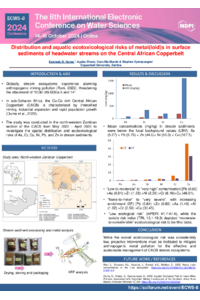
Globally, stream ecosystems draining mining landscapes experience alarming metal(loid) pollution, threatening the attainment of “2030 UN-SDGs 6 and 14”. This study was conducted monthly in the north-western Zambian Copperbelt between May 2022 and April 2023 to investigate the spatiotemporal distribution and ecotoxicological risks of As, Cr, Cu, Ni, Pb, and Zn in stream sediments. Pb (12.7), Cu (2073), and Zn (126.6) mg/kg were highest in the dry season. Generally, metal concentrations (mg/kg) followed the order Pb (5.98) <As (6.98) <Zn (49.6) <Ni (99.7) <Cr (109.2) <Cu (418.3). Streams with anthropogenic inputs were most impacted by Cu (1691-2073 mg/kg), up to 28% above the local background value. Cu, Ni, and Cr exhibited “moderately–severe” enrichment and “moderate” and “low-to-medium” contamination. The contamination factor (CF) ranged from “low-to-moderate” to “very high” [Pb (0.63) >As (0.81) >Zn (1.33) >Ni (2.39) >Cr (6.16)>Cu (46.01)]. KSC sediments were enriched from “none-to-minor” to “very severe”, with increasing enrichment (EF) [Pb (0.64) >Zn (0.89) >As (1.48) >Ni (1.82) >Cr (2.59) >Cu (30.45)]. Ecological risk assessment indicated a “low risk” (mPERI 41.7-47.4), while the toxicity risk index (TRI, 13.1-19.3) depicted “moderate-to-considerable” ecotoxicological risk to benthic biota. Based on the sediment quality guidelines, As and Cr concentrations were “potentially hazardous”; Cu and Ni were “hazardous”, while Pb and Zn were “non-toxic”. While the overall ecotoxicological risk was considerably low, proactive interventions must be instituted to mitigate anthropogenic metal pollution for the effective and sustainable management of CACB aquatic ecosystems.
Keywords
aquatic ecotoxicological risk
benthic biota
SDGs 6 and 14
sediment enrichment
Central African Copperbelt
metal(loid)s
Poster
8th International Water Wonference Oct 2024.pdf
A Conceptual Study of Multi-functional Coastal Reservoirs in Major Estuaries of the Mekong Delta, Vietnam
Endemics and Invasives: a recent history of distributional range shifts in the fish fauna of the lower New River drainage, USA.