Event submissions
Published
This submission belongs to the session 3. Biomedical Biomaterials of the event The 1st International Online Conference on Bioengineering
Published date
11 Oct, 2024
Academic Editor
'%3e%3cpath%20d='M12.6657%2010.9104C12.4185%2010.325%2012.0599%209.79327%2011.6097%209.34482C11.1609%208.89508%2010.6293%208.5365%2010.0442%208.28888C10.0389%208.28626%2010.0337%208.28495%2010.0285%208.28233C10.8446%207.69279%2011.3752%206.73249%2011.3752%205.64904C11.3752%203.8542%209.92103%202.39999%208.1262%202.39999C6.33136%202.39999%204.87715%203.8542%204.87715%205.64904C4.87715%206.73249%205.40774%207.69279%206.22393%208.28364C6.21869%208.28626%206.21345%208.28757%206.20821%208.29019C5.62129%208.5378%205.09463%208.89284%204.64265%209.34613C4.1929%209.79493%203.83432%2010.3266%203.58671%2010.9117C3.34345%2011.4845%203.21226%2012.0987%203.20023%2012.7209C3.19988%2012.7349%203.20233%2012.7488%203.20744%2012.7619C3.21255%2012.7749%203.22022%2012.7867%203.22998%2012.7968C3.23975%2012.8068%203.25142%2012.8147%203.26431%2012.8202C3.2772%2012.8256%203.29105%2012.8284%203.30504%2012.8284H4.09109C4.14874%2012.8284%204.19459%2012.7825%204.1959%2012.7262C4.2221%2011.7148%204.62823%2010.7676%205.34617%2010.0497C6.08899%209.30683%207.0755%208.89808%208.1262%208.89808C9.17689%208.89808%2010.1634%209.30683%2010.9062%2010.0497C11.6242%2010.7676%2012.0303%2011.7148%2012.0565%2012.7262C12.0578%2012.7838%2012.1037%2012.8284%2012.1613%2012.8284H12.9474C12.9613%2012.8284%2012.9752%2012.8256%2012.9881%2012.8202C13.001%2012.8147%2013.0126%2012.8068%2013.0224%2012.7968C13.0322%2012.7867%2013.0398%2012.7749%2013.0449%2012.7619C13.0501%2012.7488%2013.0525%2012.7349%2013.0522%2012.7209C13.0391%2012.0947%2012.9094%2011.4855%2012.6657%2010.9104ZM8.1262%207.9024C7.52486%207.9024%206.9589%207.6679%206.53312%207.24211C6.10733%206.81633%205.87283%206.25037%205.87283%205.64904C5.87283%205.0477%206.10733%204.48174%206.53312%204.05596C6.9589%203.63018%207.52486%203.39567%208.1262%203.39567C8.72753%203.39567%209.29349%203.63018%209.71927%204.05596C10.1451%204.48174%2010.3796%205.0477%2010.3796%205.64904C10.3796%206.25037%2010.1451%206.81633%209.71927%207.24211C9.29349%207.6679%208.72753%207.9024%208.1262%207.9024Z'%20fill='%235D1EE1'/%3e%3c/g%3e%3c/svg%3e) Rossana Madrid
Rossana MadridCitation
Anna Petrovna Solonenko, Alisa Evgen’evna Shevchenko, Denis Anreevich Polonyankin, Granulated wollastonite–hardystonite bioceramics, in Proceedings of The 1st International Online Conference on Bioengineering, 16 October–18 October 2024, MDPI: Basel, Switzerland
Share
Email
Facebook
Twitter
LinkedIn
Granulated wollastonite–hardystonite bioceramics
'%3e%3cpath%20d='M12.6647%2010.9104C12.4176%2010.325%2012.0589%209.7933%2011.6088%209.34485C11.16%208.89511%2010.6283%208.53653%2010.0432%208.28891C10.038%208.28629%2010.0327%208.28498%2010.0275%208.28236C10.8437%207.69282%2011.3743%206.73252%2011.3743%205.64907C11.3743%203.85423%209.92005%202.40002%208.12522%202.40002C6.33038%202.40002%204.87618%203.85423%204.87618%205.64907C4.87618%206.73252%205.40677%207.69282%206.22296%208.28367C6.21772%208.28629%206.21248%208.2876%206.20724%208.29022C5.62031%208.53783%205.09365%208.89287%204.64167%209.34616C4.19192%209.79496%203.83334%2010.3266%203.58573%2010.9117C3.34247%2011.4846%203.21128%2012.0987%203.19925%2012.721C3.1989%2012.735%203.20135%2012.7489%203.20646%2012.7619C3.21157%2012.7749%203.21924%2012.7868%203.22901%2012.7968C3.23877%2012.8068%203.25045%2012.8148%203.26334%2012.8202C3.27623%2012.8256%203.29007%2012.8284%203.30406%2012.8284H4.09012C4.14776%2012.8284%204.19362%2012.7825%204.19493%2012.7262C4.22113%2011.7148%204.62726%2010.7676%205.34519%2010.0497C6.08802%209.30686%207.07452%208.89811%208.12522%208.89811C9.17592%208.89811%2010.1624%209.30686%2010.9052%2010.0497C11.6232%2010.7676%2012.0293%2011.7148%2012.0555%2012.7262C12.0568%2012.7839%2012.1027%2012.8284%2012.1603%2012.8284H12.9464C12.9604%2012.8284%2012.9742%2012.8256%2012.9871%2012.8202C13%2012.8148%2013.0117%2012.8068%2013.0214%2012.7968C13.0312%2012.7868%2013.0389%2012.7749%2013.044%2012.7619C13.0491%2012.7489%2013.0515%2012.735%2013.0512%2012.721C13.0381%2012.0947%2012.9084%2011.4856%2012.6647%2010.9104ZM8.12522%207.90243C7.52388%207.90243%206.95792%207.66793%206.53214%207.24215C6.10636%206.81636%205.87185%206.2504%205.87185%205.64907C5.87185%205.04773%206.10636%204.48177%206.53214%204.05599C6.95792%203.63021%207.52388%203.3957%208.12522%203.3957C8.72655%203.3957%209.29252%203.63021%209.7183%204.05599C10.1441%204.48177%2010.3786%205.04773%2010.3786%205.64907C10.3786%206.2504%2010.1441%206.81636%209.7183%207.24215C9.29252%207.66793%208.72655%207.90243%208.12522%207.90243Z'%20fill='%235D1EE1'/%3e%3c/g%3e%3c/svg%3e)
Anna Petrovna Solonenko 1
Alisa Evgen’evna Shevchenko 1
Denis Anreevich Polonyankin 2
1. Scientific Laboratory, Stomatological Department, Omsk State Medical University, 644099 Omsk, Russia
2. Physics Department, Radio Engineering Faculty, Omsk State Technical University, 644050 Omsk, Russia
Abstract
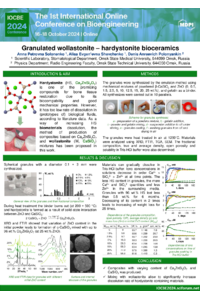
Introduction: Hardystonite (HS, Ca2ZnSi2O7) is a promising compound for bone tissue restoration due to its biocompatibility and good mechanical properties. However, it has too low a rate of dissolution in biological fluids, according to data in the literature. In this work, we propose a method of composite production based on Ca2ZnSi2O7 and CaSiO3 mixtures to increase the dissolution of HS materials.
Methods: Granules were synthesized by the emulsion method using mechanical mixtures of powdered β-wollastonite and ZnO (0, 0.5, 1.5, 2.5, 5, 10, 12.5, 15, 20, 25 wt.%), with gelatin as a binder. All syntheses were carried out in 10 parallels. Granules were heat-treated in air at 1250°C and analyzed using XRD, FTIR, TGA and SEM. Their fractional composition, true and average density, open porosity and solubility in Tris-HCl buffer were determined.
Results and Discussion: Spherical granules with a diameter of 0.1÷3 mm were synthesized. During heat treatment, the binder burns out (200÷500°C) and hardystonite is formed as a result of solid-state interaction between ZnO and CaSiO3 (above 750°C). According to XRD and FTIR, variation in ZnO content in the initial powder leads to the formation of α-CaSiO3 mixed with up to 96 wt.% Ca2ZnSi2O7. The granules had a density >1 g/cm3 and open porosity of 60±5%. Materials can gradually dissolve in Tris-HCl buffer. Concentrations of ions in solutions decrease in the order Ca2+ > SiO32– > Zn2+ at all time points. The less HS content in granules, the more Ca2+ and SiO32– quantities and less Zn2+ in the surrounding media. Granules with 96 wt.% HS lost less than 0.5 wt.% in 6 months. A 2-fold decrease in HS content leads to a 25-fold increase in weight loss.
Conclusions: Composites with varying content of Ca2ZnSi2O7 and CaSiO3 were produced. Mixing with wollastonite allowed for a significant increase in the dissolution rate of HS-containing materials.
Keywords
Biomaterials
spherical granules
porosity
phase composition
Poster
101067.pdf
Three-dimensional neuroinflammation model as an alternative for tests in neural research
BIO-SURFACTANTS: A GREEN APPROACH TO TOILETRIES