Event submissions
Published
This submission belongs to the session 3. Biomedical Biomaterials of the event The 1st International Online Conference on Bioengineering
Published date
11 Oct, 2024
Academic Editor
'%3e%3cpath%20d='M12.6657%2010.9104C12.4185%2010.325%2012.0599%209.79327%2011.6097%209.34482C11.1609%208.89508%2010.6293%208.5365%2010.0442%208.28888C10.0389%208.28626%2010.0337%208.28495%2010.0285%208.28233C10.8446%207.69279%2011.3752%206.73249%2011.3752%205.64904C11.3752%203.8542%209.92103%202.39999%208.1262%202.39999C6.33136%202.39999%204.87715%203.8542%204.87715%205.64904C4.87715%206.73249%205.40774%207.69279%206.22393%208.28364C6.21869%208.28626%206.21345%208.28757%206.20821%208.29019C5.62129%208.5378%205.09463%208.89284%204.64265%209.34613C4.1929%209.79493%203.83432%2010.3266%203.58671%2010.9117C3.34345%2011.4845%203.21226%2012.0987%203.20023%2012.7209C3.19988%2012.7349%203.20233%2012.7488%203.20744%2012.7619C3.21255%2012.7749%203.22022%2012.7867%203.22998%2012.7968C3.23975%2012.8068%203.25142%2012.8147%203.26431%2012.8202C3.2772%2012.8256%203.29105%2012.8284%203.30504%2012.8284H4.09109C4.14874%2012.8284%204.19459%2012.7825%204.1959%2012.7262C4.2221%2011.7148%204.62823%2010.7676%205.34617%2010.0497C6.08899%209.30683%207.0755%208.89808%208.1262%208.89808C9.17689%208.89808%2010.1634%209.30683%2010.9062%2010.0497C11.6242%2010.7676%2012.0303%2011.7148%2012.0565%2012.7262C12.0578%2012.7838%2012.1037%2012.8284%2012.1613%2012.8284H12.9474C12.9613%2012.8284%2012.9752%2012.8256%2012.9881%2012.8202C13.001%2012.8147%2013.0126%2012.8068%2013.0224%2012.7968C13.0322%2012.7867%2013.0398%2012.7749%2013.0449%2012.7619C13.0501%2012.7488%2013.0525%2012.7349%2013.0522%2012.7209C13.0391%2012.0947%2012.9094%2011.4855%2012.6657%2010.9104ZM8.1262%207.9024C7.52486%207.9024%206.9589%207.6679%206.53312%207.24211C6.10733%206.81633%205.87283%206.25037%205.87283%205.64904C5.87283%205.0477%206.10733%204.48174%206.53312%204.05596C6.9589%203.63018%207.52486%203.39567%208.1262%203.39567C8.72753%203.39567%209.29349%203.63018%209.71927%204.05596C10.1451%204.48174%2010.3796%205.0477%2010.3796%205.64904C10.3796%206.25037%2010.1451%206.81633%209.71927%207.24211C9.29349%207.6679%208.72753%207.9024%208.1262%207.9024Z'%20fill='%235D1EE1'/%3e%3c/g%3e%3c/svg%3e) Rossana Madrid
Rossana MadridCitation
Oleh Trufanov, Valentyna Martsenyuk, Liudmyla Stepaniuk, Hanna Ananina, Natalia Trufanova, Alginate–Polysaccharide Hydrogel Films for Lactic Acid Bacteria Immobilization, Cultivation, and Low-Temperature Storage, in Proceedings of The 1st International Online Conference on Bioengineering, 16 October–18 October 2024, MDPI: Basel, Switzerland
Share
Email
Facebook
Twitter
LinkedIn
Alginate–Polysaccharide Hydrogel Films for Lactic Acid Bacteria Immobilization, Cultivation, and Low-Temperature Storage
'%3e%3cpath%20d='M12.6647%2010.9104C12.4176%2010.325%2012.0589%209.7933%2011.6088%209.34485C11.16%208.89511%2010.6283%208.53653%2010.0432%208.28891C10.038%208.28629%2010.0327%208.28498%2010.0275%208.28236C10.8437%207.69282%2011.3743%206.73252%2011.3743%205.64907C11.3743%203.85423%209.92005%202.40002%208.12522%202.40002C6.33038%202.40002%204.87618%203.85423%204.87618%205.64907C4.87618%206.73252%205.40677%207.69282%206.22296%208.28367C6.21772%208.28629%206.21248%208.2876%206.20724%208.29022C5.62031%208.53783%205.09365%208.89287%204.64167%209.34616C4.19192%209.79496%203.83334%2010.3266%203.58573%2010.9117C3.34247%2011.4846%203.21128%2012.0987%203.19925%2012.721C3.1989%2012.735%203.20135%2012.7489%203.20646%2012.7619C3.21157%2012.7749%203.21924%2012.7868%203.22901%2012.7968C3.23877%2012.8068%203.25045%2012.8148%203.26334%2012.8202C3.27623%2012.8256%203.29007%2012.8284%203.30406%2012.8284H4.09012C4.14776%2012.8284%204.19362%2012.7825%204.19493%2012.7262C4.22113%2011.7148%204.62726%2010.7676%205.34519%2010.0497C6.08802%209.30686%207.07452%208.89811%208.12522%208.89811C9.17592%208.89811%2010.1624%209.30686%2010.9052%2010.0497C11.6232%2010.7676%2012.0293%2011.7148%2012.0555%2012.7262C12.0568%2012.7839%2012.1027%2012.8284%2012.1603%2012.8284H12.9464C12.9604%2012.8284%2012.9742%2012.8256%2012.9871%2012.8202C13%2012.8148%2013.0117%2012.8068%2013.0214%2012.7968C13.0312%2012.7868%2013.0389%2012.7749%2013.044%2012.7619C13.0491%2012.7489%2013.0515%2012.735%2013.0512%2012.721C13.0381%2012.0947%2012.9084%2011.4856%2012.6647%2010.9104ZM8.12522%207.90243C7.52388%207.90243%206.95792%207.66793%206.53214%207.24215C6.10636%206.81636%205.87185%206.2504%205.87185%205.64907C5.87185%205.04773%206.10636%204.48177%206.53214%204.05599C6.95792%203.63021%207.52388%203.3957%208.12522%203.3957C8.72655%203.3957%209.29252%203.63021%209.7183%204.05599C10.1441%204.48177%2010.3786%205.04773%2010.3786%205.64907C10.3786%206.2504%2010.1441%206.81636%209.7183%207.24215C9.29252%207.66793%208.72655%207.90243%208.12522%207.90243Z'%20fill='%235D1EE1'/%3e%3c/g%3e%3c/svg%3e)
Oleh Trufanov 1
Valentyna Martsenyuk 1
Liudmyla Stepaniuk 1
Hanna Ananina 1
Natalia Trufanova 2
1. Department of Cryomicrobiology, Institute for Problems of Cryobiology and Cryomedicine of National Academy of Sciences of Ukraine, Kharkiv, 61016, Ukraine
2. Department of Cryobiochemistry, Institute for Problems of Cryobiology and Cryomedicine of National Academy of Sciences of Ukraine, Kharkiv, 61016, Ukraine
Abstract
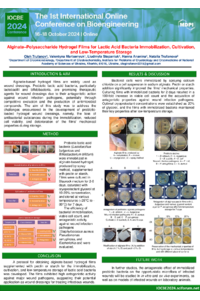
Introduction: Alginate-based hydrogel films are widely used as wound dressings. Probiotic lactic acid bacteria, particularly lactobacilli and bifidobacteria, are promising therapeutic agents for wound dressings due to their antagonistic action against wound infection pathogens, potentially through competitive exclusion and the production of antimicrobial compounds. The aim of this study was to address the challenges encountered in the development of probiotic-loaded hydrogel wound dressings, namely, the loss of antibacterial substances during the immobilization, reduced cell viability, and deterioration of the films' mechanical properties during storage.
Methods: Probiotic lactic acid bacteria (Lactobacillus bulgaricus and Bifidobacterium bifidum) were immobilized in alginate-based hydrogel supplemented with pectin or starch. Films were cultured in Blaurock medium for 2-6 days, saturated with cryoprotectants (glycerol or DMSO) at 5-20% concentration, and stored at various temperatures (+25°C to -80°C) for 7 days. The efficiency of bacterial immobilization, viable cell count, and antagonistic activity against wound infection pathogens (Staphylococcus aureus, Pseudomonas aeruginosa, and Escherichia coli) were evaluated.
Results and Discussion: Bacterial cells were immobilized by spraying calcium chloride on a cell suspension in sodium alginate. Pectin or starch addition significantly improved the films' mechanical properties. Culturing films with immobilized bacteria for 2 days resulted in a 100-fold increase in viable cell count and the acquisition of antagonistic properties against wound infection pathogens. Optimal cryoprotectant concentrations were established, and the films with immobilized bacteria maintained their key properties after low-temperature storage.
Conclusions: A protocol for obtaining alginate-based hydrogel films supplemented with pectin or starch for the immobilization, cultivation, and low-temperature storage of lactic acid bacteria was developed. The films exhibited high antagonistic activity against major wound pathogens, suggesting their potential application as wound dressings for treating infectious wounds.
Keywords
Alginate-polysaccharide hydrogels
Poster
097426.pdf
Electrospun hyaluronan-based nanofibers with mangiferin: preparation, morphology, and drug release kinetics
The influence of polymer shell composition on the release rate and stability of doxorubicin-loaded Fe3O4 nanoparticles