Event submissions
Published
This submission belongs to the session 6. Biochemical Engineering of the event The 1st International Online Conference on Bioengineering
Published date
11 Oct, 2024
Academic Editor
'%3e%3cpath%20d='M12.6657%2010.9104C12.4185%2010.325%2012.0599%209.79327%2011.6097%209.34482C11.1609%208.89508%2010.6293%208.5365%2010.0442%208.28888C10.0389%208.28626%2010.0337%208.28495%2010.0285%208.28233C10.8446%207.69279%2011.3752%206.73249%2011.3752%205.64904C11.3752%203.8542%209.92103%202.39999%208.1262%202.39999C6.33136%202.39999%204.87715%203.8542%204.87715%205.64904C4.87715%206.73249%205.40774%207.69279%206.22393%208.28364C6.21869%208.28626%206.21345%208.28757%206.20821%208.29019C5.62129%208.5378%205.09463%208.89284%204.64265%209.34613C4.1929%209.79493%203.83432%2010.3266%203.58671%2010.9117C3.34345%2011.4845%203.21226%2012.0987%203.20023%2012.7209C3.19988%2012.7349%203.20233%2012.7488%203.20744%2012.7619C3.21255%2012.7749%203.22022%2012.7867%203.22998%2012.7968C3.23975%2012.8068%203.25142%2012.8147%203.26431%2012.8202C3.2772%2012.8256%203.29105%2012.8284%203.30504%2012.8284H4.09109C4.14874%2012.8284%204.19459%2012.7825%204.1959%2012.7262C4.2221%2011.7148%204.62823%2010.7676%205.34617%2010.0497C6.08899%209.30683%207.0755%208.89808%208.1262%208.89808C9.17689%208.89808%2010.1634%209.30683%2010.9062%2010.0497C11.6242%2010.7676%2012.0303%2011.7148%2012.0565%2012.7262C12.0578%2012.7838%2012.1037%2012.8284%2012.1613%2012.8284H12.9474C12.9613%2012.8284%2012.9752%2012.8256%2012.9881%2012.8202C13.001%2012.8147%2013.0126%2012.8068%2013.0224%2012.7968C13.0322%2012.7867%2013.0398%2012.7749%2013.0449%2012.7619C13.0501%2012.7488%2013.0525%2012.7349%2013.0522%2012.7209C13.0391%2012.0947%2012.9094%2011.4855%2012.6657%2010.9104ZM8.1262%207.9024C7.52486%207.9024%206.9589%207.6679%206.53312%207.24211C6.10733%206.81633%205.87283%206.25037%205.87283%205.64904C5.87283%205.0477%206.10733%204.48174%206.53312%204.05596C6.9589%203.63018%207.52486%203.39567%208.1262%203.39567C8.72753%203.39567%209.29349%203.63018%209.71927%204.05596C10.1451%204.48174%2010.3796%205.0477%2010.3796%205.64904C10.3796%206.25037%2010.1451%206.81633%209.71927%207.24211C9.29349%207.6679%208.72753%207.9024%208.1262%207.9024Z'%20fill='%235D1EE1'/%3e%3c/g%3e%3c/svg%3e) Liang Luo
Liang LuoCitation
Vesna Kalaba, Dragica Đurđević-Milošević, Tanja Ilić, Dragana Kalaba, COMPARISON OF THE EFFECTS OF ESSENTIAL OILS AND ANTIBIOTICS ON LISTERIA MONOCYTOGENES ISOLATES, in Proceedings of The 1st International Online Conference on Bioengineering, 16 October–18 October 2024, MDPI: Basel, Switzerland
Share
Email
Facebook
Twitter
LinkedIn
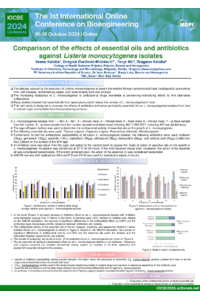
COMPARISON OF THE EFFECTS OF ESSENTIAL OILS AND ANTIBIOTICS ON LISTERIA MONOCYTOGENES ISOLATES
'%3e%3cpath%20d='M12.6647%2010.9104C12.4176%2010.325%2012.0589%209.7933%2011.6088%209.34485C11.16%208.89511%2010.6283%208.53653%2010.0432%208.28891C10.038%208.28629%2010.0327%208.28498%2010.0275%208.28236C10.8437%207.69282%2011.3743%206.73252%2011.3743%205.64907C11.3743%203.85423%209.92005%202.40002%208.12522%202.40002C6.33038%202.40002%204.87618%203.85423%204.87618%205.64907C4.87618%206.73252%205.40677%207.69282%206.22296%208.28367C6.21772%208.28629%206.21248%208.2876%206.20724%208.29022C5.62031%208.53783%205.09365%208.89287%204.64167%209.34616C4.19192%209.79496%203.83334%2010.3266%203.58573%2010.9117C3.34247%2011.4846%203.21128%2012.0987%203.19925%2012.721C3.1989%2012.735%203.20135%2012.7489%203.20646%2012.7619C3.21157%2012.7749%203.21924%2012.7868%203.22901%2012.7968C3.23877%2012.8068%203.25045%2012.8148%203.26334%2012.8202C3.27623%2012.8256%203.29007%2012.8284%203.30406%2012.8284H4.09012C4.14776%2012.8284%204.19362%2012.7825%204.19493%2012.7262C4.22113%2011.7148%204.62726%2010.7676%205.34519%2010.0497C6.08802%209.30686%207.07452%208.89811%208.12522%208.89811C9.17592%208.89811%2010.1624%209.30686%2010.9052%2010.0497C11.6232%2010.7676%2012.0293%2011.7148%2012.0555%2012.7262C12.0568%2012.7839%2012.1027%2012.8284%2012.1603%2012.8284H12.9464C12.9604%2012.8284%2012.9742%2012.8256%2012.9871%2012.8202C13%2012.8148%2013.0117%2012.8068%2013.0214%2012.7968C13.0312%2012.7868%2013.0389%2012.7749%2013.044%2012.7619C13.0491%2012.7489%2013.0515%2012.735%2013.0512%2012.721C13.0381%2012.0947%2012.9084%2011.4856%2012.6647%2010.9104ZM8.12522%207.90243C7.52388%207.90243%206.95792%207.66793%206.53214%207.24215C6.10636%206.81636%205.87185%206.2504%205.87185%205.64907C5.87185%205.04773%206.10636%204.48177%206.53214%204.05599C6.95792%203.63021%207.52388%203.3957%208.12522%203.3957C8.72655%203.3957%209.29252%203.63021%209.7183%204.05599C10.1441%204.48177%2010.3786%205.04773%2010.3786%205.64907C10.3786%206.2504%2010.1441%206.81636%209.7183%207.24215C9.29252%207.66793%208.72655%207.90243%208.12522%207.90243Z'%20fill='%235D1EE1'/%3e%3c/g%3e%3c/svg%3e)
Vesna Kalaba 1

Dragica Đurđević-Milošević 2
Tanja Ilić 3
Dragana Kalaba 4
1. College of Health Sciences Prijedor, Nikole Pašića 4a, 79101 Prijedor, Bosnia and Herzegovina
2. Institute of Chemistry, Technology and Microbiology, Prokupačka 41, 11000 Belgrade, Serbia
3. PI Veterinary Institute Republic of Srpska „Dr Vaso Butozan“ Banja Luka, Branka Radičevića 18, 78000 Banja Luka, Bosnia and Herzegovina
4. AU “Benu“, Sutjeska br. 2, 21000, Novi Sad, Serbia
Abstract
Food contamination with Listeria monocytogenes can cause health problems of increasing global concern. The resistance of L. monocytogenes to antibiotics requires finding alternative solutions to protect human health. This mini study was designed to evaluate the effects of antibiotics and some particularly essential oils on L. monocytogenes isolates from food of an animal origin and isolates from food-producing surfaces.
This aim was to investigate the effects of seven antibiotics (amikacin, gentamicin, penicillin, cephalexin, ceftriaxone, tetracycline, and nalidixic acid) on L. monocytogenes isolated from food and surface samples. Also, the antibacterial activity of four essential oils (thyme, oregano, peppermint, and rosemary) against the growth of L. monocytogenes isolates was investigated. Listeria monocytogenes isolates were from food of an animal origin and food-producing surfaces as a potential source of food cross-contamination and subsequently a causative agent of listeriosis.
The isolation and determination of L. monocytogenes from food samples followed ISO 11290-1, including the API Listeria. Surface samplings were performed following ISO 18593 followed by the isolation and determination of L. monocytogenes. The disc diffusion method was used and the tests were performed in triplicate.
The results of this study confirmed more pronounced antibacterial activity of essential oils compared to antimicrobial drugs. The essential oil of Thymus vulgaris showed a bactericidal effect against all tested L. monocytogenes isolates.
Keywords
antibiotics
essential oils
Listeria monocytogenes
Poster
101197.pdf
Human embryonic stem cells naïve pluripotency induction in a fully defined xenogeneic-free synthetic polymer dish coating (PMEDSAH).
VALORIZATION OF LIGNOCELLULOSIC MATERIALS FOR THE BIOSYNTHESIS OF VOLATILE FATTY ACIDS USING CLOSTRIDIUM STRAINS