Event submissions
Published
This submission belongs to the session 5. Biosignal Processing of the event The 1st International Online Conference on Bioengineering
Published date
11 Oct, 2024
Academic Editor
'%3e%3cpath%20d='M12.6657%2010.9104C12.4185%2010.325%2012.0599%209.79327%2011.6097%209.34482C11.1609%208.89508%2010.6293%208.5365%2010.0442%208.28888C10.0389%208.28626%2010.0337%208.28495%2010.0285%208.28233C10.8446%207.69279%2011.3752%206.73249%2011.3752%205.64904C11.3752%203.8542%209.92103%202.39999%208.1262%202.39999C6.33136%202.39999%204.87715%203.8542%204.87715%205.64904C4.87715%206.73249%205.40774%207.69279%206.22393%208.28364C6.21869%208.28626%206.21345%208.28757%206.20821%208.29019C5.62129%208.5378%205.09463%208.89284%204.64265%209.34613C4.1929%209.79493%203.83432%2010.3266%203.58671%2010.9117C3.34345%2011.4845%203.21226%2012.0987%203.20023%2012.7209C3.19988%2012.7349%203.20233%2012.7488%203.20744%2012.7619C3.21255%2012.7749%203.22022%2012.7867%203.22998%2012.7968C3.23975%2012.8068%203.25142%2012.8147%203.26431%2012.8202C3.2772%2012.8256%203.29105%2012.8284%203.30504%2012.8284H4.09109C4.14874%2012.8284%204.19459%2012.7825%204.1959%2012.7262C4.2221%2011.7148%204.62823%2010.7676%205.34617%2010.0497C6.08899%209.30683%207.0755%208.89808%208.1262%208.89808C9.17689%208.89808%2010.1634%209.30683%2010.9062%2010.0497C11.6242%2010.7676%2012.0303%2011.7148%2012.0565%2012.7262C12.0578%2012.7838%2012.1037%2012.8284%2012.1613%2012.8284H12.9474C12.9613%2012.8284%2012.9752%2012.8256%2012.9881%2012.8202C13.001%2012.8147%2013.0126%2012.8068%2013.0224%2012.7968C13.0322%2012.7867%2013.0398%2012.7749%2013.0449%2012.7619C13.0501%2012.7488%2013.0525%2012.7349%2013.0522%2012.7209C13.0391%2012.0947%2012.9094%2011.4855%2012.6657%2010.9104ZM8.1262%207.9024C7.52486%207.9024%206.9589%207.6679%206.53312%207.24211C6.10733%206.81633%205.87283%206.25037%205.87283%205.64904C5.87283%205.0477%206.10733%204.48174%206.53312%204.05596C6.9589%203.63018%207.52486%203.39567%208.1262%203.39567C8.72753%203.39567%209.29349%203.63018%209.71927%204.05596C10.1451%204.48174%2010.3796%205.0477%2010.3796%205.64904C10.3796%206.25037%2010.1451%206.81633%209.71927%207.24211C9.29349%207.6679%208.72753%207.9024%208.1262%207.9024Z'%20fill='%235D1EE1'/%3e%3c/g%3e%3c/svg%3e) Andrea Cataldo
Andrea CataldoCitation
Thauanne Santana Fonseca Valença, Thiago Valença Silva, Eduardo Oliveira Freire, Elyson Ádan Nunes Carvalho, SYMMETRY-BASED EYE DETECTION IN FACIAL IMAGES USING HOUGH TRANSFORM FOR CIRCLES, in Proceedings of The 1st International Online Conference on Bioengineering, 16 October–18 October 2024, MDPI: Basel, Switzerland
Share
Email
Facebook
Twitter
LinkedIn
SYMMETRY-BASED EYE DETECTION IN FACIAL IMAGES USING HOUGH TRANSFORM FOR CIRCLES
'%3e%3cpath%20d='M12.6647%2010.9104C12.4176%2010.325%2012.0589%209.7933%2011.6088%209.34485C11.16%208.89511%2010.6283%208.53653%2010.0432%208.28891C10.038%208.28629%2010.0327%208.28498%2010.0275%208.28236C10.8437%207.69282%2011.3743%206.73252%2011.3743%205.64907C11.3743%203.85423%209.92005%202.40002%208.12522%202.40002C6.33038%202.40002%204.87618%203.85423%204.87618%205.64907C4.87618%206.73252%205.40677%207.69282%206.22296%208.28367C6.21772%208.28629%206.21248%208.2876%206.20724%208.29022C5.62031%208.53783%205.09365%208.89287%204.64167%209.34616C4.19192%209.79496%203.83334%2010.3266%203.58573%2010.9117C3.34247%2011.4846%203.21128%2012.0987%203.19925%2012.721C3.1989%2012.735%203.20135%2012.7489%203.20646%2012.7619C3.21157%2012.7749%203.21924%2012.7868%203.22901%2012.7968C3.23877%2012.8068%203.25045%2012.8148%203.26334%2012.8202C3.27623%2012.8256%203.29007%2012.8284%203.30406%2012.8284H4.09012C4.14776%2012.8284%204.19362%2012.7825%204.19493%2012.7262C4.22113%2011.7148%204.62726%2010.7676%205.34519%2010.0497C6.08802%209.30686%207.07452%208.89811%208.12522%208.89811C9.17592%208.89811%2010.1624%209.30686%2010.9052%2010.0497C11.6232%2010.7676%2012.0293%2011.7148%2012.0555%2012.7262C12.0568%2012.7839%2012.1027%2012.8284%2012.1603%2012.8284H12.9464C12.9604%2012.8284%2012.9742%2012.8256%2012.9871%2012.8202C13%2012.8148%2013.0117%2012.8068%2013.0214%2012.7968C13.0312%2012.7868%2013.0389%2012.7749%2013.044%2012.7619C13.0491%2012.7489%2013.0515%2012.735%2013.0512%2012.721C13.0381%2012.0947%2012.9084%2011.4856%2012.6647%2010.9104ZM8.12522%207.90243C7.52388%207.90243%206.95792%207.66793%206.53214%207.24215C6.10636%206.81636%205.87185%206.2504%205.87185%205.64907C5.87185%205.04773%206.10636%204.48177%206.53214%204.05599C6.95792%203.63021%207.52388%203.3957%208.12522%203.3957C8.72655%203.3957%209.29252%203.63021%209.7183%204.05599C10.1441%204.48177%2010.3786%205.04773%2010.3786%205.64907C10.3786%206.2504%2010.1441%206.81636%209.7183%207.24215C9.29252%207.66793%208.72655%207.90243%208.12522%207.90243Z'%20fill='%235D1EE1'/%3e%3c/g%3e%3c/svg%3e)
Thauanne Santana Fonseca Valença 1
Thiago Valença Silva 2

Eduardo Oliveira Freire 3
Elyson Ádan Nunes Carvalho 1
1. Electrical Engineering Department, Federal University of Sergipe, Cidade Univ. Prof. José Aloísio de Campos, Av. Marcelo Deda Chagas, s/n, Bairro Rosa Elze, São Cristóvão/SE, CEP 49107-230, Brazil
2. SiDi, Avenida República do Líbano, número: 251, Salas 2901, 2902, 2903 e 2904, Torre B, Bairro: Pina CEP 51110-160, Recife - PE, Brazil
3. Neuroscience and Applied Technologies Laboratory (LINTEC), Bioengineering Department, Faculty of Exact Sciences and Technology (FACET), National University of Tucuman, Superior Institute of Biological Research (INSIBIO), National Scientific and Technical
Abstract
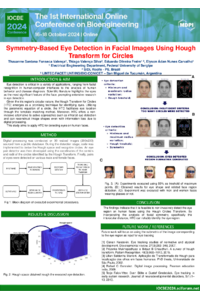
Introduction: Eye detection is critical in a variety of applications, ranging from facial recognition in human-computer interfaces to the analysis of human behavior and disease diagnosis. Scientific literature highlights the eyes as the most significant feature of the face, prompting extensive research in eye detection. Given the iris region's circular nature, the Hough Transform for Circles (HTC) emerges as a promising technique for identifying eyes. Utilizing the parametric equation of a circle, the HTC facilitates eye location through the template matching method. Moreover, HTC offers a non-invasive alternative to active approaches such as infrared eye detection and can reconstruct image shapes even with information loss due to digital processing. This study aims to apply HTC for detecting eyes on human faces.
Methods: Digital processing was conducted on 30 resized images (200x233) sourced from a public database. During the detection stage, code was implemented to derive the Hough space and recognize circles. An eye pair detector was then developed using the coordinates of the centers and radii of the circles identified by the Hough Transform. Finally, pairs of eyes were detected on various male and female faces.
Results and Discussion: Experiments on diverse faces revealed that applying HTC alone was insufficient for accurate eye identification, as circles other than the eyes were frequently detected. This led to the hypothesis that accurate identification could be achieved by focusing solely on the eye region, leveraging the symmetry of the face. This hypothesis was confirmed, demonstrating that the region corresponding to the eyes could be accurately identified by analyzing facial symmetry.
Conclusions: The findings indicate that it is feasible to non-invasively detect the eye region on human faces using the Hough Circles Transform. By incorporating the analysis of facial symmetry, specifically the interocular distance, HTC can reliably identify the eye region.
Keywords
Hough Transform for Circles
eye detection
digital image processing
face symmetry.
Poster
101176.pdf
VALORIZATION OF LIGNOCELLULOSIC MATERIALS FOR THE BIOSYNTHESIS OF VOLATILE FATTY ACIDS USING CLOSTRIDIUM STRAINS
Functional Characterization of Brain Areas Using Functional Magnetic Resonance Imaging