Event submissions
Published
This submission belongs to the session 3. Biomedical Biomaterials of the event The 1st International Online Conference on Bioengineering
Published date
11 Oct, 2024
Academic Editor
'%3e%3cpath%20d='M12.6657%2010.9104C12.4185%2010.325%2012.0599%209.79327%2011.6097%209.34482C11.1609%208.89508%2010.6293%208.5365%2010.0442%208.28888C10.0389%208.28626%2010.0337%208.28495%2010.0285%208.28233C10.8446%207.69279%2011.3752%206.73249%2011.3752%205.64904C11.3752%203.8542%209.92103%202.39999%208.1262%202.39999C6.33136%202.39999%204.87715%203.8542%204.87715%205.64904C4.87715%206.73249%205.40774%207.69279%206.22393%208.28364C6.21869%208.28626%206.21345%208.28757%206.20821%208.29019C5.62129%208.5378%205.09463%208.89284%204.64265%209.34613C4.1929%209.79493%203.83432%2010.3266%203.58671%2010.9117C3.34345%2011.4845%203.21226%2012.0987%203.20023%2012.7209C3.19988%2012.7349%203.20233%2012.7488%203.20744%2012.7619C3.21255%2012.7749%203.22022%2012.7867%203.22998%2012.7968C3.23975%2012.8068%203.25142%2012.8147%203.26431%2012.8202C3.2772%2012.8256%203.29105%2012.8284%203.30504%2012.8284H4.09109C4.14874%2012.8284%204.19459%2012.7825%204.1959%2012.7262C4.2221%2011.7148%204.62823%2010.7676%205.34617%2010.0497C6.08899%209.30683%207.0755%208.89808%208.1262%208.89808C9.17689%208.89808%2010.1634%209.30683%2010.9062%2010.0497C11.6242%2010.7676%2012.0303%2011.7148%2012.0565%2012.7262C12.0578%2012.7838%2012.1037%2012.8284%2012.1613%2012.8284H12.9474C12.9613%2012.8284%2012.9752%2012.8256%2012.9881%2012.8202C13.001%2012.8147%2013.0126%2012.8068%2013.0224%2012.7968C13.0322%2012.7867%2013.0398%2012.7749%2013.0449%2012.7619C13.0501%2012.7488%2013.0525%2012.7349%2013.0522%2012.7209C13.0391%2012.0947%2012.9094%2011.4855%2012.6657%2010.9104ZM8.1262%207.9024C7.52486%207.9024%206.9589%207.6679%206.53312%207.24211C6.10733%206.81633%205.87283%206.25037%205.87283%205.64904C5.87283%205.0477%206.10733%204.48174%206.53312%204.05596C6.9589%203.63018%207.52486%203.39567%208.1262%203.39567C8.72753%203.39567%209.29349%203.63018%209.71927%204.05596C10.1451%204.48174%2010.3796%205.0477%2010.3796%205.64904C10.3796%206.25037%2010.1451%206.81633%209.71927%207.24211C9.29349%207.6679%208.72753%207.9024%208.1262%207.9024Z'%20fill='%235D1EE1'/%3e%3c/g%3e%3c/svg%3e) Gary Bowlin
Gary BowlinCitation
Partha Protim Borthakur, The Role and Future Directions of 3D Printing in Custom Prosthetic Design, in Proceedings of The 1st International Online Conference on Bioengineering, 16 October–18 October 2024, MDPI: Basel, Switzerland
Share
Email
Facebook
Twitter
LinkedIn
The Role and Future Directions of 3D Printing in Custom Prosthetic Design

Partha Protim Borthakur 1
1. Dibrugarh University, India
Abstract
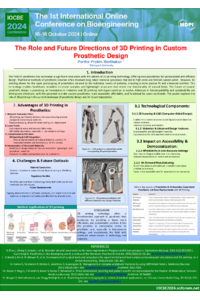
The advent of 3D printing technology has revolutionized various manufacturing sectors including the medical field, particularly in the production of prosthetic limbs. Traditional prosthetic manufacturing processes are often time-consuming and expensive, causing amputees to endure long waiting periods and high costs. In contrast, 3D printing offers a rapid, cost-effective alternative, enabling the creation of custom-made prosthetics tailored to the specific needs and measurements of each wearer. Integrating 3D printing technology into prosthetics and orthopedics has ushered in a new era of customization and innovation. This advanced approach facilitates the creation of personalized prosthetics and bone replacements tailored to individual patients' needs. With the latest advancements in software and 3D printing, the use of custom orthopedic implants for complex surgical cases has gained significant popularity. This paper explores the advantages of using 3D printing for prosthetic limb production, highlighting its ability to significantly reduce production time and costs while maintaining high functionality and quality. By leveraging 3D scanning and computer-aided design (CAD), precise digital models of a patient's residual limb can be created, ensuring a perfect fit and improved comfort. Additionally, the flexibility of 3D printing allows for the incorporation of advanced materials and design features, enhancing the durability and performance of the prosthetics. This study also examines the potential for 3D printing to democratize access to prosthetic care, especially in low-resource settings. The affordability and accessibility of 3D printers, coupled with open-source designs, empower local communities and healthcare providers to produce prosthetics on demand, reducing dependency on centralized manufacturing facilities. By addressing the current limitations and challenges, including material constraints and regulatory hurdles, this paper highlights the transformative impact of 3D printing on the prosthetics industry.
Keywords
3D Printing
Custom Prosthetics
Orthopedic Implants
Personalized Medicine
Bone Replacement
Additive Manufacturing
Poster
sciforum-101164.pdf
Use of Low-level Electrical Stimulation for Bacterial Inhibition
Enhancing burn wound healing with Plectranthus amboinicus extract-loaded foam dressings