Event submissions
Published
This submission belongs to the session 4. Nano-Biotechnology of the event The 1st International Online Conference on Bioengineering
Published date
11 Oct, 2024
Academic Editor
'%3e%3cpath%20d='M12.6657%2010.9104C12.4185%2010.325%2012.0599%209.79327%2011.6097%209.34482C11.1609%208.89508%2010.6293%208.5365%2010.0442%208.28888C10.0389%208.28626%2010.0337%208.28495%2010.0285%208.28233C10.8446%207.69279%2011.3752%206.73249%2011.3752%205.64904C11.3752%203.8542%209.92103%202.39999%208.1262%202.39999C6.33136%202.39999%204.87715%203.8542%204.87715%205.64904C4.87715%206.73249%205.40774%207.69279%206.22393%208.28364C6.21869%208.28626%206.21345%208.28757%206.20821%208.29019C5.62129%208.5378%205.09463%208.89284%204.64265%209.34613C4.1929%209.79493%203.83432%2010.3266%203.58671%2010.9117C3.34345%2011.4845%203.21226%2012.0987%203.20023%2012.7209C3.19988%2012.7349%203.20233%2012.7488%203.20744%2012.7619C3.21255%2012.7749%203.22022%2012.7867%203.22998%2012.7968C3.23975%2012.8068%203.25142%2012.8147%203.26431%2012.8202C3.2772%2012.8256%203.29105%2012.8284%203.30504%2012.8284H4.09109C4.14874%2012.8284%204.19459%2012.7825%204.1959%2012.7262C4.2221%2011.7148%204.62823%2010.7676%205.34617%2010.0497C6.08899%209.30683%207.0755%208.89808%208.1262%208.89808C9.17689%208.89808%2010.1634%209.30683%2010.9062%2010.0497C11.6242%2010.7676%2012.0303%2011.7148%2012.0565%2012.7262C12.0578%2012.7838%2012.1037%2012.8284%2012.1613%2012.8284H12.9474C12.9613%2012.8284%2012.9752%2012.8256%2012.9881%2012.8202C13.001%2012.8147%2013.0126%2012.8068%2013.0224%2012.7968C13.0322%2012.7867%2013.0398%2012.7749%2013.0449%2012.7619C13.0501%2012.7488%2013.0525%2012.7349%2013.0522%2012.7209C13.0391%2012.0947%2012.9094%2011.4855%2012.6657%2010.9104ZM8.1262%207.9024C7.52486%207.9024%206.9589%207.6679%206.53312%207.24211C6.10733%206.81633%205.87283%206.25037%205.87283%205.64904C5.87283%205.0477%206.10733%204.48174%206.53312%204.05596C6.9589%203.63018%207.52486%203.39567%208.1262%203.39567C8.72753%203.39567%209.29349%203.63018%209.71927%204.05596C10.1451%204.48174%2010.3796%205.0477%2010.3796%205.64904C10.3796%206.25037%2010.1451%206.81633%209.71927%207.24211C9.29349%207.6679%208.72753%207.9024%208.1262%207.9024Z'%20fill='%235D1EE1'/%3e%3c/g%3e%3c/svg%3e) Gary Chinga Carrasco
Gary Chinga CarrascoCitation
Sofia Shtykalova, Vladimir Kudryashov, Anna Egorova, Yulia Panova, Alina Roman, Anton Kiselev, Anionic peptide coating as a modification of PEI-based polyplexes for successful gene delivery., in Proceedings of The 1st International Online Conference on Bioengineering, 16 October–18 October 2024, MDPI: Basel, Switzerland
Share
Email
Facebook
Twitter
LinkedIn
Anionic peptide coating as a modification of PEI-based polyplexes for successful gene delivery.
'%3e%3cpath%20d='M12.6647%2010.9104C12.4176%2010.325%2012.0589%209.7933%2011.6088%209.34485C11.16%208.89511%2010.6283%208.53653%2010.0432%208.28891C10.038%208.28629%2010.0327%208.28498%2010.0275%208.28236C10.8437%207.69282%2011.3743%206.73252%2011.3743%205.64907C11.3743%203.85423%209.92005%202.40002%208.12522%202.40002C6.33038%202.40002%204.87618%203.85423%204.87618%205.64907C4.87618%206.73252%205.40677%207.69282%206.22296%208.28367C6.21772%208.28629%206.21248%208.2876%206.20724%208.29022C5.62031%208.53783%205.09365%208.89287%204.64167%209.34616C4.19192%209.79496%203.83334%2010.3266%203.58573%2010.9117C3.34247%2011.4846%203.21128%2012.0987%203.19925%2012.721C3.1989%2012.735%203.20135%2012.7489%203.20646%2012.7619C3.21157%2012.7749%203.21924%2012.7868%203.22901%2012.7968C3.23877%2012.8068%203.25045%2012.8148%203.26334%2012.8202C3.27623%2012.8256%203.29007%2012.8284%203.30406%2012.8284H4.09012C4.14776%2012.8284%204.19362%2012.7825%204.19493%2012.7262C4.22113%2011.7148%204.62726%2010.7676%205.34519%2010.0497C6.08802%209.30686%207.07452%208.89811%208.12522%208.89811C9.17592%208.89811%2010.1624%209.30686%2010.9052%2010.0497C11.6232%2010.7676%2012.0293%2011.7148%2012.0555%2012.7262C12.0568%2012.7839%2012.1027%2012.8284%2012.1603%2012.8284H12.9464C12.9604%2012.8284%2012.9742%2012.8256%2012.9871%2012.8202C13%2012.8148%2013.0117%2012.8068%2013.0214%2012.7968C13.0312%2012.7868%2013.0389%2012.7749%2013.044%2012.7619C13.0491%2012.7489%2013.0515%2012.735%2013.0512%2012.721C13.0381%2012.0947%2012.9084%2011.4856%2012.6647%2010.9104ZM8.12522%207.90243C7.52388%207.90243%206.95792%207.66793%206.53214%207.24215C6.10636%206.81636%205.87185%206.2504%205.87185%205.64907C5.87185%205.04773%206.10636%204.48177%206.53214%204.05599C6.95792%203.63021%207.52388%203.3957%208.12522%203.3957C8.72655%203.3957%209.29252%203.63021%209.7183%204.05599C10.1441%204.48177%2010.3786%205.04773%2010.3786%205.64907C10.3786%206.2504%2010.1441%206.81636%209.7183%207.24215C9.29252%207.66793%208.72655%207.90243%208.12522%207.90243Z'%20fill='%235D1EE1'/%3e%3c/g%3e%3c/svg%3e)
Sofia Shtykalova 1
Vladimir Kudryashov 1
Anna Egorova 1
Yulia Panova 1,2
Alina Roman 1,2

Anton Kiselev 1
1. Department of Genomic Medicine, D.O. Ott Research Institute of Obstetrics, Gynecology and Reproductology, Mendeleevskaya Line 3, 199034, Saint-Petersburg, Russia
2. St. Petersburg State University, Universitetskaya Embankment 7-9, 199034, Saint-Petersburg, Russia
Abstract
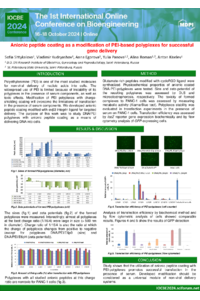
Introduction. Polyethylenimine (PEI) is one of the most studied molecules for non-viral delivery of nucleic acids into cells. The widespread use of PEI is limited because of instability of its polyplexes in the presence of serum components, as well as toxic effects. Modification of PEI polyplexes with charge-shielding coating will overcome the limitations of transfection in the presence of serum components. We developed anionic peptide coating modified with ανβ3 integrin ligand for targeted delivery. The purpose of this work was to study DNA/PEI polyplexes with anionic peptide coating as a means of delivering DNA into cells.
Methods. Glutamate-rich peptides modified with cycloRGD ligand were synthesized. Physicochemical properties of anionic coated DNA-PEI-polyplexes were tested. Size and zeta-potential of the resulting polyplexes was assessed by DLS and microelectrophoresis, respectively. The toxicity of formed complexes to PANC-1 cells was assessed by measuring metabolic activity (AlamarBlue test). Polyplexes stability was evaluated in transfection experiments in the presence of serum on PANC-1 cells. Transfection efficiency was assessed by lacZ reporter gene expression biochemically and by flow cytometry analysis of GFP-expressing cells.
Results. Optimal charge ratio of DNA/PEI/anionic peptide was found to be 1/16/4. Polyplexes with all studied anionic peptides at this charge ratio are nontoxic for PANC-1 cells. Addition of peptides to PEI-polyplexes increases their stability when incubated with polyanions. Interestingly, almost all polyplexes at the chosen charge ratio were large in size (> 500 nm in diameter). Charge ratio of 1/16/4 is also the ratio at which the charge of polyplexes changes from positive to negative. Reporter genes products were detected in cells after transfection with these polyplexes, indicating successful delivery.
Conclusion. Study shows that the utilization of anionic peptide coating with PEI-polyplexes promotes successful transfection in the presence of serum. Developed modification should be considered as a universal module of non-viral delivery systems.
Keywords
Polyethylenimine
PEI
anionic peptides
charge-shielding coating
gene delivery
non-viral vectors
Poster
poster 101123 Shtykalova.pdf
The Development of a CO2 Monitoring Device for the Early Detection of Sepsis
Cortical Dynamics of Phosphene Perception: A Study Using EEG Signals