Event submissions
Published
This submission belongs to the session 1. Regenerative and Tissue Engineering of the event The 1st International Online Conference on Bioengineering
Published date
11 Oct, 2024
Academic Editor
'%3e%3cpath%20d='M12.6657%2010.9104C12.4185%2010.325%2012.0599%209.79327%2011.6097%209.34482C11.1609%208.89508%2010.6293%208.5365%2010.0442%208.28888C10.0389%208.28626%2010.0337%208.28495%2010.0285%208.28233C10.8446%207.69279%2011.3752%206.73249%2011.3752%205.64904C11.3752%203.8542%209.92103%202.39999%208.1262%202.39999C6.33136%202.39999%204.87715%203.8542%204.87715%205.64904C4.87715%206.73249%205.40774%207.69279%206.22393%208.28364C6.21869%208.28626%206.21345%208.28757%206.20821%208.29019C5.62129%208.5378%205.09463%208.89284%204.64265%209.34613C4.1929%209.79493%203.83432%2010.3266%203.58671%2010.9117C3.34345%2011.4845%203.21226%2012.0987%203.20023%2012.7209C3.19988%2012.7349%203.20233%2012.7488%203.20744%2012.7619C3.21255%2012.7749%203.22022%2012.7867%203.22998%2012.7968C3.23975%2012.8068%203.25142%2012.8147%203.26431%2012.8202C3.2772%2012.8256%203.29105%2012.8284%203.30504%2012.8284H4.09109C4.14874%2012.8284%204.19459%2012.7825%204.1959%2012.7262C4.2221%2011.7148%204.62823%2010.7676%205.34617%2010.0497C6.08899%209.30683%207.0755%208.89808%208.1262%208.89808C9.17689%208.89808%2010.1634%209.30683%2010.9062%2010.0497C11.6242%2010.7676%2012.0303%2011.7148%2012.0565%2012.7262C12.0578%2012.7838%2012.1037%2012.8284%2012.1613%2012.8284H12.9474C12.9613%2012.8284%2012.9752%2012.8256%2012.9881%2012.8202C13.001%2012.8147%2013.0126%2012.8068%2013.0224%2012.7968C13.0322%2012.7867%2013.0398%2012.7749%2013.0449%2012.7619C13.0501%2012.7488%2013.0525%2012.7349%2013.0522%2012.7209C13.0391%2012.0947%2012.9094%2011.4855%2012.6657%2010.9104ZM8.1262%207.9024C7.52486%207.9024%206.9589%207.6679%206.53312%207.24211C6.10733%206.81633%205.87283%206.25037%205.87283%205.64904C5.87283%205.0477%206.10733%204.48174%206.53312%204.05596C6.9589%203.63018%207.52486%203.39567%208.1262%203.39567C8.72753%203.39567%209.29349%203.63018%209.71927%204.05596C10.1451%204.48174%2010.3796%205.0477%2010.3796%205.64904C10.3796%206.25037%2010.1451%206.81633%209.71927%207.24211C9.29349%207.6679%208.72753%207.9024%208.1262%207.9024Z'%20fill='%235D1EE1'/%3e%3c/g%3e%3c/svg%3e) Elena A Jones
Elena A JonesCitation
Natalia Trufanova, Oleh Trufanov, Galina Bozhok, Ruslana Oberemok, Olena Revenko, Oleksandr Petrenko, Bioengineering of MSC-based 3D constructs with different types of cell organization, in Proceedings of The 1st International Online Conference on Bioengineering, 16 October–18 October 2024, MDPI: Basel, Switzerland
Share
Email
Facebook
Twitter
LinkedIn
Bioengineering of MSC-based 3D constructs with different types of cell organization
'%3e%3cpath%20d='M12.6647%2010.9104C12.4176%2010.325%2012.0589%209.7933%2011.6088%209.34485C11.16%208.89511%2010.6283%208.53653%2010.0432%208.28891C10.038%208.28629%2010.0327%208.28498%2010.0275%208.28236C10.8437%207.69282%2011.3743%206.73252%2011.3743%205.64907C11.3743%203.85423%209.92005%202.40002%208.12522%202.40002C6.33038%202.40002%204.87618%203.85423%204.87618%205.64907C4.87618%206.73252%205.40677%207.69282%206.22296%208.28367C6.21772%208.28629%206.21248%208.2876%206.20724%208.29022C5.62031%208.53783%205.09365%208.89287%204.64167%209.34616C4.19192%209.79496%203.83334%2010.3266%203.58573%2010.9117C3.34247%2011.4846%203.21128%2012.0987%203.19925%2012.721C3.1989%2012.735%203.20135%2012.7489%203.20646%2012.7619C3.21157%2012.7749%203.21924%2012.7868%203.22901%2012.7968C3.23877%2012.8068%203.25045%2012.8148%203.26334%2012.8202C3.27623%2012.8256%203.29007%2012.8284%203.30406%2012.8284H4.09012C4.14776%2012.8284%204.19362%2012.7825%204.19493%2012.7262C4.22113%2011.7148%204.62726%2010.7676%205.34519%2010.0497C6.08802%209.30686%207.07452%208.89811%208.12522%208.89811C9.17592%208.89811%2010.1624%209.30686%2010.9052%2010.0497C11.6232%2010.7676%2012.0293%2011.7148%2012.0555%2012.7262C12.0568%2012.7839%2012.1027%2012.8284%2012.1603%2012.8284H12.9464C12.9604%2012.8284%2012.9742%2012.8256%2012.9871%2012.8202C13%2012.8148%2013.0117%2012.8068%2013.0214%2012.7968C13.0312%2012.7868%2013.0389%2012.7749%2013.044%2012.7619C13.0491%2012.7489%2013.0515%2012.735%2013.0512%2012.721C13.0381%2012.0947%2012.9084%2011.4856%2012.6647%2010.9104ZM8.12522%207.90243C7.52388%207.90243%206.95792%207.66793%206.53214%207.24215C6.10636%206.81636%205.87185%206.2504%205.87185%205.64907C5.87185%205.04773%206.10636%204.48177%206.53214%204.05599C6.95792%203.63021%207.52388%203.3957%208.12522%203.3957C8.72655%203.3957%209.29252%203.63021%209.7183%204.05599C10.1441%204.48177%2010.3786%205.04773%2010.3786%205.64907C10.3786%206.2504%2010.1441%206.81636%209.7183%207.24215C9.29252%207.66793%208.72655%207.90243%208.12522%207.90243Z'%20fill='%235D1EE1'/%3e%3c/g%3e%3c/svg%3e)
Natalia Trufanova 1
Oleh Trufanov 2
Galina Bozhok 3
Ruslana Oberemok 1
Olena Revenko 1
Oleksandr Petrenko 1
1. Cryobiochemistry department, Institute for Problems of Cryobiology and Cryomedicine of National Academy of Sciences of Ukraine, Kharkiv 61015, Ukraine
2. Cryomicrobiology department, Institute for Problems of Cryobiology and Cryomedicine of National Academy of Sciences of Ukraine, Kharkiv 61015, Ukraine
3. Cryoendocrinology department, Institute for Problems of Cryobiology and Cryomedicine of National Academy of Sciences of Ukraine, Kharkiv 61015, Ukraine
Abstract
Introduction:
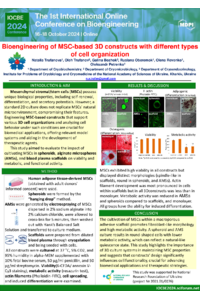
Mesenchymal stromal/stem cells (MSCs) possess unique biological properties, including self-renewal, differentiation, and secretory potentials. However, a standard 2D culture does not replicate MSCs' natural microenvironment, compromising their features. Engineering MSC-based constructs that support various 3D cell organizations and analyzing cell behavior under such conditions are crucial for biomedical applications, offering relevant model systems and aiding in the development of therapeutic agents. This study aimed to evaluate the impact of cultivating MSCs in spheroids, alginate microspheres (AMSs), and blood plasma scaffolds on viability and metabolic and functional activity.
Methods:
Human adipose tissue-derived MSCs (obtained with adult donors’ informed consent) were used. Spheroids were formed by the “hanging drop” method. AMSs were generated by electrospraying MSCs dispersed in 2% sodium alginate into 2% calcium chloride. Scaffolds were prepared through cryogelation and being seeded with cells. All constructs were cultured at 37 °C, 5% CO2, and 95% humidity in alpha-MEM supplemented with 10% fetal bovine serum, 50 μg/ml penicillin, and 50 μg/ml streptomycin. Viability (6-CFDA), metabolic activity (resazurin test), actin filaments (Phalloidin-FITC), cell spreading, and induced differentiation were examined.
Results and Discussion:
MSCs exhibited high viability in all constructs but displayed distinct morphologies (spindle-like in scaffolds, round in spheroids, and AMSs). Actin filament development was most pronounced in cells within scaffolds. Metabolic activity was reduced in spheroids and AMSs compared to the scaffolds. All groups demonstrated the ability for induced differentiation.
Conclusions:
The cultivation of MSCs within a macroporous adhesive scaffold promotes fibroblast-like morphology and high metabolic activity. A spheroid and AMS culture results in round-shaped cells with lower metabolic activity, which can reflect a natural-like quiescence state. This study highlights the importance of 3D culture systems in maintaining MSC properties and suggests that constructs' design significantly influences cell functionality, crucial for advancing biomedical applications and therapeutic strategies.
This study was supported by the National Research Foundation of Ukraine (project № 2021.01/0276).
Keywords
Mesenchymal stromal/stem cells
spheroid
alginate microsphere
macroporous scaffold
3D culture
Poster
097435.pdf
Assessing Bowling Legality in Cricket: Biomechanical Insights and Implications
Electrochemical measurements with multielectrode array systems to determine the release of serotonin by exocytosis in human platelets.