Event submissions
Published
This submission belongs to the session 5. Biosignal Processing of the event The 1st International Online Conference on Bioengineering
Published date
11 Oct, 2024
Academic Editor
'%3e%3cpath%20d='M12.6657%2010.9104C12.4185%2010.325%2012.0599%209.79327%2011.6097%209.34482C11.1609%208.89508%2010.6293%208.5365%2010.0442%208.28888C10.0389%208.28626%2010.0337%208.28495%2010.0285%208.28233C10.8446%207.69279%2011.3752%206.73249%2011.3752%205.64904C11.3752%203.8542%209.92103%202.39999%208.1262%202.39999C6.33136%202.39999%204.87715%203.8542%204.87715%205.64904C4.87715%206.73249%205.40774%207.69279%206.22393%208.28364C6.21869%208.28626%206.21345%208.28757%206.20821%208.29019C5.62129%208.5378%205.09463%208.89284%204.64265%209.34613C4.1929%209.79493%203.83432%2010.3266%203.58671%2010.9117C3.34345%2011.4845%203.21226%2012.0987%203.20023%2012.7209C3.19988%2012.7349%203.20233%2012.7488%203.20744%2012.7619C3.21255%2012.7749%203.22022%2012.7867%203.22998%2012.7968C3.23975%2012.8068%203.25142%2012.8147%203.26431%2012.8202C3.2772%2012.8256%203.29105%2012.8284%203.30504%2012.8284H4.09109C4.14874%2012.8284%204.19459%2012.7825%204.1959%2012.7262C4.2221%2011.7148%204.62823%2010.7676%205.34617%2010.0497C6.08899%209.30683%207.0755%208.89808%208.1262%208.89808C9.17689%208.89808%2010.1634%209.30683%2010.9062%2010.0497C11.6242%2010.7676%2012.0303%2011.7148%2012.0565%2012.7262C12.0578%2012.7838%2012.1037%2012.8284%2012.1613%2012.8284H12.9474C12.9613%2012.8284%2012.9752%2012.8256%2012.9881%2012.8202C13.001%2012.8147%2013.0126%2012.8068%2013.0224%2012.7968C13.0322%2012.7867%2013.0398%2012.7749%2013.0449%2012.7619C13.0501%2012.7488%2013.0525%2012.7349%2013.0522%2012.7209C13.0391%2012.0947%2012.9094%2011.4855%2012.6657%2010.9104ZM8.1262%207.9024C7.52486%207.9024%206.9589%207.6679%206.53312%207.24211C6.10733%206.81633%205.87283%206.25037%205.87283%205.64904C5.87283%205.0477%206.10733%204.48174%206.53312%204.05596C6.9589%203.63018%207.52486%203.39567%208.1262%203.39567C8.72753%203.39567%209.29349%203.63018%209.71927%204.05596C10.1451%204.48174%2010.3796%205.0477%2010.3796%205.64904C10.3796%206.25037%2010.1451%206.81633%209.71927%207.24211C9.29349%207.6679%208.72753%207.9024%208.1262%207.9024Z'%20fill='%235D1EE1'/%3e%3c/g%3e%3c/svg%3e) Andrea Cataldo
Andrea CataldoCitation
Rosalía González-Brito, Pablo Montenegro, Alicia Méndez, Ramtin E. Shabgahi, Alberto Pasquarelli, Ricardo Borges, Electrochemical measurements with multielectrode array systems to determine the release of serotonin by exocytosis in human platelets., in Proceedings of The 1st International Online Conference on Bioengineering, 16 October–18 October 2024, MDPI: Basel, Switzerland
Share
Email
Facebook
Twitter
LinkedIn
Electrochemical measurements with multielectrode array systems to determine the release of serotonin by exocytosis in human platelets.
'%3e%3cpath%20d='M12.6647%2010.9104C12.4176%2010.325%2012.0589%209.7933%2011.6088%209.34485C11.16%208.89511%2010.6283%208.53653%2010.0432%208.28891C10.038%208.28629%2010.0327%208.28498%2010.0275%208.28236C10.8437%207.69282%2011.3743%206.73252%2011.3743%205.64907C11.3743%203.85423%209.92005%202.40002%208.12522%202.40002C6.33038%202.40002%204.87618%203.85423%204.87618%205.64907C4.87618%206.73252%205.40677%207.69282%206.22296%208.28367C6.21772%208.28629%206.21248%208.2876%206.20724%208.29022C5.62031%208.53783%205.09365%208.89287%204.64167%209.34616C4.19192%209.79496%203.83334%2010.3266%203.58573%2010.9117C3.34247%2011.4846%203.21128%2012.0987%203.19925%2012.721C3.1989%2012.735%203.20135%2012.7489%203.20646%2012.7619C3.21157%2012.7749%203.21924%2012.7868%203.22901%2012.7968C3.23877%2012.8068%203.25045%2012.8148%203.26334%2012.8202C3.27623%2012.8256%203.29007%2012.8284%203.30406%2012.8284H4.09012C4.14776%2012.8284%204.19362%2012.7825%204.19493%2012.7262C4.22113%2011.7148%204.62726%2010.7676%205.34519%2010.0497C6.08802%209.30686%207.07452%208.89811%208.12522%208.89811C9.17592%208.89811%2010.1624%209.30686%2010.9052%2010.0497C11.6232%2010.7676%2012.0293%2011.7148%2012.0555%2012.7262C12.0568%2012.7839%2012.1027%2012.8284%2012.1603%2012.8284H12.9464C12.9604%2012.8284%2012.9742%2012.8256%2012.9871%2012.8202C13%2012.8148%2013.0117%2012.8068%2013.0214%2012.7968C13.0312%2012.7868%2013.0389%2012.7749%2013.044%2012.7619C13.0491%2012.7489%2013.0515%2012.735%2013.0512%2012.721C13.0381%2012.0947%2012.9084%2011.4856%2012.6647%2010.9104ZM8.12522%207.90243C7.52388%207.90243%206.95792%207.66793%206.53214%207.24215C6.10636%206.81636%205.87185%206.2504%205.87185%205.64907C5.87185%205.04773%206.10636%204.48177%206.53214%204.05599C6.95792%203.63021%207.52388%203.3957%208.12522%203.3957C8.72655%203.3957%209.29252%203.63021%209.7183%204.05599C10.1441%204.48177%2010.3786%205.04773%2010.3786%205.64907C10.3786%206.2504%2010.1441%206.81636%209.7183%207.24215C9.29252%207.66793%208.72655%207.90243%208.12522%207.90243Z'%20fill='%235D1EE1'/%3e%3c/g%3e%3c/svg%3e)
Rosalía González-Brito 1,2,3
Pablo Montenegro 1,2

Alicia Méndez 1,2
Ramtin E. Shabgahi 4
Alberto Pasquarelli 4

Ricardo Borges 1,2
1. Pharmacology Unit, Medical School, Universidad de La Laguna. Spain
2. Instituto Fundación Teófilo Hernando, Madrid, Spain
3. Organic Chemistry Department, Universidad de La Laguna, Spain
4. Institute of Electron Devices and Circuits, Ulm University, Germany
Abstract
Introduction.
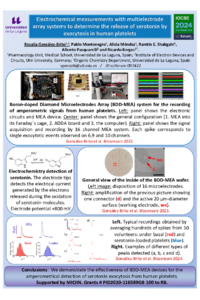
Serotonin is a neurotransmitter that participates in the homeostasis of many physiological functions in humans. The study and understanding of its cellular biology are of special relevance in advancing knowledge of the different actions and biosignal processes of this biological amine. It accumulates in intracellular vesicles and is released by exocytosis. Over 90% of blood serotonin is accumulated in platelets, where the highest content is stored in the so-called delta granules.
We are carrying out a quantitative study of the release, by exocytosis, of serotonin in platelets using amperometry with multi-electrode array (MEA) systems. Each exocytotic event is recorded as an amperometric deflection called a “spike”.
Methods.
We fabricate and optimize novel boron-doped nanocrystalline diamond 16-microelectrode array devices (16-BBD-MEA): opaque devices on silicon substrates (BDD-on-silicon MEA)1 and transparent devices on quartz substrates (BDD-on-quartz MEA)2.
With these 16-BBD-MEA systems, we record the amperometric spikes. The measurements are carried out under two different conditions: basal (without the modification of isolated platelets) and after loading the platelets with10 µM serotonin for 2 h.1,2
Results.
MEA systems are a solid tool for studying exocytosis in human platelets. This is important as platelets are one of few easily accessible human cells. From each spike, we calculate four kinetic parameters: Imax (maximum oxidation current, in pA), t1/2 (spike width at half maximum, in ms), Q (spike net charge, in pQ) and the ascending slope of the spike (in pA/ms). These parameters permit us to characterize and classify the secretory spikes.1,2
Conclusions.
It is possible to quantitatively determine the release of serotonin by exocytosis from human platelets using BDD-MEA devices.
References.
1 González Brito, R; Montenegro, P; Méndez, A; Carabelli, V; Tomagra, G; Shabgahi, R.E.; Pasquarelli, A.; Borges, R. Biosensors2023, 13, 86.
2 González Brito, R; Montenegro, P; Méndez, A; Shabgahi, R.E.; Pasquarelli, A.; Borges, R. Biosensors2024, 14, 75.
Keywords
amperometry
electrochemistry
exocytosis
serotonin
human platelets
Poster
097422.pdf
Bioengineering of MSC-based 3D constructs with different types of cell organization
Time–frequency approaches for analyzing electromyographic bursting signals with high non-stationary components: towards assessing muscle function