Event submissions
Published
This submission belongs to the session 3. Biomedical Biomaterials of the event The 1st International Online Conference on Bioengineering
Published date
11 Oct, 2024
Academic Editor
'%3e%3cpath%20d='M12.6657%2010.9104C12.4185%2010.325%2012.0599%209.79327%2011.6097%209.34482C11.1609%208.89508%2010.6293%208.5365%2010.0442%208.28888C10.0389%208.28626%2010.0337%208.28495%2010.0285%208.28233C10.8446%207.69279%2011.3752%206.73249%2011.3752%205.64904C11.3752%203.8542%209.92103%202.39999%208.1262%202.39999C6.33136%202.39999%204.87715%203.8542%204.87715%205.64904C4.87715%206.73249%205.40774%207.69279%206.22393%208.28364C6.21869%208.28626%206.21345%208.28757%206.20821%208.29019C5.62129%208.5378%205.09463%208.89284%204.64265%209.34613C4.1929%209.79493%203.83432%2010.3266%203.58671%2010.9117C3.34345%2011.4845%203.21226%2012.0987%203.20023%2012.7209C3.19988%2012.7349%203.20233%2012.7488%203.20744%2012.7619C3.21255%2012.7749%203.22022%2012.7867%203.22998%2012.7968C3.23975%2012.8068%203.25142%2012.8147%203.26431%2012.8202C3.2772%2012.8256%203.29105%2012.8284%203.30504%2012.8284H4.09109C4.14874%2012.8284%204.19459%2012.7825%204.1959%2012.7262C4.2221%2011.7148%204.62823%2010.7676%205.34617%2010.0497C6.08899%209.30683%207.0755%208.89808%208.1262%208.89808C9.17689%208.89808%2010.1634%209.30683%2010.9062%2010.0497C11.6242%2010.7676%2012.0303%2011.7148%2012.0565%2012.7262C12.0578%2012.7838%2012.1037%2012.8284%2012.1613%2012.8284H12.9474C12.9613%2012.8284%2012.9752%2012.8256%2012.9881%2012.8202C13.001%2012.8147%2013.0126%2012.8068%2013.0224%2012.7968C13.0322%2012.7867%2013.0398%2012.7749%2013.0449%2012.7619C13.0501%2012.7488%2013.0525%2012.7349%2013.0522%2012.7209C13.0391%2012.0947%2012.9094%2011.4855%2012.6657%2010.9104ZM8.1262%207.9024C7.52486%207.9024%206.9589%207.6679%206.53312%207.24211C6.10733%206.81633%205.87283%206.25037%205.87283%205.64904C5.87283%205.0477%206.10733%204.48174%206.53312%204.05596C6.9589%203.63018%207.52486%203.39567%208.1262%203.39567C8.72753%203.39567%209.29349%203.63018%209.71927%204.05596C10.1451%204.48174%2010.3796%205.0477%2010.3796%205.64904C10.3796%206.25037%2010.1451%206.81633%209.71927%207.24211C9.29349%207.6679%208.72753%207.9024%208.1262%207.9024Z'%20fill='%235D1EE1'/%3e%3c/g%3e%3c/svg%3e) Gary Bowlin
Gary BowlinCitation
Paula Melina Garcia Zeman, Silvina Tineo, Gabriela Simonelli, Gaston Lagarrigue, Marta Saravia, Inhibitory action of bioactive composites on S. mutans., in Proceedings of The 1st International Online Conference on Bioengineering, 16 October–18 October 2024, MDPI: Basel, Switzerland
Share
Email
Facebook
Twitter
LinkedIn
Inhibitory action of bioactive composites on S. mutans.
'%3e%3cpath%20d='M12.6647%2010.9104C12.4176%2010.325%2012.0589%209.7933%2011.6088%209.34485C11.16%208.89511%2010.6283%208.53653%2010.0432%208.28891C10.038%208.28629%2010.0327%208.28498%2010.0275%208.28236C10.8437%207.69282%2011.3743%206.73252%2011.3743%205.64907C11.3743%203.85423%209.92005%202.40002%208.12522%202.40002C6.33038%202.40002%204.87618%203.85423%204.87618%205.64907C4.87618%206.73252%205.40677%207.69282%206.22296%208.28367C6.21772%208.28629%206.21248%208.2876%206.20724%208.29022C5.62031%208.53783%205.09365%208.89287%204.64167%209.34616C4.19192%209.79496%203.83334%2010.3266%203.58573%2010.9117C3.34247%2011.4846%203.21128%2012.0987%203.19925%2012.721C3.1989%2012.735%203.20135%2012.7489%203.20646%2012.7619C3.21157%2012.7749%203.21924%2012.7868%203.22901%2012.7968C3.23877%2012.8068%203.25045%2012.8148%203.26334%2012.8202C3.27623%2012.8256%203.29007%2012.8284%203.30406%2012.8284H4.09012C4.14776%2012.8284%204.19362%2012.7825%204.19493%2012.7262C4.22113%2011.7148%204.62726%2010.7676%205.34519%2010.0497C6.08802%209.30686%207.07452%208.89811%208.12522%208.89811C9.17592%208.89811%2010.1624%209.30686%2010.9052%2010.0497C11.6232%2010.7676%2012.0293%2011.7148%2012.0555%2012.7262C12.0568%2012.7839%2012.1027%2012.8284%2012.1603%2012.8284H12.9464C12.9604%2012.8284%2012.9742%2012.8256%2012.9871%2012.8202C13%2012.8148%2013.0117%2012.8068%2013.0214%2012.7968C13.0312%2012.7868%2013.0389%2012.7749%2013.044%2012.7619C13.0491%2012.7489%2013.0515%2012.735%2013.0512%2012.721C13.0381%2012.0947%2012.9084%2011.4856%2012.6647%2010.9104ZM8.12522%207.90243C7.52388%207.90243%206.95792%207.66793%206.53214%207.24215C6.10636%206.81636%205.87185%206.2504%205.87185%205.64907C5.87185%205.04773%206.10636%204.48177%206.53214%204.05599C6.95792%203.63021%207.52388%203.3957%208.12522%203.3957C8.72655%203.3957%209.29252%203.63021%209.7183%204.05599C10.1441%204.48177%2010.3786%205.04773%2010.3786%205.64907C10.3786%206.2504%2010.1441%206.81636%209.7183%207.24215C9.29252%207.66793%208.72655%207.90243%208.12522%207.90243Z'%20fill='%235D1EE1'/%3e%3c/g%3e%3c/svg%3e)
Paula Melina Garcia Zeman 1
Silvina Tineo 2
Gabriela Simonelli 3
Gaston Lagarrigue 1
Marta Saravia 2
1. Catedra de Biomateriales de la Facultad de Odontologia de la Universidad Nacional de Tucuman, Argentina
2. Laboratorio de Microbiologia Oral de la Facultad de Odontologia de la Universidad Nacional de Tucuman, Argentina (LABOFOUNT)
3. Laboratorio Fisica del Solido, Facultad de Ciencias Exactas y Tecnologia, INFINOA(Univesidad Nacional de Tucuman-CONICET), Argentina
Abstract
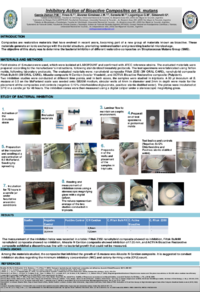
Composites are restorative materials that have evolved in recent years, becoming part of a new group of materials known as bioactive materials. These materials generate an ionic exchange with dental structure, promoting remineralization and preventing bacterial activity. This study aimed to determine the bacterial inhibition of different restorative composites on S. mutans group.
Field strains of S. mutans were used and isolated in our laboratory (LABOFOUNT) and confirmed by reference strains ATCC. Nanohybrid Composite Filtek Z350 (3M ORAL CARE), Nanohybrid Composite Filtek Bulkfill (3M ORAL CARE) (traditional composites) and Alkasite N Cention Composite (Ivoclar Vivadent), and ACTIVA Bioactive Restorative Composite (Pulpdent) (bioactive composites) were evaluated. They were prepared according to the manufacturer's instructions, following standardized biosafety protocols. Test bodies were fabricated using Teflon molds, following laboratory protocols.
Two inhibition studies were performed at different times, in both cases, the samples were studied in triplicate. 50 μl of S. mutans inoculum at 0.5 McFarland scale was seeded in SB20M medium, circular perforations of 4mm in diameter and 2mm in depth were made for the placement of composites and controls (negative: 0.12% chlorhexidine digluconate and positive: sterile distilled water), incubated at 37°C in a candle jar for 48 hours. Subsequently, the inhibition halos were measured with a digital caliper under a stereoscopic magnifying glass.
Inhibition halos of 18,2 mm and 18,4 mm average values corresponding to the two studies were measured for the negative control, while values of 6,9 and 7,1 mm were obtained for Alkasite N. Cention Composite. No inhibition halos could be determined for the other materials.
In this study, only Alkasite N Cention Composite inhibited S. mutans bacterial growth. It is suggested to conduct inhibition studies in relation to the minimum inhibitory concentration (MIC) and colony-forming unit (CFU) count to further evaluate the effect of bioactive composites on S. mutans.
Keywords
biomaterials
bioactive
composites
Streptococos mutans.
Poster
097320.pdf
Time–frequency approaches for analyzing electromyographic bursting signals with high non-stationary components: towards assessing muscle function
A new methodological approach Based on the Stationarity and Permutation Entropy of EMG Bursts for Assessing Muscle Function Alterations in a Parkinson’s Disease Animal Model