Event submissions
Published
This submission belongs to the session S3. Diet and Chronic Disease Management of the event The 4th International Electronic Conference on Nutrients
Published date
11 Oct, 2024
Academic Editor
'%3e%3cpath%20d='M12.6657%2010.9104C12.4185%2010.325%2012.0599%209.79327%2011.6097%209.34482C11.1609%208.89508%2010.6293%208.5365%2010.0442%208.28888C10.0389%208.28626%2010.0337%208.28495%2010.0285%208.28233C10.8446%207.69279%2011.3752%206.73249%2011.3752%205.64904C11.3752%203.8542%209.92103%202.39999%208.1262%202.39999C6.33136%202.39999%204.87715%203.8542%204.87715%205.64904C4.87715%206.73249%205.40774%207.69279%206.22393%208.28364C6.21869%208.28626%206.21345%208.28757%206.20821%208.29019C5.62129%208.5378%205.09463%208.89284%204.64265%209.34613C4.1929%209.79493%203.83432%2010.3266%203.58671%2010.9117C3.34345%2011.4845%203.21226%2012.0987%203.20023%2012.7209C3.19988%2012.7349%203.20233%2012.7488%203.20744%2012.7619C3.21255%2012.7749%203.22022%2012.7867%203.22998%2012.7968C3.23975%2012.8068%203.25142%2012.8147%203.26431%2012.8202C3.2772%2012.8256%203.29105%2012.8284%203.30504%2012.8284H4.09109C4.14874%2012.8284%204.19459%2012.7825%204.1959%2012.7262C4.2221%2011.7148%204.62823%2010.7676%205.34617%2010.0497C6.08899%209.30683%207.0755%208.89808%208.1262%208.89808C9.17689%208.89808%2010.1634%209.30683%2010.9062%2010.0497C11.6242%2010.7676%2012.0303%2011.7148%2012.0565%2012.7262C12.0578%2012.7838%2012.1037%2012.8284%2012.1613%2012.8284H12.9474C12.9613%2012.8284%2012.9752%2012.8256%2012.9881%2012.8202C13.001%2012.8147%2013.0126%2012.8068%2013.0224%2012.7968C13.0322%2012.7867%2013.0398%2012.7749%2013.0449%2012.7619C13.0501%2012.7488%2013.0525%2012.7349%2013.0522%2012.7209C13.0391%2012.0947%2012.9094%2011.4855%2012.6657%2010.9104ZM8.1262%207.9024C7.52486%207.9024%206.9589%207.6679%206.53312%207.24211C6.10733%206.81633%205.87283%206.25037%205.87283%205.64904C5.87283%205.0477%206.10733%204.48174%206.53312%204.05596C6.9589%203.63018%207.52486%203.39567%208.1262%203.39567C8.72753%203.39567%209.29349%203.63018%209.71927%204.05596C10.1451%204.48174%2010.3796%205.0477%2010.3796%205.64904C10.3796%206.25037%2010.1451%206.81633%209.71927%207.24211C9.29349%207.6679%208.72753%207.9024%208.1262%207.9024Z'%20fill='%235D1EE1'/%3e%3c/g%3e%3c/svg%3e) Jaime Uribarri
Jaime UribarriCitation
Ankan Naskar, DEVELOPMENT AND CHARACTERIZATION OF STIMULI-RESPONSIVE IN SITU HONEY GEL FOR IMPROVED WOUND HEALING APPROACH, in Proceedings of The 4th International Electronic Conference on Nutrients, 16 October–18 October 2024, MDPI: Basel, Switzerland
Share
Email
Facebook
Twitter
LinkedIn
DEVELOPMENT AND CHARACTERIZATION OF STIMULI-RESPONSIVE IN SITU HONEY GEL FOR IMPROVED WOUND HEALING APPROACH

Ankan Naskar 1
1. Department of Pharmaceutical Sciences and Technology, Birla Institute of Technology, Mesra, Ranchi, Jharkhand, India
Abstract
INTRODUCTION: Honey has been proven to be efficacious in wound healing since ancient times. In the modern world, the application of honey has reappeared with a focus on the treatment of diabetic wounds.
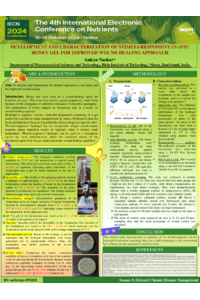
METHODS: Thus, in the present study, an in situ hydrogel was fabricated through the use of a stimuli-responsive polymer, poloxamer 407, and chitosan. Each polymer was dispersed individually using the cold method. Subsequently, medical-grade honey was incorporated into the in situ hydrogel formulation, where the temperature at the site of application stimulated the conversion of the formulation from a sol form into a gel. An initial characterization of the formulation's spray diameter, gel-to-sol conversion, rheological parameters, and mucoadhesive characteristics has been performed. The anti-microbial activity, anti-oxidant activity, and in vivo wound healing efficacy of the formulation were also studied.
RESULTS: The selected in situ formulation demonstrated a phase transition at 33°C, a pH of 5.8, which is appropriate for use in wounds, and an appropriate viscosity (408 cP) that would allow the hydrogel to be applied easily. However, its strong mucoadhesive force (20.300 ± 0.557 g) would prevent the formulation from leaking after its application. Furthermore, the antibacterial efficacy of the formulation was also found to be satisfactory against both Escherichia coli (gram -ve) and Staphylococcus aureus (gram +ve). The excision wound model showed that the treatment group exhibited rapid re-epithelization and collagen formation in comparison to the control group and the standard group. The biochemical anti-oxidant assay showed that there were significant results in the treatment group compared to the control group.
CONCLUSIONS: Based on these findings, it could be concluded that using this in situ hydrogel of honey is a better option for treating diabetic wounds.
Keywords
Honey
in-situ hydrogel
stimuli-responsive
sol-to-gel
antibacterial
wound healing
Poster
sciforum-093205_Ankan Naskar.pdf
Revolutionizing Dietary Behavior: Harnessing Technology for Healthier Eating Habits
High and low adherence to Mediterranean and DASH diet patterns and the risk of heart failure: a meta-analysis of observational studies