Event submissions
Published
This submission belongs to the session S1. Plant-Based Diets: Health and Well-Being of the event The 4th International Electronic Conference on Nutrients
Published date
11 Oct, 2024
Academic Editor
'%3e%3cpath%20d='M12.6657%2010.9104C12.4185%2010.325%2012.0599%209.79327%2011.6097%209.34482C11.1609%208.89508%2010.6293%208.5365%2010.0442%208.28888C10.0389%208.28626%2010.0337%208.28495%2010.0285%208.28233C10.8446%207.69279%2011.3752%206.73249%2011.3752%205.64904C11.3752%203.8542%209.92103%202.39999%208.1262%202.39999C6.33136%202.39999%204.87715%203.8542%204.87715%205.64904C4.87715%206.73249%205.40774%207.69279%206.22393%208.28364C6.21869%208.28626%206.21345%208.28757%206.20821%208.29019C5.62129%208.5378%205.09463%208.89284%204.64265%209.34613C4.1929%209.79493%203.83432%2010.3266%203.58671%2010.9117C3.34345%2011.4845%203.21226%2012.0987%203.20023%2012.7209C3.19988%2012.7349%203.20233%2012.7488%203.20744%2012.7619C3.21255%2012.7749%203.22022%2012.7867%203.22998%2012.7968C3.23975%2012.8068%203.25142%2012.8147%203.26431%2012.8202C3.2772%2012.8256%203.29105%2012.8284%203.30504%2012.8284H4.09109C4.14874%2012.8284%204.19459%2012.7825%204.1959%2012.7262C4.2221%2011.7148%204.62823%2010.7676%205.34617%2010.0497C6.08899%209.30683%207.0755%208.89808%208.1262%208.89808C9.17689%208.89808%2010.1634%209.30683%2010.9062%2010.0497C11.6242%2010.7676%2012.0303%2011.7148%2012.0565%2012.7262C12.0578%2012.7838%2012.1037%2012.8284%2012.1613%2012.8284H12.9474C12.9613%2012.8284%2012.9752%2012.8256%2012.9881%2012.8202C13.001%2012.8147%2013.0126%2012.8068%2013.0224%2012.7968C13.0322%2012.7867%2013.0398%2012.7749%2013.0449%2012.7619C13.0501%2012.7488%2013.0525%2012.7349%2013.0522%2012.7209C13.0391%2012.0947%2012.9094%2011.4855%2012.6657%2010.9104ZM8.1262%207.9024C7.52486%207.9024%206.9589%207.6679%206.53312%207.24211C6.10733%206.81633%205.87283%206.25037%205.87283%205.64904C5.87283%205.0477%206.10733%204.48174%206.53312%204.05596C6.9589%203.63018%207.52486%203.39567%208.1262%203.39567C8.72753%203.39567%209.29349%203.63018%209.71927%204.05596C10.1451%204.48174%2010.3796%205.0477%2010.3796%205.64904C10.3796%206.25037%2010.1451%206.81633%209.71927%207.24211C9.29349%207.6679%208.72753%207.9024%208.1262%207.9024Z'%20fill='%235D1EE1'/%3e%3c/g%3e%3c/svg%3e) Mauro Lombardo
Mauro LombardoCitation
Udielle Vermelho Lacerda, Carolina Vargas Pereira da Costa, Rodrigo Rezende Cardoso, Carolina Thomaz dos Santos D'Almeida, Laura da Silva Cruz, Amanda Bubula de Souza, Mariana Simões Larraz Ferreira, Luciana Azevedo, Monique Renon Eller, Frederico Augusto Ribeiro de Barros, Green tea kombucha is rich in phenolic compounds and exhibits cytotoxic potential against cancer cell lines, in Proceedings of The 4th International Electronic Conference on Nutrients, 16 October–18 October 2024, MDPI: Basel, Switzerland
Share
Email
Facebook
Twitter
LinkedIn
Green tea kombucha is rich in phenolic compounds and exhibits cytotoxic potential against cancer cell lines
'%3e%3cpath%20d='M12.6647%2010.9104C12.4176%2010.325%2012.0589%209.7933%2011.6088%209.34485C11.16%208.89511%2010.6283%208.53653%2010.0432%208.28891C10.038%208.28629%2010.0327%208.28498%2010.0275%208.28236C10.8437%207.69282%2011.3743%206.73252%2011.3743%205.64907C11.3743%203.85423%209.92005%202.40002%208.12522%202.40002C6.33038%202.40002%204.87618%203.85423%204.87618%205.64907C4.87618%206.73252%205.40677%207.69282%206.22296%208.28367C6.21772%208.28629%206.21248%208.2876%206.20724%208.29022C5.62031%208.53783%205.09365%208.89287%204.64167%209.34616C4.19192%209.79496%203.83334%2010.3266%203.58573%2010.9117C3.34247%2011.4846%203.21128%2012.0987%203.19925%2012.721C3.1989%2012.735%203.20135%2012.7489%203.20646%2012.7619C3.21157%2012.7749%203.21924%2012.7868%203.22901%2012.7968C3.23877%2012.8068%203.25045%2012.8148%203.26334%2012.8202C3.27623%2012.8256%203.29007%2012.8284%203.30406%2012.8284H4.09012C4.14776%2012.8284%204.19362%2012.7825%204.19493%2012.7262C4.22113%2011.7148%204.62726%2010.7676%205.34519%2010.0497C6.08802%209.30686%207.07452%208.89811%208.12522%208.89811C9.17592%208.89811%2010.1624%209.30686%2010.9052%2010.0497C11.6232%2010.7676%2012.0293%2011.7148%2012.0555%2012.7262C12.0568%2012.7839%2012.1027%2012.8284%2012.1603%2012.8284H12.9464C12.9604%2012.8284%2012.9742%2012.8256%2012.9871%2012.8202C13%2012.8148%2013.0117%2012.8068%2013.0214%2012.7968C13.0312%2012.7868%2013.0389%2012.7749%2013.044%2012.7619C13.0491%2012.7489%2013.0515%2012.735%2013.0512%2012.721C13.0381%2012.0947%2012.9084%2011.4856%2012.6647%2010.9104ZM8.12522%207.90243C7.52388%207.90243%206.95792%207.66793%206.53214%207.24215C6.10636%206.81636%205.87185%206.2504%205.87185%205.64907C5.87185%205.04773%206.10636%204.48177%206.53214%204.05599C6.95792%203.63021%207.52388%203.3957%208.12522%203.3957C8.72655%203.3957%209.29252%203.63021%209.7183%204.05599C10.1441%204.48177%2010.3786%205.04773%2010.3786%205.64907C10.3786%206.2504%2010.1441%206.81636%209.7183%207.24215C9.29252%207.66793%208.72655%207.90243%208.12522%207.90243Z'%20fill='%235D1EE1'/%3e%3c/g%3e%3c/svg%3e)
Udielle Vermelho Lacerda 1
Carolina Vargas Pereira da Costa 1
Rodrigo Rezende Cardoso 1
Carolina Thomaz dos Santos D'Almeida 2
Laura da Silva Cruz 3
Amanda Bubula de Souza 3
Mariana Simões Larraz Ferreira 2
Luciana Azevedo 3
Monique Renon Eller 1

Frederico Augusto Ribeiro de Barros 1
1. Universidade Federal de Viçosa
2. Universidade Federal do Estado do Rio de Janeiro
3. Universidade Federal de Alfenas
Abstract
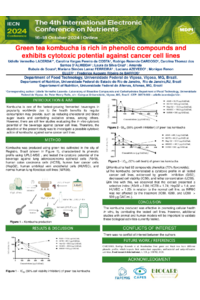
Kombucha is one of the fastest-growing fermented beverages in popularity worldwide due to the health benefits its regular consumption may provide, such as reducing cholesterol and blood sugar levels and combating oxidative stress, among others. However, there are still few studies evaluating the in vitro cytotoxic potential of the beverage against cancer cell lines. Therefore, we produced kombucha using green tea cultivated in the city of Registro, Brazil, characterized its phenolic profile using UPLC-MSE, and tested the cytotoxic potential of the beverage against lung adenocarcinoma epithelial cells (A549), human colon carcinoma cells (HCT8), human liver cancer cells (HepG2), human umbilical vein endothelial cells (HUVEC), and normal human lung fibroblast cell lines (IMR90). The green tea kombucha presented 92 phenolic compounds, most of which were classified as flavonoids. The kombucha demonstrated a cytotoxic profile in all tested cancer cell lines, evidenced by growth inhibition (GI50), decreased cell viability (IC50), and lethal concentration (LC50). In line with this, we observed that the extract presented a selective index (A549 = 2.84; HCT8 = 1.74; HepG2 = 1.4; and HUVEC = 1.23) in relation to the normal cell line, as IMR90 was not affected by the treatment (IC50, IG50, and LC50 > 500 µg GAE/mL). It is believed that the flavonoids, which are the most abundant in kombucha, are capable of acting on crucial signaling pathways for tumor development. Our findings indicate that green tea kombucha is effective in promoting cellular health in vitro, and complementary studies with animal and human models will be crucial to confirm these tested biological activities.
Keywords
phenolic compounds
health
flavonoids
Poster
Pôster IECN - Udielle Vermelho Lacerda.pdf
Development of energy bars from traditional fruits and vegetables to increase antioxidant levels
Effect of multi-strain probiotic supplementation on magnesium and calcium metabolism in obese postmenopausal women: a randomized trial