Event submissions
Published
This submission belongs to the session 5. Biosignal Processing of the event The 1st International Online Conference on Bioengineering
Published date
11 Oct, 2024
Academic Editor
'%3e%3cpath%20d='M12.6657%2010.9104C12.4185%2010.325%2012.0599%209.79327%2011.6097%209.34482C11.1609%208.89508%2010.6293%208.5365%2010.0442%208.28888C10.0389%208.28626%2010.0337%208.28495%2010.0285%208.28233C10.8446%207.69279%2011.3752%206.73249%2011.3752%205.64904C11.3752%203.8542%209.92103%202.39999%208.1262%202.39999C6.33136%202.39999%204.87715%203.8542%204.87715%205.64904C4.87715%206.73249%205.40774%207.69279%206.22393%208.28364C6.21869%208.28626%206.21345%208.28757%206.20821%208.29019C5.62129%208.5378%205.09463%208.89284%204.64265%209.34613C4.1929%209.79493%203.83432%2010.3266%203.58671%2010.9117C3.34345%2011.4845%203.21226%2012.0987%203.20023%2012.7209C3.19988%2012.7349%203.20233%2012.7488%203.20744%2012.7619C3.21255%2012.7749%203.22022%2012.7867%203.22998%2012.7968C3.23975%2012.8068%203.25142%2012.8147%203.26431%2012.8202C3.2772%2012.8256%203.29105%2012.8284%203.30504%2012.8284H4.09109C4.14874%2012.8284%204.19459%2012.7825%204.1959%2012.7262C4.2221%2011.7148%204.62823%2010.7676%205.34617%2010.0497C6.08899%209.30683%207.0755%208.89808%208.1262%208.89808C9.17689%208.89808%2010.1634%209.30683%2010.9062%2010.0497C11.6242%2010.7676%2012.0303%2011.7148%2012.0565%2012.7262C12.0578%2012.7838%2012.1037%2012.8284%2012.1613%2012.8284H12.9474C12.9613%2012.8284%2012.9752%2012.8256%2012.9881%2012.8202C13.001%2012.8147%2013.0126%2012.8068%2013.0224%2012.7968C13.0322%2012.7867%2013.0398%2012.7749%2013.0449%2012.7619C13.0501%2012.7488%2013.0525%2012.7349%2013.0522%2012.7209C13.0391%2012.0947%2012.9094%2011.4855%2012.6657%2010.9104ZM8.1262%207.9024C7.52486%207.9024%206.9589%207.6679%206.53312%207.24211C6.10733%206.81633%205.87283%206.25037%205.87283%205.64904C5.87283%205.0477%206.10733%204.48174%206.53312%204.05596C6.9589%203.63018%207.52486%203.39567%208.1262%203.39567C8.72753%203.39567%209.29349%203.63018%209.71927%204.05596C10.1451%204.48174%2010.3796%205.0477%2010.3796%205.64904C10.3796%206.25037%2010.1451%206.81633%209.71927%207.24211C9.29349%207.6679%208.72753%207.9024%208.1262%207.9024Z'%20fill='%235D1EE1'/%3e%3c/g%3e%3c/svg%3e) Andrea Cataldo
Andrea CataldoCitation
Lakshmi Yaneesha Sujeeun, Nowsheen Goonoo, Itisha Chummun Phul, Shakuntala Baichoo, Archana Bhaw-Luximon, Modelling Cell--Material Interactions in Wound Healing Scaffolds Using Machine Learning and Deep Learning Approaches, in Proceedings of The 1st International Online Conference on Bioengineering, 16 October–18 October 2024, MDPI: Basel, Switzerland
Share
Email
Facebook
Twitter
LinkedIn
Modelling Cell--Material Interactions in Wound Healing Scaffolds Using Machine Learning and Deep Learning Approaches
'%3e%3cpath%20d='M12.6647%2010.9104C12.4176%2010.325%2012.0589%209.7933%2011.6088%209.34485C11.16%208.89511%2010.6283%208.53653%2010.0432%208.28891C10.038%208.28629%2010.0327%208.28498%2010.0275%208.28236C10.8437%207.69282%2011.3743%206.73252%2011.3743%205.64907C11.3743%203.85423%209.92005%202.40002%208.12522%202.40002C6.33038%202.40002%204.87618%203.85423%204.87618%205.64907C4.87618%206.73252%205.40677%207.69282%206.22296%208.28367C6.21772%208.28629%206.21248%208.2876%206.20724%208.29022C5.62031%208.53783%205.09365%208.89287%204.64167%209.34616C4.19192%209.79496%203.83334%2010.3266%203.58573%2010.9117C3.34247%2011.4846%203.21128%2012.0987%203.19925%2012.721C3.1989%2012.735%203.20135%2012.7489%203.20646%2012.7619C3.21157%2012.7749%203.21924%2012.7868%203.22901%2012.7968C3.23877%2012.8068%203.25045%2012.8148%203.26334%2012.8202C3.27623%2012.8256%203.29007%2012.8284%203.30406%2012.8284H4.09012C4.14776%2012.8284%204.19362%2012.7825%204.19493%2012.7262C4.22113%2011.7148%204.62726%2010.7676%205.34519%2010.0497C6.08802%209.30686%207.07452%208.89811%208.12522%208.89811C9.17592%208.89811%2010.1624%209.30686%2010.9052%2010.0497C11.6232%2010.7676%2012.0293%2011.7148%2012.0555%2012.7262C12.0568%2012.7839%2012.1027%2012.8284%2012.1603%2012.8284H12.9464C12.9604%2012.8284%2012.9742%2012.8256%2012.9871%2012.8202C13%2012.8148%2013.0117%2012.8068%2013.0214%2012.7968C13.0312%2012.7868%2013.0389%2012.7749%2013.044%2012.7619C13.0491%2012.7489%2013.0515%2012.735%2013.0512%2012.721C13.0381%2012.0947%2012.9084%2011.4856%2012.6647%2010.9104ZM8.12522%207.90243C7.52388%207.90243%206.95792%207.66793%206.53214%207.24215C6.10636%206.81636%205.87185%206.2504%205.87185%205.64907C5.87185%205.04773%206.10636%204.48177%206.53214%204.05599C6.95792%203.63021%207.52388%203.3957%208.12522%203.3957C8.72655%203.3957%209.29252%203.63021%209.7183%204.05599C10.1441%204.48177%2010.3786%205.04773%2010.3786%205.64907C10.3786%206.2504%2010.1441%206.81636%209.7183%207.24215C9.29252%207.66793%208.72655%207.90243%208.12522%207.90243Z'%20fill='%235D1EE1'/%3e%3c/g%3e%3c/svg%3e)
Lakshmi Yaneesha Sujeeun 1,2

Nowsheen Goonoo 1
Itisha Chummun Phul 1
Shakuntala Baichoo 2
Archana Bhaw-Luximon 1
1. Biomaterials, Drug Delivery and Nanotechnology Unit, Centre for Biomedical and Biomaterials Research, University of Mauritius, 80837, Réduit, Mauritius
2. Department of Digital Technologies, Faculty of Information, Communication and Digital Technologies, University of Mauritius, 80837, Réduit, Mauritius
Abstract
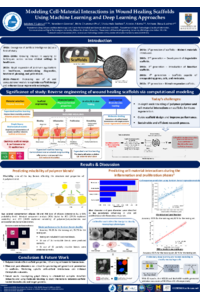
Biopolymer-based scaffolds have emerged as therapeutic solutions, supporting tissue regeneration and accelerating wound healing. The clinical translation of scaffolds remains challenging due to the complex nature of wound healing. Understanding intricate cell--material interactions is crucial for designing tailored scaffolds. The ideal scaffold requires a strategic balance of physico-chemical properties that influence the scaffold’s biological performance. Machine learning (ML) and deep learning (DL) have transformed tissue engineering by enabling the prediction of tissue outcomes in complex biological settings. This study applies ML and DL to model the relationship between scaffold properties and cell response, outlining the necessary scaffold requirements for different cell lines to provide design insights and predict scaffold performance.
Classification models were developed to predict the miscibility of polymer blends used to engineer scaffolds. Physico-chemical features of polymer blends were used as input data. Regression models were developed to predict cell--material interactions during the inflammation and proliferation phases of the wound healing process, using scaffold physico-chemical characteristics and in vitro cell culture data. Macrophage cell features were extracted from scanning electron microscope (SEM) images and classified by phenotypes. Pre-trained DL convolution neural network (CNN) models were applied and fine-tuned for cell-image classification.
Key physico-chemical parameters influencing the miscibility of polymer blends and cell responses were identified using random forest models, achieving validation accuracies between 63% and 96%. Fiber diameter and pore diameter were the most relevant parameters impacting cell responses on scaffolds. Two pre-trained DL models indicated that CNNs effectively classify macrophage cells from SEM images based on phenotypes, independently of other physico-chemical features (validation accuracies between 83% and 91%).
Polymer blends influence scaffold properties, which dictate cell--material interactions. Predictive modelling highlighted fibre diameter and pore diameter as crucial for directing cell growth and penetration in scaffolds. For proper wound healing, inflammation and proliferation phases are critical. Thus, predicting specific cell--scaffold interactions can facilitate appropriate therapy.
Keywords
biopolymer scaffolds
machine learning
cell-material interaction
wound healing
Poster
IOCBE2024_Lakshmi_Sujeeun_sciforum-097258.pdf
Applying 3D Modelling and Numerical Simulation Techniques for Precise Orthotic Design in Scoliosis Treatment
Assessment of the post-acute COVID-19 syndrome cardiovascular effect through ECG analysis