Event submissions
Published
This submission belongs to the session 4. Nano-Biotechnology of the event The 1st International Online Conference on Bioengineering
Published date
11 Oct, 2024
Academic Editor
'%3e%3cpath%20d='M12.6657%2010.9104C12.4185%2010.325%2012.0599%209.79327%2011.6097%209.34482C11.1609%208.89508%2010.6293%208.5365%2010.0442%208.28888C10.0389%208.28626%2010.0337%208.28495%2010.0285%208.28233C10.8446%207.69279%2011.3752%206.73249%2011.3752%205.64904C11.3752%203.8542%209.92103%202.39999%208.1262%202.39999C6.33136%202.39999%204.87715%203.8542%204.87715%205.64904C4.87715%206.73249%205.40774%207.69279%206.22393%208.28364C6.21869%208.28626%206.21345%208.28757%206.20821%208.29019C5.62129%208.5378%205.09463%208.89284%204.64265%209.34613C4.1929%209.79493%203.83432%2010.3266%203.58671%2010.9117C3.34345%2011.4845%203.21226%2012.0987%203.20023%2012.7209C3.19988%2012.7349%203.20233%2012.7488%203.20744%2012.7619C3.21255%2012.7749%203.22022%2012.7867%203.22998%2012.7968C3.23975%2012.8068%203.25142%2012.8147%203.26431%2012.8202C3.2772%2012.8256%203.29105%2012.8284%203.30504%2012.8284H4.09109C4.14874%2012.8284%204.19459%2012.7825%204.1959%2012.7262C4.2221%2011.7148%204.62823%2010.7676%205.34617%2010.0497C6.08899%209.30683%207.0755%208.89808%208.1262%208.89808C9.17689%208.89808%2010.1634%209.30683%2010.9062%2010.0497C11.6242%2010.7676%2012.0303%2011.7148%2012.0565%2012.7262C12.0578%2012.7838%2012.1037%2012.8284%2012.1613%2012.8284H12.9474C12.9613%2012.8284%2012.9752%2012.8256%2012.9881%2012.8202C13.001%2012.8147%2013.0126%2012.8068%2013.0224%2012.7968C13.0322%2012.7867%2013.0398%2012.7749%2013.0449%2012.7619C13.0501%2012.7488%2013.0525%2012.7349%2013.0522%2012.7209C13.0391%2012.0947%2012.9094%2011.4855%2012.6657%2010.9104ZM8.1262%207.9024C7.52486%207.9024%206.9589%207.6679%206.53312%207.24211C6.10733%206.81633%205.87283%206.25037%205.87283%205.64904C5.87283%205.0477%206.10733%204.48174%206.53312%204.05596C6.9589%203.63018%207.52486%203.39567%208.1262%203.39567C8.72753%203.39567%209.29349%203.63018%209.71927%204.05596C10.1451%204.48174%2010.3796%205.0477%2010.3796%205.64904C10.3796%206.25037%2010.1451%206.81633%209.71927%207.24211C9.29349%207.6679%208.72753%207.9024%208.1262%207.9024Z'%20fill='%235D1EE1'/%3e%3c/g%3e%3c/svg%3e) Gary Chinga Carrasco
Gary Chinga CarrascoCitation
Devesh Bekah, Yash Boyjoo, Itisha Chummun Phul, Nowsheen Goonoo, Bernard Pecheur, Patricia D'Unienville, Yi Wang, Jason White, Archana Bhaw-Luximon, Copper-based Nanovaccines for Disease Control in Plants, in Proceedings of The 1st International Online Conference on Bioengineering, 16 October–18 October 2024, MDPI: Basel, Switzerland
Share
Email
Facebook
Twitter
LinkedIn
Copper-based Nanovaccines for Disease Control in Plants
'%3e%3cpath%20d='M12.6647%2010.9104C12.4176%2010.325%2012.0589%209.7933%2011.6088%209.34485C11.16%208.89511%2010.6283%208.53653%2010.0432%208.28891C10.038%208.28629%2010.0327%208.28498%2010.0275%208.28236C10.8437%207.69282%2011.3743%206.73252%2011.3743%205.64907C11.3743%203.85423%209.92005%202.40002%208.12522%202.40002C6.33038%202.40002%204.87618%203.85423%204.87618%205.64907C4.87618%206.73252%205.40677%207.69282%206.22296%208.28367C6.21772%208.28629%206.21248%208.2876%206.20724%208.29022C5.62031%208.53783%205.09365%208.89287%204.64167%209.34616C4.19192%209.79496%203.83334%2010.3266%203.58573%2010.9117C3.34247%2011.4846%203.21128%2012.0987%203.19925%2012.721C3.1989%2012.735%203.20135%2012.7489%203.20646%2012.7619C3.21157%2012.7749%203.21924%2012.7868%203.22901%2012.7968C3.23877%2012.8068%203.25045%2012.8148%203.26334%2012.8202C3.27623%2012.8256%203.29007%2012.8284%203.30406%2012.8284H4.09012C4.14776%2012.8284%204.19362%2012.7825%204.19493%2012.7262C4.22113%2011.7148%204.62726%2010.7676%205.34519%2010.0497C6.08802%209.30686%207.07452%208.89811%208.12522%208.89811C9.17592%208.89811%2010.1624%209.30686%2010.9052%2010.0497C11.6232%2010.7676%2012.0293%2011.7148%2012.0555%2012.7262C12.0568%2012.7839%2012.1027%2012.8284%2012.1603%2012.8284H12.9464C12.9604%2012.8284%2012.9742%2012.8256%2012.9871%2012.8202C13%2012.8148%2013.0117%2012.8068%2013.0214%2012.7968C13.0312%2012.7868%2013.0389%2012.7749%2013.044%2012.7619C13.0491%2012.7489%2013.0515%2012.735%2013.0512%2012.721C13.0381%2012.0947%2012.9084%2011.4856%2012.6647%2010.9104ZM8.12522%207.90243C7.52388%207.90243%206.95792%207.66793%206.53214%207.24215C6.10636%206.81636%205.87185%206.2504%205.87185%205.64907C5.87185%205.04773%206.10636%204.48177%206.53214%204.05599C6.95792%203.63021%207.52388%203.3957%208.12522%203.3957C8.72655%203.3957%209.29252%203.63021%209.7183%204.05599C10.1441%204.48177%2010.3786%205.04773%2010.3786%205.64907C10.3786%206.2504%2010.1441%206.81636%209.7183%207.24215C9.29252%207.66793%208.72655%207.90243%208.12522%207.90243Z'%20fill='%235D1EE1'/%3e%3c/g%3e%3c/svg%3e)
Devesh Bekah 1
Yash Boyjoo 1
Itisha Chummun Phul 1

Nowsheen Goonoo 1
Bernard Pecheur 2
Patricia D'Unienville 3

Yi Wang 4
Jason White 5
Archana Bhaw-Luximon 1
1. Centre for Biomedical and Biomaterials Research, University of Mauritius, Mauritius
2. Food and Agricultural Research & Extension Institute, Mauritius
3. Ingenia Ltd., Mauritius
4. Department of Analytical Chemistry, Connecticut Agricultural Experiment Station (CAES), United States
5. Connecticut Agricultural Experiment Station (CAES), United States
Abstract
Introduction
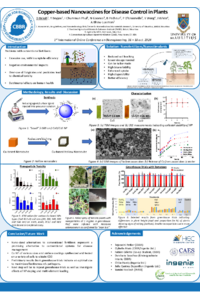
There is a worldwide need to develop novel and sustainable ways to tackle food safety and disease resistance in agriculture. Plants are conventionally treated with a large quantity of pesticides, with delivery being inefficient. The use of nanomaterials for disease control can be a more efficient and target-specific strategy. Copper, one of the eight essential plant micronutrients, provides protection against diseases such as ergot and bacterial wilt. By using nanoscale carriers or nanoscale variants of copper-based particles, one could potentially decrease disease proliferation, and reduce the environmental and public health impact of pesticides.
Methods
Water-dispersible copper-based nanoparticles were synthesized using a simple one-pot chemical precipitation method with various ligands used to coat and stabilize the nanomaterials. All particles were characterized using standard techniques such as TEM, DLS, and FTIR. An extensive greenhouse trial was performed on tomato plants with half of the plants inoculated with Ralstonia solanacearum and the rest used as control. The application of nanoparticles was carried out via both foliar spray (1 mg/plant) and soil (200 mg NP/kg soil). Parameters such as plant height, leaf count, and number of flowers/fruits as well as signs of wilting were recorded regularly. Root and shoot biomass and metal contents were determined to evaluate the effectiveness of the NPs.
Results and Discussion
The nanoparticle sizes ranged from 40 to 500 nm, depending on stabilizing ligand and reaction protocol. Copper content varied between 20 and 60% (EDX elemental analysis). In the greenhouse trials, it was observed that there was a size dependence on resistance to bacterial wilt, with smaller nanoparticles leading to higher resistance.
Conclusions
Overall, our data showed that copper-based nanoparticles can be useful in providing resistance to bacterial wilt in tomato plants. In vitro testing on mammalian cell lines (L929, A549, and PC12) is under way to establish nanoparticle toxicity.
Keywords
nanovaccine
sustainability
disease control
food safety
Poster
Bioeng_poster_DB_Sciforum-097201.pdf
Assessment of the post-acute COVID-19 syndrome cardiovascular effect through ECG analysis
Agricultural-Waste-Derived Wound Patch for Enhanced Healing of Cutaneous Leishmaniasis Wounds