Event submissions
Published
This submission belongs to the session 1. Regenerative and Tissue Engineering of the event The 1st International Online Conference on Bioengineering
Published date
11 Oct, 2024
Academic Editor
'%3e%3cpath%20d='M12.6657%2010.9104C12.4185%2010.325%2012.0599%209.79327%2011.6097%209.34482C11.1609%208.89508%2010.6293%208.5365%2010.0442%208.28888C10.0389%208.28626%2010.0337%208.28495%2010.0285%208.28233C10.8446%207.69279%2011.3752%206.73249%2011.3752%205.64904C11.3752%203.8542%209.92103%202.39999%208.1262%202.39999C6.33136%202.39999%204.87715%203.8542%204.87715%205.64904C4.87715%206.73249%205.40774%207.69279%206.22393%208.28364C6.21869%208.28626%206.21345%208.28757%206.20821%208.29019C5.62129%208.5378%205.09463%208.89284%204.64265%209.34613C4.1929%209.79493%203.83432%2010.3266%203.58671%2010.9117C3.34345%2011.4845%203.21226%2012.0987%203.20023%2012.7209C3.19988%2012.7349%203.20233%2012.7488%203.20744%2012.7619C3.21255%2012.7749%203.22022%2012.7867%203.22998%2012.7968C3.23975%2012.8068%203.25142%2012.8147%203.26431%2012.8202C3.2772%2012.8256%203.29105%2012.8284%203.30504%2012.8284H4.09109C4.14874%2012.8284%204.19459%2012.7825%204.1959%2012.7262C4.2221%2011.7148%204.62823%2010.7676%205.34617%2010.0497C6.08899%209.30683%207.0755%208.89808%208.1262%208.89808C9.17689%208.89808%2010.1634%209.30683%2010.9062%2010.0497C11.6242%2010.7676%2012.0303%2011.7148%2012.0565%2012.7262C12.0578%2012.7838%2012.1037%2012.8284%2012.1613%2012.8284H12.9474C12.9613%2012.8284%2012.9752%2012.8256%2012.9881%2012.8202C13.001%2012.8147%2013.0126%2012.8068%2013.0224%2012.7968C13.0322%2012.7867%2013.0398%2012.7749%2013.0449%2012.7619C13.0501%2012.7488%2013.0525%2012.7349%2013.0522%2012.7209C13.0391%2012.0947%2012.9094%2011.4855%2012.6657%2010.9104ZM8.1262%207.9024C7.52486%207.9024%206.9589%207.6679%206.53312%207.24211C6.10733%206.81633%205.87283%206.25037%205.87283%205.64904C5.87283%205.0477%206.10733%204.48174%206.53312%204.05596C6.9589%203.63018%207.52486%203.39567%208.1262%203.39567C8.72753%203.39567%209.29349%203.63018%209.71927%204.05596C10.1451%204.48174%2010.3796%205.0477%2010.3796%205.64904C10.3796%206.25037%2010.1451%206.81633%209.71927%207.24211C9.29349%207.6679%208.72753%207.9024%208.1262%207.9024Z'%20fill='%235D1EE1'/%3e%3c/g%3e%3c/svg%3e) Elena A Jones
Elena A JonesCitation
Marie Andrea Laetitia Huët, Itisha Chummun Phul, Nowsheen Goonoo, Archana Bhaw-Luximon, Agricultural-Waste-Derived Wound Patch for Enhanced Healing of Cutaneous Leishmaniasis Wounds, in Proceedings of The 1st International Online Conference on Bioengineering, 16 October–18 October 2024, MDPI: Basel, Switzerland
Share
Email
Facebook
Twitter
LinkedIn
Agricultural-Waste-Derived Wound Patch for Enhanced Healing of Cutaneous Leishmaniasis Wounds

Marie Andrea Laetitia Huët 1
'%3e%3cpath%20d='M12.6647%2010.9104C12.4176%2010.325%2012.0589%209.7933%2011.6088%209.34485C11.16%208.89511%2010.6283%208.53653%2010.0432%208.28891C10.038%208.28629%2010.0327%208.28498%2010.0275%208.28236C10.8437%207.69282%2011.3743%206.73252%2011.3743%205.64907C11.3743%203.85423%209.92005%202.40002%208.12522%202.40002C6.33038%202.40002%204.87618%203.85423%204.87618%205.64907C4.87618%206.73252%205.40677%207.69282%206.22296%208.28367C6.21772%208.28629%206.21248%208.2876%206.20724%208.29022C5.62031%208.53783%205.09365%208.89287%204.64167%209.34616C4.19192%209.79496%203.83334%2010.3266%203.58573%2010.9117C3.34247%2011.4846%203.21128%2012.0987%203.19925%2012.721C3.1989%2012.735%203.20135%2012.7489%203.20646%2012.7619C3.21157%2012.7749%203.21924%2012.7868%203.22901%2012.7968C3.23877%2012.8068%203.25045%2012.8148%203.26334%2012.8202C3.27623%2012.8256%203.29007%2012.8284%203.30406%2012.8284H4.09012C4.14776%2012.8284%204.19362%2012.7825%204.19493%2012.7262C4.22113%2011.7148%204.62726%2010.7676%205.34519%2010.0497C6.08802%209.30686%207.07452%208.89811%208.12522%208.89811C9.17592%208.89811%2010.1624%209.30686%2010.9052%2010.0497C11.6232%2010.7676%2012.0293%2011.7148%2012.0555%2012.7262C12.0568%2012.7839%2012.1027%2012.8284%2012.1603%2012.8284H12.9464C12.9604%2012.8284%2012.9742%2012.8256%2012.9871%2012.8202C13%2012.8148%2013.0117%2012.8068%2013.0214%2012.7968C13.0312%2012.7868%2013.0389%2012.7749%2013.044%2012.7619C13.0491%2012.7489%2013.0515%2012.735%2013.0512%2012.721C13.0381%2012.0947%2012.9084%2011.4856%2012.6647%2010.9104ZM8.12522%207.90243C7.52388%207.90243%206.95792%207.66793%206.53214%207.24215C6.10636%206.81636%205.87185%206.2504%205.87185%205.64907C5.87185%205.04773%206.10636%204.48177%206.53214%204.05599C6.95792%203.63021%207.52388%203.3957%208.12522%203.3957C8.72655%203.3957%209.29252%203.63021%209.7183%204.05599C10.1441%204.48177%2010.3786%205.04773%2010.3786%205.64907C10.3786%206.2504%2010.1441%206.81636%209.7183%207.24215C9.29252%207.66793%208.72655%207.90243%208.12522%207.90243Z'%20fill='%235D1EE1'/%3e%3c/g%3e%3c/svg%3e)
Itisha Chummun Phul 1

Nowsheen Goonoo 1
Archana Bhaw-Luximon 1
1. Biomaterials, Drug Delivery and Nanotechnology Unit, Centre for Biomedical and Biomaterials Research, University of Mauritius, 80837, Réduit, Mauritius
Abstract
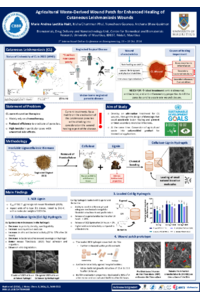
Introduction: The World Health Organization has raised the alarm concerning the burden of cutaneous leishmaniasis (CL), which mainly affects poor marginalized communities globally, causing non-healing ulcerated wounds that leave stigmatizing scars. Secondary bacterial infections highly hinder the healing process, making patients more vulnerable to other diseases. This study aims to develop wound dressings that accelerate healing while preventing secondary infections using sugarcane bagasse lignocellulosic biomass, which is abundant in Mauritius. This approach shifts the focus from merely eradicating Leishmania parasites to improving wound healing in CL patients.
Methods: Cellulose and lignin were extracted using a single cost-effective protocol, blended in varying ratios and chemically crosslinked to form soft hydrogels (Cel-lig). Their physicochemical properties, biocompatibility with murine cells and antibacterial activity were evaluated. The optimal hydrogel was then loaded with eugenol (EUG) and berberine (BER), respectively, to enhance its biological activities. The in vitro biocompatibility of the loaded scaffolds was tested with mouse fibroblasts (L929) and macrophages (RAW 264.7), and the production of a pro-inflammatory cytokine (TNF-α) was determined. Additionally, the antibacterial activity of the loaded hydrogels was tested against a representative of the common bacteria isolated from CL wounds.
Results and Discussion: The Cel-lig 70:30 hydrogel possessed adequate surface stiffness for the adhesion and migration of the L929 cells in vitro and antibacterial activity owing to lignin’s intrinsic antimicrobial properties. Loading of EUG and BER into Cel-lig 70:30 did not alter the hydrogel’s physicochemical characteristics. The hydrogels did not trigger high production levels of TNF-α from the RAW 264.7 macrophages and showcased significant antibacterial activity against Gram-positive and Gram-negative bacteria, with the 24-hour growth reduction percentages ranging from 61 to 79%.
Conclusion: Among all the hydrogels tested, the Cel-lig 70:30 hydrogels loaded with eugenol and berberine, respectively, demonstrated the best attributes for advanced testing and for conversion into a wound patch for direct use on CL wounds.
Keywords
Biomaterials Engineering
Tissue Engineering
Leishmaniasis
Wound Healing
Poster
IOCBE 2024_poster_sciforum-097158.pdf
Copper-based Nanovaccines for Disease Control in Plants
Computational design of plasmonic nano-biosensor based on metamaterial structure for early detection of liver cancer