Event submissions
Published
This submission belongs to the session 6. Biochemical Engineering of the event The 1st International Online Conference on Bioengineering
Published date
11 Oct, 2024
Academic Editor
'%3e%3cpath%20d='M12.6657%2010.9104C12.4185%2010.325%2012.0599%209.79327%2011.6097%209.34482C11.1609%208.89508%2010.6293%208.5365%2010.0442%208.28888C10.0389%208.28626%2010.0337%208.28495%2010.0285%208.28233C10.8446%207.69279%2011.3752%206.73249%2011.3752%205.64904C11.3752%203.8542%209.92103%202.39999%208.1262%202.39999C6.33136%202.39999%204.87715%203.8542%204.87715%205.64904C4.87715%206.73249%205.40774%207.69279%206.22393%208.28364C6.21869%208.28626%206.21345%208.28757%206.20821%208.29019C5.62129%208.5378%205.09463%208.89284%204.64265%209.34613C4.1929%209.79493%203.83432%2010.3266%203.58671%2010.9117C3.34345%2011.4845%203.21226%2012.0987%203.20023%2012.7209C3.19988%2012.7349%203.20233%2012.7488%203.20744%2012.7619C3.21255%2012.7749%203.22022%2012.7867%203.22998%2012.7968C3.23975%2012.8068%203.25142%2012.8147%203.26431%2012.8202C3.2772%2012.8256%203.29105%2012.8284%203.30504%2012.8284H4.09109C4.14874%2012.8284%204.19459%2012.7825%204.1959%2012.7262C4.2221%2011.7148%204.62823%2010.7676%205.34617%2010.0497C6.08899%209.30683%207.0755%208.89808%208.1262%208.89808C9.17689%208.89808%2010.1634%209.30683%2010.9062%2010.0497C11.6242%2010.7676%2012.0303%2011.7148%2012.0565%2012.7262C12.0578%2012.7838%2012.1037%2012.8284%2012.1613%2012.8284H12.9474C12.9613%2012.8284%2012.9752%2012.8256%2012.9881%2012.8202C13.001%2012.8147%2013.0126%2012.8068%2013.0224%2012.7968C13.0322%2012.7867%2013.0398%2012.7749%2013.0449%2012.7619C13.0501%2012.7488%2013.0525%2012.7349%2013.0522%2012.7209C13.0391%2012.0947%2012.9094%2011.4855%2012.6657%2010.9104ZM8.1262%207.9024C7.52486%207.9024%206.9589%207.6679%206.53312%207.24211C6.10733%206.81633%205.87283%206.25037%205.87283%205.64904C5.87283%205.0477%206.10733%204.48174%206.53312%204.05596C6.9589%203.63018%207.52486%203.39567%208.1262%203.39567C8.72753%203.39567%209.29349%203.63018%209.71927%204.05596C10.1451%204.48174%2010.3796%205.0477%2010.3796%205.64904C10.3796%206.25037%2010.1451%206.81633%209.71927%207.24211C9.29349%207.6679%208.72753%207.9024%208.1262%207.9024Z'%20fill='%235D1EE1'/%3e%3c/g%3e%3c/svg%3e) Liang Luo
Liang LuoCitation
Houria Bouabane, Khedoudja Kanoun, Boumediene Meddah, Antibacterial effects of the Algerian Tetraclinis articulata leaf extract against Klebsiella pneumoniae, in Proceedings of The 1st International Online Conference on Bioengineering, 16 October–18 October 2024, MDPI: Basel, Switzerland
Share
Email
Facebook
Twitter
LinkedIn
Antibacterial effects of the Algerian Tetraclinis articulata leaf extract against Klebsiella pneumoniae
'%3e%3cpath%20d='M12.6647%2010.9104C12.4176%2010.325%2012.0589%209.7933%2011.6088%209.34485C11.16%208.89511%2010.6283%208.53653%2010.0432%208.28891C10.038%208.28629%2010.0327%208.28498%2010.0275%208.28236C10.8437%207.69282%2011.3743%206.73252%2011.3743%205.64907C11.3743%203.85423%209.92005%202.40002%208.12522%202.40002C6.33038%202.40002%204.87618%203.85423%204.87618%205.64907C4.87618%206.73252%205.40677%207.69282%206.22296%208.28367C6.21772%208.28629%206.21248%208.2876%206.20724%208.29022C5.62031%208.53783%205.09365%208.89287%204.64167%209.34616C4.19192%209.79496%203.83334%2010.3266%203.58573%2010.9117C3.34247%2011.4846%203.21128%2012.0987%203.19925%2012.721C3.1989%2012.735%203.20135%2012.7489%203.20646%2012.7619C3.21157%2012.7749%203.21924%2012.7868%203.22901%2012.7968C3.23877%2012.8068%203.25045%2012.8148%203.26334%2012.8202C3.27623%2012.8256%203.29007%2012.8284%203.30406%2012.8284H4.09012C4.14776%2012.8284%204.19362%2012.7825%204.19493%2012.7262C4.22113%2011.7148%204.62726%2010.7676%205.34519%2010.0497C6.08802%209.30686%207.07452%208.89811%208.12522%208.89811C9.17592%208.89811%2010.1624%209.30686%2010.9052%2010.0497C11.6232%2010.7676%2012.0293%2011.7148%2012.0555%2012.7262C12.0568%2012.7839%2012.1027%2012.8284%2012.1603%2012.8284H12.9464C12.9604%2012.8284%2012.9742%2012.8256%2012.9871%2012.8202C13%2012.8148%2013.0117%2012.8068%2013.0214%2012.7968C13.0312%2012.7868%2013.0389%2012.7749%2013.044%2012.7619C13.0491%2012.7489%2013.0515%2012.735%2013.0512%2012.721C13.0381%2012.0947%2012.9084%2011.4856%2012.6647%2010.9104ZM8.12522%207.90243C7.52388%207.90243%206.95792%207.66793%206.53214%207.24215C6.10636%206.81636%205.87185%206.2504%205.87185%205.64907C5.87185%205.04773%206.10636%204.48177%206.53214%204.05599C6.95792%203.63021%207.52388%203.3957%208.12522%203.3957C8.72655%203.3957%209.29252%203.63021%209.7183%204.05599C10.1441%204.48177%2010.3786%205.04773%2010.3786%205.64907C10.3786%206.2504%2010.1441%206.81636%209.7183%207.24215C9.29252%207.66793%208.72655%207.90243%208.12522%207.90243Z'%20fill='%235D1EE1'/%3e%3c/g%3e%3c/svg%3e)
Houria Bouabane 1
Khedoudja Kanoun 2
Boumediene Meddah 3
1. Faculty of Nature and Life Science, Environment departement, Laboratory of Molecular Microbiology Health and Proteomics, Rectorat Ex ITMA, BP 89 Sidi-Belabbes, Algeria.
2. Faculty of Nature and Life Science, Biology departement, Laboratory of Molecular Microbiology Health and Proteomics, Rectorat Ex ITMA, BP 89 Sidi-Belabbes, Algeria.
3. Faculty of Nature and Life Science, Biology departement, Laboratory of Research, Bioconversion, Engineering Microbiology and Health Safety, BP 305 Mamounia Road, Mascara Algeria.
Abstract
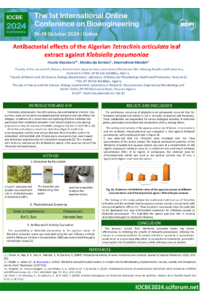
Medicinal plant extracts, rich in bioactive compounds like alkaloids, flavonoids, and terpenoids, exhibit diverse biological activities and are increasingly researched for pharmaceutical use. Algeria, abundant in medicinal plants, includes Tetraclinis articulata from the Cupressaceae family, traditionally used to treat various diseases due to its potent bioactive compounds. The leaves of T. articulata are especially valued for their therapeutic properties in Algerian traditional medicine. This study aimed to assess the antibacterial activity of an aqueous extract from T. articulata leaves against Klebsiella pneumoniae, alongside phytochemical analysis. The plant extracts were prepared by decoction; the phenolic compounds and flavonoids were screened using FeCl3 and Shinoda tests, respectively. The antibacterial activity was evaluated using the agar well method with Chloramphenicol as the reference antibiotic, and the Minimum Inhibitory Concentration (MIC) was determined using the broth microdilution method. Preliminary phytochemical screening revealed that the extract from the leaves of T. articulata is rich in phenolic compounds and flavonoids. The aqueous extract of T. articulata leaves exhibited significant inhibition of K. pneumoniae growth at a concentration of 200 mg/ml with an inhibition zone of 11 ± 0.00 mm and MIC = 25 mg/ml . This extract demonstrated efficacy in inhibiting the growth of K. pneumoniae. The use of the aqueous extract of T. articulata as an antibiotic to combat infections caused by K. pneumoniae could offer a natural and potentially effective alternative to traditional treatments, while helping to reduce the risk of antibiotic resistance.
Keywords
T. articulata
Antibacterial activity
K. pneumoniae
phenolic compounds
flavonoids
Poster
BOUABANE HOURIA IOCBE2024 IOCBE2024.pdf
Cell Sorting Enhances the Training Efficiency of AI-Driven Automated Cell Morphology Analysers
A Comparative Developed Method for Visible (VIS) Spectrophotometric Determination and Statistical Analysis of Ibuprofen in Two Pharmaceuticals