Event submissions
Published
This submission belongs to the session 3. Biomedical Biomaterials of the event The 1st International Online Conference on Bioengineering
Published date
11 Oct, 2024
Academic Editor
'%3e%3cpath%20d='M12.6657%2010.9104C12.4185%2010.325%2012.0599%209.79327%2011.6097%209.34482C11.1609%208.89508%2010.6293%208.5365%2010.0442%208.28888C10.0389%208.28626%2010.0337%208.28495%2010.0285%208.28233C10.8446%207.69279%2011.3752%206.73249%2011.3752%205.64904C11.3752%203.8542%209.92103%202.39999%208.1262%202.39999C6.33136%202.39999%204.87715%203.8542%204.87715%205.64904C4.87715%206.73249%205.40774%207.69279%206.22393%208.28364C6.21869%208.28626%206.21345%208.28757%206.20821%208.29019C5.62129%208.5378%205.09463%208.89284%204.64265%209.34613C4.1929%209.79493%203.83432%2010.3266%203.58671%2010.9117C3.34345%2011.4845%203.21226%2012.0987%203.20023%2012.7209C3.19988%2012.7349%203.20233%2012.7488%203.20744%2012.7619C3.21255%2012.7749%203.22022%2012.7867%203.22998%2012.7968C3.23975%2012.8068%203.25142%2012.8147%203.26431%2012.8202C3.2772%2012.8256%203.29105%2012.8284%203.30504%2012.8284H4.09109C4.14874%2012.8284%204.19459%2012.7825%204.1959%2012.7262C4.2221%2011.7148%204.62823%2010.7676%205.34617%2010.0497C6.08899%209.30683%207.0755%208.89808%208.1262%208.89808C9.17689%208.89808%2010.1634%209.30683%2010.9062%2010.0497C11.6242%2010.7676%2012.0303%2011.7148%2012.0565%2012.7262C12.0578%2012.7838%2012.1037%2012.8284%2012.1613%2012.8284H12.9474C12.9613%2012.8284%2012.9752%2012.8256%2012.9881%2012.8202C13.001%2012.8147%2013.0126%2012.8068%2013.0224%2012.7968C13.0322%2012.7867%2013.0398%2012.7749%2013.0449%2012.7619C13.0501%2012.7488%2013.0525%2012.7349%2013.0522%2012.7209C13.0391%2012.0947%2012.9094%2011.4855%2012.6657%2010.9104ZM8.1262%207.9024C7.52486%207.9024%206.9589%207.6679%206.53312%207.24211C6.10733%206.81633%205.87283%206.25037%205.87283%205.64904C5.87283%205.0477%206.10733%204.48174%206.53312%204.05596C6.9589%203.63018%207.52486%203.39567%208.1262%203.39567C8.72753%203.39567%209.29349%203.63018%209.71927%204.05596C10.1451%204.48174%2010.3796%205.0477%2010.3796%205.64904C10.3796%206.25037%2010.1451%206.81633%209.71927%207.24211C9.29349%207.6679%208.72753%207.9024%208.1262%207.9024Z'%20fill='%235D1EE1'/%3e%3c/g%3e%3c/svg%3e) Gary Bowlin
Gary BowlinCitation
Farah Hamandi, Evan Helton, Mikayla Padgitt, Tarun Goswami, Enhancing Cross-Linked UHMWPE Knee Prosthesis Design: A Comprehensive Approach to Assessment and Optimization, in Proceedings of The 1st International Online Conference on Bioengineering, 16 October–18 October 2024, MDPI: Basel, Switzerland
Share
Email
Facebook
Twitter
LinkedIn
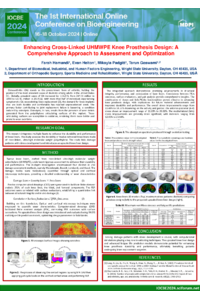
Enhancing Cross-Linked UHMWPE Knee Prosthesis Design: A Comprehensive Approach to Assessment and Optimization
'%3e%3cpath%20d='M12.6647%2010.9104C12.4176%2010.325%2012.0589%209.7933%2011.6088%209.34485C11.16%208.89511%2010.6283%208.53653%2010.0432%208.28891C10.038%208.28629%2010.0327%208.28498%2010.0275%208.28236C10.8437%207.69282%2011.3743%206.73252%2011.3743%205.64907C11.3743%203.85423%209.92005%202.40002%208.12522%202.40002C6.33038%202.40002%204.87618%203.85423%204.87618%205.64907C4.87618%206.73252%205.40677%207.69282%206.22296%208.28367C6.21772%208.28629%206.21248%208.2876%206.20724%208.29022C5.62031%208.53783%205.09365%208.89287%204.64167%209.34616C4.19192%209.79496%203.83334%2010.3266%203.58573%2010.9117C3.34247%2011.4846%203.21128%2012.0987%203.19925%2012.721C3.1989%2012.735%203.20135%2012.7489%203.20646%2012.7619C3.21157%2012.7749%203.21924%2012.7868%203.22901%2012.7968C3.23877%2012.8068%203.25045%2012.8148%203.26334%2012.8202C3.27623%2012.8256%203.29007%2012.8284%203.30406%2012.8284H4.09012C4.14776%2012.8284%204.19362%2012.7825%204.19493%2012.7262C4.22113%2011.7148%204.62726%2010.7676%205.34519%2010.0497C6.08802%209.30686%207.07452%208.89811%208.12522%208.89811C9.17592%208.89811%2010.1624%209.30686%2010.9052%2010.0497C11.6232%2010.7676%2012.0293%2011.7148%2012.0555%2012.7262C12.0568%2012.7839%2012.1027%2012.8284%2012.1603%2012.8284H12.9464C12.9604%2012.8284%2012.9742%2012.8256%2012.9871%2012.8202C13%2012.8148%2013.0117%2012.8068%2013.0214%2012.7968C13.0312%2012.7868%2013.0389%2012.7749%2013.044%2012.7619C13.0491%2012.7489%2013.0515%2012.735%2013.0512%2012.721C13.0381%2012.0947%2012.9084%2011.4856%2012.6647%2010.9104ZM8.12522%207.90243C7.52388%207.90243%206.95792%207.66793%206.53214%207.24215C6.10636%206.81636%205.87185%206.2504%205.87185%205.64907C5.87185%205.04773%206.10636%204.48177%206.53214%204.05599C6.95792%203.63021%207.52388%203.3957%208.12522%203.3957C8.72655%203.3957%209.29252%203.63021%209.7183%204.05599C10.1441%204.48177%2010.3786%205.04773%2010.3786%205.64907C10.3786%206.2504%2010.1441%206.81636%209.7183%207.24215C9.29252%207.66793%208.72655%207.90243%208.12522%207.90243Z'%20fill='%235D1EE1'/%3e%3c/g%3e%3c/svg%3e)
Farah Hamandi 1
Evan Helton 1
Mikayla Padgitt 1
Tarun Goswami 1
1. Department of Biomedical, Industrial, and Human Factors Engineering, Wright State University, Dayton, OH 45435, USA
Abstract
Introduction: Osteoarthritis (OA) is a major cause of disability, often necessitating knee replacement surgery. The longevity and effectiveness of knee implants are crucial, with loosening being a primary cause of joint replacement failure, often induced by osteolysis from wear debris on polyethylene articulating surfaces. This research focuses on enhancing the durability and performance of knee liners, critical components in knee prosthetics. This study evaluates the durability of twenty retrieved knee liners made of cross-linked, ultra-high-molecular-weight polyethylene (UHMWPE) and correlates damage patterns with stress development. Additionally, an upscaled knee liner design is introduced. Methods: The retrieved UHMWPE knee liners underwent rigorous assessment using four in vivo damage assessment methods. Optical and confocal microscopy techniques were employed to quantify wear characteristics. Computer-aided drawing (CAD) facilitated finite element analysis (FEA), correlating FEA outcomes with surface evaluations. An upscaled knee liner design was introduced and evaluated using ANSYS and fatigue life prediction models, optimizing design parameters in SolidWorks. Results: This study shows advancements in the structural integrity, performance, and optimization of knee liners. Correlations between FEA outcomes, surface evaluations, and gait analysis provide comprehensive insights. The integrated approach, combining in vivo damage assessment and computational simulation, proves effective in advancing knee prosthesis design. Conclusion: Linking damage patterns with stress development is crucial, with computational simulations playing a key role in validating techniques. The upscaled knee liner design and advanced fatigue life prediction models demonstrate potential for enhancing knee prosthesis durability and performance, ultimately benefiting patients undergoing knee replacement surgeries.
Keywords
Osteoarthritis
Knee replacement surgery
Joint replacement failure
Loosening
Polyethylene articulating surfaces
Knee liners
Cross-linked UHMWPE
Damage patterns
In vivo damage assessment
Finite element analysis (FEA)
Surface evaluations
Computati
Poster
093824 Farah Hamandi.pdf
Sustainable Pharmaceutical Development Utilizing Vigna Mungo Polymer Microbeads
Molecular Diversity Analysis of Sweet Sorghum [Sorghum Bicolor (L.) Moench] Collections of Ethiopia as revealed by Microsatellite Markers