Event submissions
Published
This submission belongs to the session 3. Biomedical Biomaterials of the event The 1st International Online Conference on Bioengineering
Published date
11 Oct, 2024
Academic Editor
'%3e%3cpath%20d='M12.6657%2010.9104C12.4185%2010.325%2012.0599%209.79327%2011.6097%209.34482C11.1609%208.89508%2010.6293%208.5365%2010.0442%208.28888C10.0389%208.28626%2010.0337%208.28495%2010.0285%208.28233C10.8446%207.69279%2011.3752%206.73249%2011.3752%205.64904C11.3752%203.8542%209.92103%202.39999%208.1262%202.39999C6.33136%202.39999%204.87715%203.8542%204.87715%205.64904C4.87715%206.73249%205.40774%207.69279%206.22393%208.28364C6.21869%208.28626%206.21345%208.28757%206.20821%208.29019C5.62129%208.5378%205.09463%208.89284%204.64265%209.34613C4.1929%209.79493%203.83432%2010.3266%203.58671%2010.9117C3.34345%2011.4845%203.21226%2012.0987%203.20023%2012.7209C3.19988%2012.7349%203.20233%2012.7488%203.20744%2012.7619C3.21255%2012.7749%203.22022%2012.7867%203.22998%2012.7968C3.23975%2012.8068%203.25142%2012.8147%203.26431%2012.8202C3.2772%2012.8256%203.29105%2012.8284%203.30504%2012.8284H4.09109C4.14874%2012.8284%204.19459%2012.7825%204.1959%2012.7262C4.2221%2011.7148%204.62823%2010.7676%205.34617%2010.0497C6.08899%209.30683%207.0755%208.89808%208.1262%208.89808C9.17689%208.89808%2010.1634%209.30683%2010.9062%2010.0497C11.6242%2010.7676%2012.0303%2011.7148%2012.0565%2012.7262C12.0578%2012.7838%2012.1037%2012.8284%2012.1613%2012.8284H12.9474C12.9613%2012.8284%2012.9752%2012.8256%2012.9881%2012.8202C13.001%2012.8147%2013.0126%2012.8068%2013.0224%2012.7968C13.0322%2012.7867%2013.0398%2012.7749%2013.0449%2012.7619C13.0501%2012.7488%2013.0525%2012.7349%2013.0522%2012.7209C13.0391%2012.0947%2012.9094%2011.4855%2012.6657%2010.9104ZM8.1262%207.9024C7.52486%207.9024%206.9589%207.6679%206.53312%207.24211C6.10733%206.81633%205.87283%206.25037%205.87283%205.64904C5.87283%205.0477%206.10733%204.48174%206.53312%204.05596C6.9589%203.63018%207.52486%203.39567%208.1262%203.39567C8.72753%203.39567%209.29349%203.63018%209.71927%204.05596C10.1451%204.48174%2010.3796%205.0477%2010.3796%205.64904C10.3796%206.25037%2010.1451%206.81633%209.71927%207.24211C9.29349%207.6679%208.72753%207.9024%208.1262%207.9024Z'%20fill='%235D1EE1'/%3e%3c/g%3e%3c/svg%3e) Gary Bowlin
Gary BowlinCitation
Anna Melnyk, Magdalena Górecka, Anna Ronowska, Aleksandra Mielewczyk-Gryń, Marcin Wekwejt, REFINING MAGNESIUM PHOSPHATE CEMENT PROPERTIES: INFLUENCE OF MG-P AND P-L RATIOS ON BIOMEDICAL EFFICACY, in Proceedings of The 1st International Online Conference on Bioengineering, 16 October–18 October 2024, MDPI: Basel, Switzerland
Share
Email
Facebook
Twitter
LinkedIn
REFINING MAGNESIUM PHOSPHATE CEMENT PROPERTIES: INFLUENCE OF MG-P AND P-L RATIOS ON BIOMEDICAL EFFICACY
'%3e%3cpath%20d='M12.6647%2010.9104C12.4176%2010.325%2012.0589%209.7933%2011.6088%209.34485C11.16%208.89511%2010.6283%208.53653%2010.0432%208.28891C10.038%208.28629%2010.0327%208.28498%2010.0275%208.28236C10.8437%207.69282%2011.3743%206.73252%2011.3743%205.64907C11.3743%203.85423%209.92005%202.40002%208.12522%202.40002C6.33038%202.40002%204.87618%203.85423%204.87618%205.64907C4.87618%206.73252%205.40677%207.69282%206.22296%208.28367C6.21772%208.28629%206.21248%208.2876%206.20724%208.29022C5.62031%208.53783%205.09365%208.89287%204.64167%209.34616C4.19192%209.79496%203.83334%2010.3266%203.58573%2010.9117C3.34247%2011.4846%203.21128%2012.0987%203.19925%2012.721C3.1989%2012.735%203.20135%2012.7489%203.20646%2012.7619C3.21157%2012.7749%203.21924%2012.7868%203.22901%2012.7968C3.23877%2012.8068%203.25045%2012.8148%203.26334%2012.8202C3.27623%2012.8256%203.29007%2012.8284%203.30406%2012.8284H4.09012C4.14776%2012.8284%204.19362%2012.7825%204.19493%2012.7262C4.22113%2011.7148%204.62726%2010.7676%205.34519%2010.0497C6.08802%209.30686%207.07452%208.89811%208.12522%208.89811C9.17592%208.89811%2010.1624%209.30686%2010.9052%2010.0497C11.6232%2010.7676%2012.0293%2011.7148%2012.0555%2012.7262C12.0568%2012.7839%2012.1027%2012.8284%2012.1603%2012.8284H12.9464C12.9604%2012.8284%2012.9742%2012.8256%2012.9871%2012.8202C13%2012.8148%2013.0117%2012.8068%2013.0214%2012.7968C13.0312%2012.7868%2013.0389%2012.7749%2013.044%2012.7619C13.0491%2012.7489%2013.0515%2012.735%2013.0512%2012.721C13.0381%2012.0947%2012.9084%2011.4856%2012.6647%2010.9104ZM8.12522%207.90243C7.52388%207.90243%206.95792%207.66793%206.53214%207.24215C6.10636%206.81636%205.87185%206.2504%205.87185%205.64907C5.87185%205.04773%206.10636%204.48177%206.53214%204.05599C6.95792%203.63021%207.52388%203.3957%208.12522%203.3957C8.72655%203.3957%209.29252%203.63021%209.7183%204.05599C10.1441%204.48177%2010.3786%205.04773%2010.3786%205.64907C10.3786%206.2504%2010.1441%206.81636%209.7183%207.24215C9.29252%207.66793%208.72655%207.90243%208.12522%207.90243Z'%20fill='%235D1EE1'/%3e%3c/g%3e%3c/svg%3e)
Anna Melnyk 1
Magdalena Górecka 1
Anna Ronowska 2

Aleksandra Mielewczyk-Gryń 3

Marcin Wekwejt 4
1. Scientific Club ‘Materials in Medicine, Advanced Materials Centre, Gdańsk University of Technology, Gdańsk, Poland
2. Chair of Clinical Biochemistry, Department of Laboratory Medicine, Medical University of Gdańsk, Gdańsk, Poland
3. Department of Ceramics, Faculty of Applied Physics and Mathematics, Gdańsk University of Technology, Gdańsk, Poland
4. Department of Biomaterials Technology, Faculty of Mechanical Engineering and Ship Technology, Gdansk University of Technology, Gdańsk, Poland
Abstract
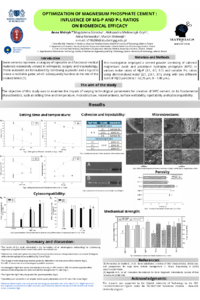
Bone cements represent a category of injectable and functional medical materials extensively utilized in orthopedic surgery and traumatology. These materials are formulated by combining a powder and a liquid to create a moldable paste, which subsequently hardens at the site of the treated defect. Magnesium phosphate cements (MPCs) demonstrate superior initial mechanical properties, reduced setting times, and a more favorable bioresorption rate compared to currently used calcium phosphate cements, making them notably advantageous.
The objective of this study was to examine the impact of varying technological parameters for the creation of MPC cement on its fundamental characteristics, such as setting time and temperature, microstructure, microhardness, surface wettability, injectability, and cytocompatibility. The investigation employed a cement powder consisting of calcined magnesium oxide and potassium hydrogen phosphate in various molar ratios of Mg-P (3:1, 4:1, and 5:1) and variable P-L ratios using demineralized water (2:1, 2.5:1, and 3:1), along with two different sizes of MgO particles.
The results of this study led to the formulation of an advantageous methodology for synthesizing magnesium potassium phosphate cements tailored for biomedical uses. It was observed that each of the assessed parameters substantially impacted the main properties of the material, including microstructure, hydraulic reaction, k-struvite crystallization, mechanical properties, and cytocompatibility. Our research verified that through the adjustment of optimal magnesium-to-phosphate and powder-to-liquid ratios, it is feasible to engineer a functional cement designed specifically for bone repair applications.
Acknowledgement
This research was supported by the Gdańsk University of Technology by the DEC -14/2022/IDUB/III.4.1/Tgrant under the TECHNETIUM 'Excellence Initiative – Research University program.
Keywords
Bone cements
Magnesium Phosphate
Technology Optimization
Mg-P and P-L ratios
Poster
100766.pdf
Effective Splicing Correction of SMN2 Gene in SMA Cells after Delivery of RNA Interpolyelectrolyte Complexes
Cardiovascular Health Analysis and Decision Making Using Artificial Intelligence