Event submissions
Published
This submission belongs to the session 3. Biomedical Biomaterials of the event The 1st International Online Conference on Bioengineering
Published date
11 Oct, 2024
Academic Editor
'%3e%3cpath%20d='M12.6657%2010.9104C12.4185%2010.325%2012.0599%209.79327%2011.6097%209.34482C11.1609%208.89508%2010.6293%208.5365%2010.0442%208.28888C10.0389%208.28626%2010.0337%208.28495%2010.0285%208.28233C10.8446%207.69279%2011.3752%206.73249%2011.3752%205.64904C11.3752%203.8542%209.92103%202.39999%208.1262%202.39999C6.33136%202.39999%204.87715%203.8542%204.87715%205.64904C4.87715%206.73249%205.40774%207.69279%206.22393%208.28364C6.21869%208.28626%206.21345%208.28757%206.20821%208.29019C5.62129%208.5378%205.09463%208.89284%204.64265%209.34613C4.1929%209.79493%203.83432%2010.3266%203.58671%2010.9117C3.34345%2011.4845%203.21226%2012.0987%203.20023%2012.7209C3.19988%2012.7349%203.20233%2012.7488%203.20744%2012.7619C3.21255%2012.7749%203.22022%2012.7867%203.22998%2012.7968C3.23975%2012.8068%203.25142%2012.8147%203.26431%2012.8202C3.2772%2012.8256%203.29105%2012.8284%203.30504%2012.8284H4.09109C4.14874%2012.8284%204.19459%2012.7825%204.1959%2012.7262C4.2221%2011.7148%204.62823%2010.7676%205.34617%2010.0497C6.08899%209.30683%207.0755%208.89808%208.1262%208.89808C9.17689%208.89808%2010.1634%209.30683%2010.9062%2010.0497C11.6242%2010.7676%2012.0303%2011.7148%2012.0565%2012.7262C12.0578%2012.7838%2012.1037%2012.8284%2012.1613%2012.8284H12.9474C12.9613%2012.8284%2012.9752%2012.8256%2012.9881%2012.8202C13.001%2012.8147%2013.0126%2012.8068%2013.0224%2012.7968C13.0322%2012.7867%2013.0398%2012.7749%2013.0449%2012.7619C13.0501%2012.7488%2013.0525%2012.7349%2013.0522%2012.7209C13.0391%2012.0947%2012.9094%2011.4855%2012.6657%2010.9104ZM8.1262%207.9024C7.52486%207.9024%206.9589%207.6679%206.53312%207.24211C6.10733%206.81633%205.87283%206.25037%205.87283%205.64904C5.87283%205.0477%206.10733%204.48174%206.53312%204.05596C6.9589%203.63018%207.52486%203.39567%208.1262%203.39567C8.72753%203.39567%209.29349%203.63018%209.71927%204.05596C10.1451%204.48174%2010.3796%205.0477%2010.3796%205.64904C10.3796%206.25037%2010.1451%206.81633%209.71927%207.24211C9.29349%207.6679%208.72753%207.9024%208.1262%207.9024Z'%20fill='%235D1EE1'/%3e%3c/g%3e%3c/svg%3e) Gary Bowlin
Gary BowlinCitation
Ana-Maria Roman, Gheorghe Bădărău, Bogdan Istrate, Nicanor Cimpoeșu, Romeu Chelariu, Mihai Axinte, Adrian Alexandru, Bogdan Pricop, Ramona Cimpoeșu, Mihai-Adrian Bernevig, In vitro analysis of antibacterial FeMnSi-Cu biodegradable alloy in Simulated Body Fluid, in Proceedings of The 1st International Online Conference on Bioengineering, 16 October–18 October 2024, MDPI: Basel, Switzerland
Share
Email
Facebook
Twitter
LinkedIn
In vitro analysis of antibacterial FeMnSi-Cu biodegradable alloy in Simulated Body Fluid
'%3e%3cpath%20d='M12.6647%2010.9104C12.4176%2010.325%2012.0589%209.7933%2011.6088%209.34485C11.16%208.89511%2010.6283%208.53653%2010.0432%208.28891C10.038%208.28629%2010.0327%208.28498%2010.0275%208.28236C10.8437%207.69282%2011.3743%206.73252%2011.3743%205.64907C11.3743%203.85423%209.92005%202.40002%208.12522%202.40002C6.33038%202.40002%204.87618%203.85423%204.87618%205.64907C4.87618%206.73252%205.40677%207.69282%206.22296%208.28367C6.21772%208.28629%206.21248%208.2876%206.20724%208.29022C5.62031%208.53783%205.09365%208.89287%204.64167%209.34616C4.19192%209.79496%203.83334%2010.3266%203.58573%2010.9117C3.34247%2011.4846%203.21128%2012.0987%203.19925%2012.721C3.1989%2012.735%203.20135%2012.7489%203.20646%2012.7619C3.21157%2012.7749%203.21924%2012.7868%203.22901%2012.7968C3.23877%2012.8068%203.25045%2012.8148%203.26334%2012.8202C3.27623%2012.8256%203.29007%2012.8284%203.30406%2012.8284H4.09012C4.14776%2012.8284%204.19362%2012.7825%204.19493%2012.7262C4.22113%2011.7148%204.62726%2010.7676%205.34519%2010.0497C6.08802%209.30686%207.07452%208.89811%208.12522%208.89811C9.17592%208.89811%2010.1624%209.30686%2010.9052%2010.0497C11.6232%2010.7676%2012.0293%2011.7148%2012.0555%2012.7262C12.0568%2012.7839%2012.1027%2012.8284%2012.1603%2012.8284H12.9464C12.9604%2012.8284%2012.9742%2012.8256%2012.9871%2012.8202C13%2012.8148%2013.0117%2012.8068%2013.0214%2012.7968C13.0312%2012.7868%2013.0389%2012.7749%2013.044%2012.7619C13.0491%2012.7489%2013.0515%2012.735%2013.0512%2012.721C13.0381%2012.0947%2012.9084%2011.4856%2012.6647%2010.9104ZM8.12522%207.90243C7.52388%207.90243%206.95792%207.66793%206.53214%207.24215C6.10636%206.81636%205.87185%206.2504%205.87185%205.64907C5.87185%205.04773%206.10636%204.48177%206.53214%204.05599C6.95792%203.63021%207.52388%203.3957%208.12522%203.3957C8.72655%203.3957%209.29252%203.63021%209.7183%204.05599C10.1441%204.48177%2010.3786%205.04773%2010.3786%205.64907C10.3786%206.2504%2010.1441%206.81636%209.7183%207.24215C9.29252%207.66793%208.72655%207.90243%208.12522%207.90243Z'%20fill='%235D1EE1'/%3e%3c/g%3e%3c/svg%3e)
Ana-Maria Roman 1
Gheorghe Bădărău 1

Bogdan Istrate 2

Nicanor Cimpoeșu 1
Romeu Chelariu 1
Mihai Axinte 1
Adrian Alexandru 1

Bogdan Pricop 1

Ramona Cimpoeșu 1
Mihai-Adrian Bernevig 3
1. Department of Materials Science, Faculty of Materials Science and Engineering, “Gheorghe Asachi” Technical University of Iasi, 41 Prof. Dimitrie Mangeron Blvd., 700050 Iasi, Romania
2. Department of Mechanical Engineering, Mechatronics and Robotics, Faculty of Mechanical Engineering, Mechatronics and Robotics, “Gheorghe Asachi” Technical University of Iași, 43 Prof. Dimitrie Mangeron Blvd., 700050 Iași, Romania
3. Department of Materials Engineering and Industrial Safety, Faculty of Materials Science and Engineering, “Gheorghe Asachi” Technical University of Iasi, 67 Prof. Dimitrie Mangeron Blvd., 700050 Iasi, Romania
Abstract
Introduction
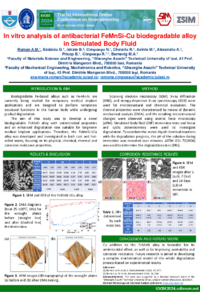
Biodegradable Fe-based alloys such as Fe-Mn-Si are currently being studied for temporary medical implant applications and are designed to perform temporary structural functions in the human body while undergoing gradual degradation. These alloys offer promising medical implant applications owing to their biocompatibility, degradability, and mechanical properties. A key challenge lies in balancing the mechanical properties with controlled degradation. Another important aspect is improved antimicrobial properties.
Methods
The aim of this study was to develop a novel biodegradable FeMnSi alloy with antimicrobial properties and an enhanced degradation rate suitable for long-term medical implant applications. Therefore, the FeMnSi-1Cu alloy was developed and investigated in both cast and hot-rolled states. Scanning electron microscopy (SEM), X-ray diffraction (XRD), and energy-dispersive X-ray spectroscopy (EDX) were used for microstructural and chemical evaluation. The thermal properties were characterized by means of dynamic mechanical analysis (DMA), and the resulting microstructural changes were observed using atomic force microscopy (AFM). Simulated body fluid (SBF) immersion tests and linear and cyclic potentiometry were used to investigate degradation. To correlate the metal–liquid chemical reactions with the degradation progress, the pH of the solution during immersion was recorded over minutes. ASTM G31-72(2004) was used to determine the degradation rates (DRs).
Results and discussion
Due to the applied thermomechanical stress, the AFM images revealed a slight change in the plate dimensions due to refinement. Generalized corrosion was identified, and an increase in mass was observed over the first 3-5 days. Despite the short immersion time and the DMA test, the samples showed a high degree of surface corrosion, which could affect their mechanical behavior under external loads.
Conclusions
The addition of Cu to the FeMnSi alloy is favorable for its antimicrobial effect, as well as for improving workability and corrosion resistance, which will encourage future studies on this alloy.
Keywords
FeMnSi-Cu antibacterial
biodegradable alloy
degradation rate
DMA
in vitro analysis
Poster
sciforum-100931.pdf
PCL and PLGA particles containing vitamins A and D for bone regeneration.
Non-Invasive Estimation of Metabolite Concentrations Using Infrared Thermal Imaging and Machine Learning