Event submissions
Published
This submission belongs to the session 5. Biosignal Processing of the event The 1st International Online Conference on Bioengineering
Published date
11 Oct, 2024
Academic Editor
'%3e%3cpath%20d='M12.6657%2010.9104C12.4185%2010.325%2012.0599%209.79327%2011.6097%209.34482C11.1609%208.89508%2010.6293%208.5365%2010.0442%208.28888C10.0389%208.28626%2010.0337%208.28495%2010.0285%208.28233C10.8446%207.69279%2011.3752%206.73249%2011.3752%205.64904C11.3752%203.8542%209.92103%202.39999%208.1262%202.39999C6.33136%202.39999%204.87715%203.8542%204.87715%205.64904C4.87715%206.73249%205.40774%207.69279%206.22393%208.28364C6.21869%208.28626%206.21345%208.28757%206.20821%208.29019C5.62129%208.5378%205.09463%208.89284%204.64265%209.34613C4.1929%209.79493%203.83432%2010.3266%203.58671%2010.9117C3.34345%2011.4845%203.21226%2012.0987%203.20023%2012.7209C3.19988%2012.7349%203.20233%2012.7488%203.20744%2012.7619C3.21255%2012.7749%203.22022%2012.7867%203.22998%2012.7968C3.23975%2012.8068%203.25142%2012.8147%203.26431%2012.8202C3.2772%2012.8256%203.29105%2012.8284%203.30504%2012.8284H4.09109C4.14874%2012.8284%204.19459%2012.7825%204.1959%2012.7262C4.2221%2011.7148%204.62823%2010.7676%205.34617%2010.0497C6.08899%209.30683%207.0755%208.89808%208.1262%208.89808C9.17689%208.89808%2010.1634%209.30683%2010.9062%2010.0497C11.6242%2010.7676%2012.0303%2011.7148%2012.0565%2012.7262C12.0578%2012.7838%2012.1037%2012.8284%2012.1613%2012.8284H12.9474C12.9613%2012.8284%2012.9752%2012.8256%2012.9881%2012.8202C13.001%2012.8147%2013.0126%2012.8068%2013.0224%2012.7968C13.0322%2012.7867%2013.0398%2012.7749%2013.0449%2012.7619C13.0501%2012.7488%2013.0525%2012.7349%2013.0522%2012.7209C13.0391%2012.0947%2012.9094%2011.4855%2012.6657%2010.9104ZM8.1262%207.9024C7.52486%207.9024%206.9589%207.6679%206.53312%207.24211C6.10733%206.81633%205.87283%206.25037%205.87283%205.64904C5.87283%205.0477%206.10733%204.48174%206.53312%204.05596C6.9589%203.63018%207.52486%203.39567%208.1262%203.39567C8.72753%203.39567%209.29349%203.63018%209.71927%204.05596C10.1451%204.48174%2010.3796%205.0477%2010.3796%205.64904C10.3796%206.25037%2010.1451%206.81633%209.71927%207.24211C9.29349%207.6679%208.72753%207.9024%208.1262%207.9024Z'%20fill='%235D1EE1'/%3e%3c/g%3e%3c/svg%3e) Andrea Cataldo
Andrea CataldoCitation
Andrea Di Credico, David Perpetuini, Pascal Izzicupo, Giulia Gaggi, Daniela Cardone, Arcangelo Merla, Claudia Rossi, Ines Bucci, Barbara Ghinassi, Angela Di Baldassarre, Non-Invasive Estimation of Metabolite Concentrations Using Infrared Thermal Imaging and Machine Learning, in Proceedings of The 1st International Online Conference on Bioengineering, 16 October–18 October 2024, MDPI: Basel, Switzerland
Share
Email
Facebook
Twitter
LinkedIn
Non-Invasive Estimation of Metabolite Concentrations Using Infrared Thermal Imaging and Machine Learning

Andrea Di Credico 1

David Perpetuini 2

Pascal Izzicupo 1
'%3e%3cpath%20d='M12.6647%2010.9104C12.4176%2010.325%2012.0589%209.7933%2011.6088%209.34485C11.16%208.89511%2010.6283%208.53653%2010.0432%208.28891C10.038%208.28629%2010.0327%208.28498%2010.0275%208.28236C10.8437%207.69282%2011.3743%206.73252%2011.3743%205.64907C11.3743%203.85423%209.92005%202.40002%208.12522%202.40002C6.33038%202.40002%204.87618%203.85423%204.87618%205.64907C4.87618%206.73252%205.40677%207.69282%206.22296%208.28367C6.21772%208.28629%206.21248%208.2876%206.20724%208.29022C5.62031%208.53783%205.09365%208.89287%204.64167%209.34616C4.19192%209.79496%203.83334%2010.3266%203.58573%2010.9117C3.34247%2011.4846%203.21128%2012.0987%203.19925%2012.721C3.1989%2012.735%203.20135%2012.7489%203.20646%2012.7619C3.21157%2012.7749%203.21924%2012.7868%203.22901%2012.7968C3.23877%2012.8068%203.25045%2012.8148%203.26334%2012.8202C3.27623%2012.8256%203.29007%2012.8284%203.30406%2012.8284H4.09012C4.14776%2012.8284%204.19362%2012.7825%204.19493%2012.7262C4.22113%2011.7148%204.62726%2010.7676%205.34519%2010.0497C6.08802%209.30686%207.07452%208.89811%208.12522%208.89811C9.17592%208.89811%2010.1624%209.30686%2010.9052%2010.0497C11.6232%2010.7676%2012.0293%2011.7148%2012.0555%2012.7262C12.0568%2012.7839%2012.1027%2012.8284%2012.1603%2012.8284H12.9464C12.9604%2012.8284%2012.9742%2012.8256%2012.9871%2012.8202C13%2012.8148%2013.0117%2012.8068%2013.0214%2012.7968C13.0312%2012.7868%2013.0389%2012.7749%2013.044%2012.7619C13.0491%2012.7489%2013.0515%2012.735%2013.0512%2012.721C13.0381%2012.0947%2012.9084%2011.4856%2012.6647%2010.9104ZM8.12522%207.90243C7.52388%207.90243%206.95792%207.66793%206.53214%207.24215C6.10636%206.81636%205.87185%206.2504%205.87185%205.64907C5.87185%205.04773%206.10636%204.48177%206.53214%204.05599C6.95792%203.63021%207.52388%203.3957%208.12522%203.3957C8.72655%203.3957%209.29252%203.63021%209.7183%204.05599C10.1441%204.48177%2010.3786%205.04773%2010.3786%205.64907C10.3786%206.2504%2010.1441%206.81636%209.7183%207.24215C9.29252%207.66793%208.72655%207.90243%208.12522%207.90243Z'%20fill='%235D1EE1'/%3e%3c/g%3e%3c/svg%3e)
Giulia Gaggi 1

Daniela Cardone 2

Arcangelo Merla 2

Claudia Rossi 3
Ines Bucci 1

Barbara Ghinassi 1
Angela Di Baldassarre 1
1. Department of Medicine and Aging Sciences, "G. D'Annunzio", University of Chieti-Pescara, 66100 Chieti, Italy
2. Department of Engineering and Geology, "G. D'Annunzio", University of Chieti-Pescara, 65127 Pescara, Italy
3. Department of Innovative Technologies in Medicine and Dentistry, “G. d'Annunzio” University of Chieti-Pescara, 66100 Chieti, Italy
Abstract
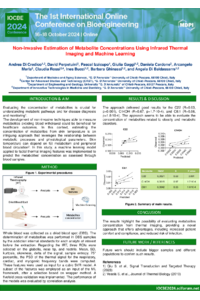
Evaluating metabolites concentration is crucial for understanding metabolic pathways and for disease diagnosis and monitoring. The development of non-invasive techniques able to measure metabolites avoiding blood withdrawal could be beneficial for healthcare outcomes. In this context, estimating the concentration of metabolites from skin temperature is an intriguing approach that leverages the relationship between metabolic processes and physiological parameters. Skin temperature can depend on fat metabolism and peripheral blood circulation. In this study, a machine learning model applied to facial thermal imaging features was implemented to predict the metabolites’ concentration as assessed through blood samples.
Whole blood was collected as a dried blood spot (DBS). The determination of metabolites was performed in DBS samples by the addiction internal standards for each analyte of interest before the extraction. Regarding the IRT recordings, three ROIs were selected on the glabella, nose tip, and nostrils. The following features were computed from the temperature time course of each ROI to feed the machineries: mean value, standard deviation, kurtosis, skewness, delta of the signal, sample entropy, 75° percentile, the PSD of the thermal signal for the respiratory, cardiac, and myogenic frequency bands. These features were used as input for a cubic SVR model. A subset of the features was employed as an input of the ML framework, after a selection based on wrapper method. A fivefold cross-validation was implemented. The performance of the models was evaluated by correlation analysis.
The approach delivered good results for the C22 (R=0.63, p=0.001), C14OH (R=0.67, p=1.7∙10-4), and C8:1 (R=0.66, p=1.8∙10-4). The approach seems to be able to evaluate the concentration of metabolites related to obesity and metabolic disorders.
The results highlight the possibility of evaluating metabolites’ concentration from thermal imaging, providing a novel approach that offers advantages, including increased patient comfort and compliance, and reduced risk of infection.
Keywords
Metabolites
Thermography
Machine Learning
Metabolic disorders
Digital health
Poster
101001.pdf
In vitro analysis of antibacterial FeMnSi-Cu biodegradable alloy in Simulated Body Fluid
ActiveHydrogels: Innovative Hydrogels Enriched with Natural Plant Extracts for Dermatology