Event submissions
Published
This submission belongs to the session 3. Biomedical Biomaterials of the event The 1st International Online Conference on Bioengineering
Published date
11 Oct, 2024
Academic Editor
'%3e%3cpath%20d='M12.6657%2010.9104C12.4185%2010.325%2012.0599%209.79327%2011.6097%209.34482C11.1609%208.89508%2010.6293%208.5365%2010.0442%208.28888C10.0389%208.28626%2010.0337%208.28495%2010.0285%208.28233C10.8446%207.69279%2011.3752%206.73249%2011.3752%205.64904C11.3752%203.8542%209.92103%202.39999%208.1262%202.39999C6.33136%202.39999%204.87715%203.8542%204.87715%205.64904C4.87715%206.73249%205.40774%207.69279%206.22393%208.28364C6.21869%208.28626%206.21345%208.28757%206.20821%208.29019C5.62129%208.5378%205.09463%208.89284%204.64265%209.34613C4.1929%209.79493%203.83432%2010.3266%203.58671%2010.9117C3.34345%2011.4845%203.21226%2012.0987%203.20023%2012.7209C3.19988%2012.7349%203.20233%2012.7488%203.20744%2012.7619C3.21255%2012.7749%203.22022%2012.7867%203.22998%2012.7968C3.23975%2012.8068%203.25142%2012.8147%203.26431%2012.8202C3.2772%2012.8256%203.29105%2012.8284%203.30504%2012.8284H4.09109C4.14874%2012.8284%204.19459%2012.7825%204.1959%2012.7262C4.2221%2011.7148%204.62823%2010.7676%205.34617%2010.0497C6.08899%209.30683%207.0755%208.89808%208.1262%208.89808C9.17689%208.89808%2010.1634%209.30683%2010.9062%2010.0497C11.6242%2010.7676%2012.0303%2011.7148%2012.0565%2012.7262C12.0578%2012.7838%2012.1037%2012.8284%2012.1613%2012.8284H12.9474C12.9613%2012.8284%2012.9752%2012.8256%2012.9881%2012.8202C13.001%2012.8147%2013.0126%2012.8068%2013.0224%2012.7968C13.0322%2012.7867%2013.0398%2012.7749%2013.0449%2012.7619C13.0501%2012.7488%2013.0525%2012.7349%2013.0522%2012.7209C13.0391%2012.0947%2012.9094%2011.4855%2012.6657%2010.9104ZM8.1262%207.9024C7.52486%207.9024%206.9589%207.6679%206.53312%207.24211C6.10733%206.81633%205.87283%206.25037%205.87283%205.64904C5.87283%205.0477%206.10733%204.48174%206.53312%204.05596C6.9589%203.63018%207.52486%203.39567%208.1262%203.39567C8.72753%203.39567%209.29349%203.63018%209.71927%204.05596C10.1451%204.48174%2010.3796%205.0477%2010.3796%205.64904C10.3796%206.25037%2010.1451%206.81633%209.71927%207.24211C9.29349%207.6679%208.72753%207.9024%208.1262%207.9024Z'%20fill='%235D1EE1'/%3e%3c/g%3e%3c/svg%3e) Gary Bowlin
Gary BowlinCitation
Claudia Garbowska, Bozena Tyliszczak, Oliwia Grzywacz, Wiktoria Wrzesińska, Magdalena Bańkosz, Magdalena Kędzierska, Peptide Nanocarriers as a Revolutionary Tool in Targeted Anti-Cancer Therapy, in Proceedings of The 1st International Online Conference on Bioengineering, 16 October–18 October 2024, MDPI: Basel, Switzerland
Share
Email
Facebook
Twitter
LinkedIn
Peptide Nanocarriers as a Revolutionary Tool in Targeted Anti-Cancer Therapy
'%3e%3cpath%20d='M12.6647%2010.9104C12.4176%2010.325%2012.0589%209.7933%2011.6088%209.34485C11.16%208.89511%2010.6283%208.53653%2010.0432%208.28891C10.038%208.28629%2010.0327%208.28498%2010.0275%208.28236C10.8437%207.69282%2011.3743%206.73252%2011.3743%205.64907C11.3743%203.85423%209.92005%202.40002%208.12522%202.40002C6.33038%202.40002%204.87618%203.85423%204.87618%205.64907C4.87618%206.73252%205.40677%207.69282%206.22296%208.28367C6.21772%208.28629%206.21248%208.2876%206.20724%208.29022C5.62031%208.53783%205.09365%208.89287%204.64167%209.34616C4.19192%209.79496%203.83334%2010.3266%203.58573%2010.9117C3.34247%2011.4846%203.21128%2012.0987%203.19925%2012.721C3.1989%2012.735%203.20135%2012.7489%203.20646%2012.7619C3.21157%2012.7749%203.21924%2012.7868%203.22901%2012.7968C3.23877%2012.8068%203.25045%2012.8148%203.26334%2012.8202C3.27623%2012.8256%203.29007%2012.8284%203.30406%2012.8284H4.09012C4.14776%2012.8284%204.19362%2012.7825%204.19493%2012.7262C4.22113%2011.7148%204.62726%2010.7676%205.34519%2010.0497C6.08802%209.30686%207.07452%208.89811%208.12522%208.89811C9.17592%208.89811%2010.1624%209.30686%2010.9052%2010.0497C11.6232%2010.7676%2012.0293%2011.7148%2012.0555%2012.7262C12.0568%2012.7839%2012.1027%2012.8284%2012.1603%2012.8284H12.9464C12.9604%2012.8284%2012.9742%2012.8256%2012.9871%2012.8202C13%2012.8148%2013.0117%2012.8068%2013.0214%2012.7968C13.0312%2012.7868%2013.0389%2012.7749%2013.044%2012.7619C13.0491%2012.7489%2013.0515%2012.735%2013.0512%2012.721C13.0381%2012.0947%2012.9084%2011.4856%2012.6647%2010.9104ZM8.12522%207.90243C7.52388%207.90243%206.95792%207.66793%206.53214%207.24215C6.10636%206.81636%205.87185%206.2504%205.87185%205.64907C5.87185%205.04773%206.10636%204.48177%206.53214%204.05599C6.95792%203.63021%207.52388%203.3957%208.12522%203.3957C8.72655%203.3957%209.29252%203.63021%209.7183%204.05599C10.1441%204.48177%2010.3786%205.04773%2010.3786%205.64907C10.3786%206.2504%2010.1441%206.81636%209.7183%207.24215C9.29252%207.66793%208.72655%207.90243%208.12522%207.90243Z'%20fill='%235D1EE1'/%3e%3c/g%3e%3c/svg%3e)
Claudia Garbowska 1

Bozena Tyliszczak 2
Oliwia Grzywacz 1
Wiktoria Wrzesińska 1
Magdalena Bańkosz 2
Magdalena Kędzierska 3
1. Department of Physics, Faculty of Materials Engineering and Physics, Cracow University of Technology, Poland
2. Department of Materials Engineering, Faculty of Materials Engineering and Physics, Cracow University of Technology, Poland
3. Department of Chemotherapy, Medical University of Lodz, WWCOiT Copernicus Hospital, Poland
Abstract
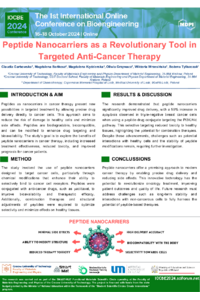
Modern oncology faces the challenge of effectively treating cancers while minimizing side effects on healthy cells. Peptide nanocarriers for drug delivery open new perspectives in targeted anti-cancer therapy, offering advanced solutions for delivering drugs directly to cancer cells. Peptides, due to their unique properties of biodegradability and biocompatibility, are ideal components of nanocarriers and are capable of efficiently binding and transporting anti-cancer drugs.
Peptide nanocarriers demonstrate the ability to enhance the biological availability of drugs, which is particularly important for anti-cancer drugs like paclitaxel that often have limited bioavailability. Thanks to chemical modification, peptides can be tailored to transport a wide range of therapeutic substances, including both small chemical molecules and larger biologically active proteins. For instance, our study highlights the successful delivery of a peptide–drug conjugate that targets the PI3K/Akt pathway in triple-negative breast cancer cells, resulting in a 50% increase in apoptosis compared to free drug treatment.
In summary, peptide nanocarriers represent a promising platform for modern targeted anti-cancer therapies, offering the possibility of significant progress in cancer treatment, as well as the improvement of clinical outcomes. Their application has the potential to revolutionize approaches to oncology therapies, contributing to extending patients' lives and improving their quality of life. However, challenges such as potential interactions with healthy tissues and the long-term stability of peptide modifications must be addressed in future research.
This research was carried out within the SMART-MAT Functional Materials Scientific Club of the Faculty of Materials Engineering and Physics at Cracow University of Technology and as part of the project entitled " Nanogels for biomedical applications", which was financed by the FutureLab organization operating at Cracow University of Technology.
Keywords
Peptide Nanocarriers
Targeted Therapy
Anti-Cancer Drugs
Biodegradability
Bioavailability
Nanomedicine
Poster
Poster-IOCB-2024.pdf
ActiveHydrogels: Innovative Hydrogels Enriched with Natural Plant Extracts for Dermatology
Biological treatment of second cheese whey using marine microalgae/cyanobacteria-based systems