Event submissions
Published
This submission belongs to the session 6. Biochemical Engineering of the event The 1st International Online Conference on Bioengineering
Published date
11 Oct, 2024
Academic Editor
'%3e%3cpath%20d='M12.6657%2010.9104C12.4185%2010.325%2012.0599%209.79327%2011.6097%209.34482C11.1609%208.89508%2010.6293%208.5365%2010.0442%208.28888C10.0389%208.28626%2010.0337%208.28495%2010.0285%208.28233C10.8446%207.69279%2011.3752%206.73249%2011.3752%205.64904C11.3752%203.8542%209.92103%202.39999%208.1262%202.39999C6.33136%202.39999%204.87715%203.8542%204.87715%205.64904C4.87715%206.73249%205.40774%207.69279%206.22393%208.28364C6.21869%208.28626%206.21345%208.28757%206.20821%208.29019C5.62129%208.5378%205.09463%208.89284%204.64265%209.34613C4.1929%209.79493%203.83432%2010.3266%203.58671%2010.9117C3.34345%2011.4845%203.21226%2012.0987%203.20023%2012.7209C3.19988%2012.7349%203.20233%2012.7488%203.20744%2012.7619C3.21255%2012.7749%203.22022%2012.7867%203.22998%2012.7968C3.23975%2012.8068%203.25142%2012.8147%203.26431%2012.8202C3.2772%2012.8256%203.29105%2012.8284%203.30504%2012.8284H4.09109C4.14874%2012.8284%204.19459%2012.7825%204.1959%2012.7262C4.2221%2011.7148%204.62823%2010.7676%205.34617%2010.0497C6.08899%209.30683%207.0755%208.89808%208.1262%208.89808C9.17689%208.89808%2010.1634%209.30683%2010.9062%2010.0497C11.6242%2010.7676%2012.0303%2011.7148%2012.0565%2012.7262C12.0578%2012.7838%2012.1037%2012.8284%2012.1613%2012.8284H12.9474C12.9613%2012.8284%2012.9752%2012.8256%2012.9881%2012.8202C13.001%2012.8147%2013.0126%2012.8068%2013.0224%2012.7968C13.0322%2012.7867%2013.0398%2012.7749%2013.0449%2012.7619C13.0501%2012.7488%2013.0525%2012.7349%2013.0522%2012.7209C13.0391%2012.0947%2012.9094%2011.4855%2012.6657%2010.9104ZM8.1262%207.9024C7.52486%207.9024%206.9589%207.6679%206.53312%207.24211C6.10733%206.81633%205.87283%206.25037%205.87283%205.64904C5.87283%205.0477%206.10733%204.48174%206.53312%204.05596C6.9589%203.63018%207.52486%203.39567%208.1262%203.39567C8.72753%203.39567%209.29349%203.63018%209.71927%204.05596C10.1451%204.48174%2010.3796%205.0477%2010.3796%205.64904C10.3796%206.25037%2010.1451%206.81633%209.71927%207.24211C9.29349%207.6679%208.72753%207.9024%208.1262%207.9024Z'%20fill='%235D1EE1'/%3e%3c/g%3e%3c/svg%3e) Liang Luo
Liang LuoCitation
Stefania Patsialou, Ioanna Aikaterini Tsakona, Dimitris V. Vayenas, Athanasia G. Tekerlekopoulou, Biological treatment of second cheese whey using marine microalgae/cyanobacteria-based systems, in Proceedings of The 1st International Online Conference on Bioengineering, 16 October–18 October 2024, MDPI: Basel, Switzerland
Share
Email
Facebook
Twitter
LinkedIn
Biological treatment of second cheese whey using marine microalgae/cyanobacteria-based systems
'%3e%3cpath%20d='M12.6647%2010.9104C12.4176%2010.325%2012.0589%209.7933%2011.6088%209.34485C11.16%208.89511%2010.6283%208.53653%2010.0432%208.28891C10.038%208.28629%2010.0327%208.28498%2010.0275%208.28236C10.8437%207.69282%2011.3743%206.73252%2011.3743%205.64907C11.3743%203.85423%209.92005%202.40002%208.12522%202.40002C6.33038%202.40002%204.87618%203.85423%204.87618%205.64907C4.87618%206.73252%205.40677%207.69282%206.22296%208.28367C6.21772%208.28629%206.21248%208.2876%206.20724%208.29022C5.62031%208.53783%205.09365%208.89287%204.64167%209.34616C4.19192%209.79496%203.83334%2010.3266%203.58573%2010.9117C3.34247%2011.4846%203.21128%2012.0987%203.19925%2012.721C3.1989%2012.735%203.20135%2012.7489%203.20646%2012.7619C3.21157%2012.7749%203.21924%2012.7868%203.22901%2012.7968C3.23877%2012.8068%203.25045%2012.8148%203.26334%2012.8202C3.27623%2012.8256%203.29007%2012.8284%203.30406%2012.8284H4.09012C4.14776%2012.8284%204.19362%2012.7825%204.19493%2012.7262C4.22113%2011.7148%204.62726%2010.7676%205.34519%2010.0497C6.08802%209.30686%207.07452%208.89811%208.12522%208.89811C9.17592%208.89811%2010.1624%209.30686%2010.9052%2010.0497C11.6232%2010.7676%2012.0293%2011.7148%2012.0555%2012.7262C12.0568%2012.7839%2012.1027%2012.8284%2012.1603%2012.8284H12.9464C12.9604%2012.8284%2012.9742%2012.8256%2012.9871%2012.8202C13%2012.8148%2013.0117%2012.8068%2013.0214%2012.7968C13.0312%2012.7868%2013.0389%2012.7749%2013.044%2012.7619C13.0491%2012.7489%2013.0515%2012.735%2013.0512%2012.721C13.0381%2012.0947%2012.9084%2011.4856%2012.6647%2010.9104ZM8.12522%207.90243C7.52388%207.90243%206.95792%207.66793%206.53214%207.24215C6.10636%206.81636%205.87185%206.2504%205.87185%205.64907C5.87185%205.04773%206.10636%204.48177%206.53214%204.05599C6.95792%203.63021%207.52388%203.3957%208.12522%203.3957C8.72655%203.3957%209.29252%203.63021%209.7183%204.05599C10.1441%204.48177%2010.3786%205.04773%2010.3786%205.64907C10.3786%206.2504%2010.1441%206.81636%209.7183%207.24215C9.29252%207.66793%208.72655%207.90243%208.12522%207.90243Z'%20fill='%235D1EE1'/%3e%3c/g%3e%3c/svg%3e)
Stefania Patsialou 1
Ioanna Aikaterini Tsakona 2
Dimitris V. Vayenas 2,3

Athanasia G. Tekerlekopoulou 1
1. Department of Sustainable Agriculture, School of Agricultural Sciences, University of Patras, 30100 Agrinio, Greece
2. Department of Chemical Engineering, School of Engineering, University of Patras, 26500 Patras, Greece
3. Institute of Chemical Engineering Sciences (ICE-HT), Stadiou Str., Platani, 26504 Patras, Greece
Abstract
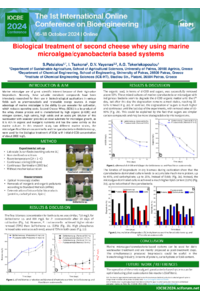
The biological treatment of second cheese whey (SCW) was investigated using two different marine cultures, the microalgae Picochlorum costavermella and the cyanobacterium Geitlerinema sp. SCW is produced as a by-product in the manufacture of whey cheese and is characterized by a high organic load (d-COD), an acidic pH and high salinity. Seawater from the coastal area of Rio, near Patras, was used for dilution of the SCW to achieve an initial concentration of about 2000 mg d-COD/L in both cases without any external addition of the inorganic nutrients N and P.
Lab-scale experiments were conducted in separate Duran flasks with a working volume of 1L, under non-sterilized conditions, at room temperature (24 ± 1 ◦C), under continuous stirring (150 rpm) and continuous illumination (2000 lux) and without mechanical aeration. Optical microscopy studies revealed the development of a mixed-microorganism culture, consisting of the dominant microalgae/cyanobacteria biomass and the indigenous bacteria of the SCW.
The growth of the mixed biomass over time was studied, as was the removal of NO3- - N, PO43-, d-COD and sugars. The simultaneous accumulation of bioproducts, such as proteins, carbohydrates and lipids, was also evaluated. The final biomass concentration was similar for both cultures, 710 mg/L for Geitlerinema sp. and 800 mg/L for P.costavermella, and the d-COD removal was approximately 55% and 65%, respectively. High removal rates were also achieved for sugars, with values of up to 80% and 91%, respectively. The cyanobacteria-dominated culture achieved higher carbohydrate (25.4%) and similar protein contents (19.8%) but a lower lipid (5.0%) content on the last day (10th day) of cultivation than the microalgae-dominated culture (10.7%, 21.3% and 11.1%, respectively).
The biological approach used in this study has demonstrated that marine microalgae/cyanobacteria-based systems can be used as post-treatment steps for the treatment of dairy wastewater, while producing biomass useful in the biotechnology industry at the same time.
Keywords
Geitlerinema sp
P.costavermella
second cheese whey
biological treatment
Poster
101010 posterPatsialou_bioengineering_IOCBE2024.pdf
Peptide Nanocarriers as a Revolutionary Tool in Targeted Anti-Cancer Therapy
Fabrication of Quercetin-Functionalized Morpholine and Pyridine Motifs-Laden Silk Fibroin Nanofibers for Effective Wound Healing in Preclinical Study