Event submissions
Published
This submission belongs to the session S2. Innovation in Dietary Choices of the event The 4th International Electronic Conference on Nutrients
Published date
11 Oct, 2024
Academic Editor
'%3e%3cpath%20d='M12.6657%2010.9104C12.4185%2010.325%2012.0599%209.79327%2011.6097%209.34482C11.1609%208.89508%2010.6293%208.5365%2010.0442%208.28888C10.0389%208.28626%2010.0337%208.28495%2010.0285%208.28233C10.8446%207.69279%2011.3752%206.73249%2011.3752%205.64904C11.3752%203.8542%209.92103%202.39999%208.1262%202.39999C6.33136%202.39999%204.87715%203.8542%204.87715%205.64904C4.87715%206.73249%205.40774%207.69279%206.22393%208.28364C6.21869%208.28626%206.21345%208.28757%206.20821%208.29019C5.62129%208.5378%205.09463%208.89284%204.64265%209.34613C4.1929%209.79493%203.83432%2010.3266%203.58671%2010.9117C3.34345%2011.4845%203.21226%2012.0987%203.20023%2012.7209C3.19988%2012.7349%203.20233%2012.7488%203.20744%2012.7619C3.21255%2012.7749%203.22022%2012.7867%203.22998%2012.7968C3.23975%2012.8068%203.25142%2012.8147%203.26431%2012.8202C3.2772%2012.8256%203.29105%2012.8284%203.30504%2012.8284H4.09109C4.14874%2012.8284%204.19459%2012.7825%204.1959%2012.7262C4.2221%2011.7148%204.62823%2010.7676%205.34617%2010.0497C6.08899%209.30683%207.0755%208.89808%208.1262%208.89808C9.17689%208.89808%2010.1634%209.30683%2010.9062%2010.0497C11.6242%2010.7676%2012.0303%2011.7148%2012.0565%2012.7262C12.0578%2012.7838%2012.1037%2012.8284%2012.1613%2012.8284H12.9474C12.9613%2012.8284%2012.9752%2012.8256%2012.9881%2012.8202C13.001%2012.8147%2013.0126%2012.8068%2013.0224%2012.7968C13.0322%2012.7867%2013.0398%2012.7749%2013.0449%2012.7619C13.0501%2012.7488%2013.0525%2012.7349%2013.0522%2012.7209C13.0391%2012.0947%2012.9094%2011.4855%2012.6657%2010.9104ZM8.1262%207.9024C7.52486%207.9024%206.9589%207.6679%206.53312%207.24211C6.10733%206.81633%205.87283%206.25037%205.87283%205.64904C5.87283%205.0477%206.10733%204.48174%206.53312%204.05596C6.9589%203.63018%207.52486%203.39567%208.1262%203.39567C8.72753%203.39567%209.29349%203.63018%209.71927%204.05596C10.1451%204.48174%2010.3796%205.0477%2010.3796%205.64904C10.3796%206.25037%2010.1451%206.81633%209.71927%207.24211C9.29349%207.6679%208.72753%207.9024%208.1262%207.9024Z'%20fill='%235D1EE1'/%3e%3c/g%3e%3c/svg%3e) Mauro Lombardo
Mauro LombardoCitation
Caroline Woelffel Silva, Danúbia Guerra, Renato Senra, Tiago Mendes, Elad Tako, Frederico Barros, Antioxidant Capacity of Hydrolysates from Macauba (Acrocomia aculeata) Kernel Protein Isolate Produced Under Different Conditions, in Proceedings of The 4th International Electronic Conference on Nutrients, 16 October–18 October 2024, MDPI: Basel, Switzerland
Share
Email
Facebook
Twitter
LinkedIn
Antioxidant Capacity of Hydrolysates from Macauba (Acrocomia aculeata) Kernel Protein Isolate Produced Under Different Conditions
'%3e%3cpath%20d='M12.6647%2010.9104C12.4176%2010.325%2012.0589%209.7933%2011.6088%209.34485C11.16%208.89511%2010.6283%208.53653%2010.0432%208.28891C10.038%208.28629%2010.0327%208.28498%2010.0275%208.28236C10.8437%207.69282%2011.3743%206.73252%2011.3743%205.64907C11.3743%203.85423%209.92005%202.40002%208.12522%202.40002C6.33038%202.40002%204.87618%203.85423%204.87618%205.64907C4.87618%206.73252%205.40677%207.69282%206.22296%208.28367C6.21772%208.28629%206.21248%208.2876%206.20724%208.29022C5.62031%208.53783%205.09365%208.89287%204.64167%209.34616C4.19192%209.79496%203.83334%2010.3266%203.58573%2010.9117C3.34247%2011.4846%203.21128%2012.0987%203.19925%2012.721C3.1989%2012.735%203.20135%2012.7489%203.20646%2012.7619C3.21157%2012.7749%203.21924%2012.7868%203.22901%2012.7968C3.23877%2012.8068%203.25045%2012.8148%203.26334%2012.8202C3.27623%2012.8256%203.29007%2012.8284%203.30406%2012.8284H4.09012C4.14776%2012.8284%204.19362%2012.7825%204.19493%2012.7262C4.22113%2011.7148%204.62726%2010.7676%205.34519%2010.0497C6.08802%209.30686%207.07452%208.89811%208.12522%208.89811C9.17592%208.89811%2010.1624%209.30686%2010.9052%2010.0497C11.6232%2010.7676%2012.0293%2011.7148%2012.0555%2012.7262C12.0568%2012.7839%2012.1027%2012.8284%2012.1603%2012.8284H12.9464C12.9604%2012.8284%2012.9742%2012.8256%2012.9871%2012.8202C13%2012.8148%2013.0117%2012.8068%2013.0214%2012.7968C13.0312%2012.7868%2013.0389%2012.7749%2013.044%2012.7619C13.0491%2012.7489%2013.0515%2012.735%2013.0512%2012.721C13.0381%2012.0947%2012.9084%2011.4856%2012.6647%2010.9104ZM8.12522%207.90243C7.52388%207.90243%206.95792%207.66793%206.53214%207.24215C6.10636%206.81636%205.87185%206.2504%205.87185%205.64907C5.87185%205.04773%206.10636%204.48177%206.53214%204.05599C6.95792%203.63021%207.52388%203.3957%208.12522%203.3957C8.72655%203.3957%209.29252%203.63021%209.7183%204.05599C10.1441%204.48177%2010.3786%205.04773%2010.3786%205.64907C10.3786%206.2504%2010.1441%206.81636%209.7183%207.24215C9.29252%207.66793%208.72655%207.90243%208.12522%207.90243Z'%20fill='%235D1EE1'/%3e%3c/g%3e%3c/svg%3e)
Caroline Woelffel Silva 1,2
Danúbia Guerra 2
Renato Senra 3
Tiago Mendes 3

Elad Tako 1

Frederico Barros 2
1. Department of Food Science, Cornell University.
2. Department of Food Technology, Federal University of Viçosa, Brazil.
3. Department of Biochemistry and Molecular Biology, Federal University of Viçosa, Brazil.
Abstract
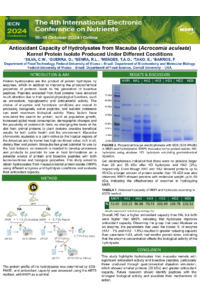
Protein hydrolysates, created by enzymatic protein hydrolysis, enhance the physicochemical properties of proteins and generate bioactive peptides. Peptides extracted from food proteins have attracted much attention due to their special physiological functions, such as antioxidant, hypoglycemic, and antibacterial activity. The choice of enzymes and hydrolysis conditions is crucial in producing biologically active peptides, and suitable proteases can exert maximum biological activity. This study aimed, for the first time, to obtain hydrolysates from macauba kernel protein isolate (MKPI) using different enzymes and hydrolysis conditions and evaluating their antioxidant capacity. Two enzymatic methods were employed: one simulating gastrointestinal digestion (HD) using pepsin and pancreatin at varying conditions (HD1: 5% for 2 hrs, HD2: 7.5% for 2 hrs, HD3: 5% for 4 hrs) and another using alcalase (HA) at different concentrations (HA1: 1%, HA2: 1.5%, HA3: 2%). The protein profile of the hydrolysates was determined by SDS-PAGE, and antioxidant capacity was assessed using the ABTS method, with MKPI as a control. Gel electrophoresis revealed that hydrolysis reduced protein sizes to below 35 kDa, with HD producing proteins smaller than 20 kDa and HA smaller than 35 kDa. MKPI contained proteins up to 60 kDa, showing effective hydrolysis by the enzymes. Antioxidant capacity was higher in HD (HD1: 102%, HD2: 101%, HD3: 101%) compared to HA (HA1: 92%, HA2: 77%, HA3: 70%) and MKPI (52%). This study highlights hydrolysates from macauba kernels with significant antioxidant activity and bioactive peptides, particularly those produced through gastrointestinal digestion simulation, which showed higher concentrations of smaller proteins (20 kDa) and greater antioxidant capacity. Future research should identify peptides with the strongest biological activity and elucidate their mechanisms of action.
Keywords
Plant-based protein
Hydrolysates
Antioxidants.
Poster
sciforum-097670-Caroline Woelffel Silva.pdf
Effect of multi-strain probiotic supplementation on magnesium and calcium metabolism in obese postmenopausal women: a randomized trial
Supplementation of grape pomace on broilers fed a high non-starch polysaccharide diet and its effects on growth performance, gut function, intestinal microbiota, and meat quality.