Event submissions
Published
This submission belongs to the session 5. Biosignal Processing of the event The 1st International Online Conference on Bioengineering
Published date
11 Oct, 2024
Academic Editor
'%3e%3cpath%20d='M12.6657%2010.9104C12.4185%2010.325%2012.0599%209.79327%2011.6097%209.34482C11.1609%208.89508%2010.6293%208.5365%2010.0442%208.28888C10.0389%208.28626%2010.0337%208.28495%2010.0285%208.28233C10.8446%207.69279%2011.3752%206.73249%2011.3752%205.64904C11.3752%203.8542%209.92103%202.39999%208.1262%202.39999C6.33136%202.39999%204.87715%203.8542%204.87715%205.64904C4.87715%206.73249%205.40774%207.69279%206.22393%208.28364C6.21869%208.28626%206.21345%208.28757%206.20821%208.29019C5.62129%208.5378%205.09463%208.89284%204.64265%209.34613C4.1929%209.79493%203.83432%2010.3266%203.58671%2010.9117C3.34345%2011.4845%203.21226%2012.0987%203.20023%2012.7209C3.19988%2012.7349%203.20233%2012.7488%203.20744%2012.7619C3.21255%2012.7749%203.22022%2012.7867%203.22998%2012.7968C3.23975%2012.8068%203.25142%2012.8147%203.26431%2012.8202C3.2772%2012.8256%203.29105%2012.8284%203.30504%2012.8284H4.09109C4.14874%2012.8284%204.19459%2012.7825%204.1959%2012.7262C4.2221%2011.7148%204.62823%2010.7676%205.34617%2010.0497C6.08899%209.30683%207.0755%208.89808%208.1262%208.89808C9.17689%208.89808%2010.1634%209.30683%2010.9062%2010.0497C11.6242%2010.7676%2012.0303%2011.7148%2012.0565%2012.7262C12.0578%2012.7838%2012.1037%2012.8284%2012.1613%2012.8284H12.9474C12.9613%2012.8284%2012.9752%2012.8256%2012.9881%2012.8202C13.001%2012.8147%2013.0126%2012.8068%2013.0224%2012.7968C13.0322%2012.7867%2013.0398%2012.7749%2013.0449%2012.7619C13.0501%2012.7488%2013.0525%2012.7349%2013.0522%2012.7209C13.0391%2012.0947%2012.9094%2011.4855%2012.6657%2010.9104ZM8.1262%207.9024C7.52486%207.9024%206.9589%207.6679%206.53312%207.24211C6.10733%206.81633%205.87283%206.25037%205.87283%205.64904C5.87283%205.0477%206.10733%204.48174%206.53312%204.05596C6.9589%203.63018%207.52486%203.39567%208.1262%203.39567C8.72753%203.39567%209.29349%203.63018%209.71927%204.05596C10.1451%204.48174%2010.3796%205.0477%2010.3796%205.64904C10.3796%206.25037%2010.1451%206.81633%209.71927%207.24211C9.29349%207.6679%208.72753%207.9024%208.1262%207.9024Z'%20fill='%235D1EE1'/%3e%3c/g%3e%3c/svg%3e) Andrea Cataldo
Andrea CataldoCitation
Nosratallah Forghani, Mohamad Forouzanfar, A Preliminary Investigation into the Feasibility of Probabilistic Blood Pressure Estimation from ECGs using Compositional Bayesian Neural Networks (Auto-BNN), in Proceedings of The 1st International Online Conference on Bioengineering, 16 October–18 October 2024, MDPI: Basel, Switzerland
Share
Email
Facebook
Twitter
LinkedIn
A Preliminary Investigation into the Feasibility of Probabilistic Blood Pressure Estimation from ECGs using Compositional Bayesian Neural Networks (Auto-BNN)
'%3e%3cpath%20d='M12.6647%2010.9104C12.4176%2010.325%2012.0589%209.7933%2011.6088%209.34485C11.16%208.89511%2010.6283%208.53653%2010.0432%208.28891C10.038%208.28629%2010.0327%208.28498%2010.0275%208.28236C10.8437%207.69282%2011.3743%206.73252%2011.3743%205.64907C11.3743%203.85423%209.92005%202.40002%208.12522%202.40002C6.33038%202.40002%204.87618%203.85423%204.87618%205.64907C4.87618%206.73252%205.40677%207.69282%206.22296%208.28367C6.21772%208.28629%206.21248%208.2876%206.20724%208.29022C5.62031%208.53783%205.09365%208.89287%204.64167%209.34616C4.19192%209.79496%203.83334%2010.3266%203.58573%2010.9117C3.34247%2011.4846%203.21128%2012.0987%203.19925%2012.721C3.1989%2012.735%203.20135%2012.7489%203.20646%2012.7619C3.21157%2012.7749%203.21924%2012.7868%203.22901%2012.7968C3.23877%2012.8068%203.25045%2012.8148%203.26334%2012.8202C3.27623%2012.8256%203.29007%2012.8284%203.30406%2012.8284H4.09012C4.14776%2012.8284%204.19362%2012.7825%204.19493%2012.7262C4.22113%2011.7148%204.62726%2010.7676%205.34519%2010.0497C6.08802%209.30686%207.07452%208.89811%208.12522%208.89811C9.17592%208.89811%2010.1624%209.30686%2010.9052%2010.0497C11.6232%2010.7676%2012.0293%2011.7148%2012.0555%2012.7262C12.0568%2012.7839%2012.1027%2012.8284%2012.1603%2012.8284H12.9464C12.9604%2012.8284%2012.9742%2012.8256%2012.9871%2012.8202C13%2012.8148%2013.0117%2012.8068%2013.0214%2012.7968C13.0312%2012.7868%2013.0389%2012.7749%2013.044%2012.7619C13.0491%2012.7489%2013.0515%2012.735%2013.0512%2012.721C13.0381%2012.0947%2012.9084%2011.4856%2012.6647%2010.9104ZM8.12522%207.90243C7.52388%207.90243%206.95792%207.66793%206.53214%207.24215C6.10636%206.81636%205.87185%206.2504%205.87185%205.64907C5.87185%205.04773%206.10636%204.48177%206.53214%204.05599C6.95792%203.63021%207.52388%203.3957%208.12522%203.3957C8.72655%203.3957%209.29252%203.63021%209.7183%204.05599C10.1441%204.48177%2010.3786%205.04773%2010.3786%205.64907C10.3786%206.2504%2010.1441%206.81636%209.7183%207.24215C9.29252%207.66793%208.72655%207.90243%208.12522%207.90243Z'%20fill='%235D1EE1'/%3e%3c/g%3e%3c/svg%3e)
Nosratallah Forghani 1

Mohamad Forouzanfar 2
1. École de technologie supérieure, Université du Québec, Canada
2. Department of Systems Engineering, École de technologie supérieure (ÉTS), 1100 Notre-Dame St W, Montreal, Quebec H3C 1K3, Canada
Abstract
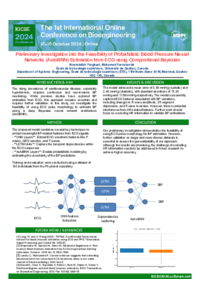
Introduction: The rising prevalence of cardiovascular disease, especially hypertension, necessitates continuous and non-invasive blood pressure (BP) monitoring. While previous studies have investigated the potential for estimating BP from electrocardiograms (ECGs) , these claims require further verification. This study presents a preliminary investigation into the feasibility of estimating BP from ECG pulse morphology using a novel deep compositional Bayesian neural network (auto-BNN).
Methods: Our model leverages a deep learning architecture to capture the variations in ECG morphology associated with BP. It incorporates convolutional neural network (CNN) layers for ECG waveform feature extraction, a long short-term memory (LSTM) unit to capture temporal dependencies in ECG sequences, and variational layers based on auto-BNN to enable uncertainty estimation.
Results and Discussion: An initial evaluation of data from 130 individuals sourced from Physionet yielded mean errors of 3.38 mmHg (systolic) and 2.40 mmHg (diastolic) with standard deviations of 13.20 mmHg and 11.88 mmHg, respectively. These results suggest that our model could potentially capture correlations between BP variations and ECG signals, such as changes in R wave amplitude, ST-segment depression, T-wave inversions, and widened P waves associated with high BP, as well as sinus tachycardia and ST-segment/T-wave changes associated with low BP. However, it is important to note that these correlations may have captured the relationship between heart rate (HR) and BP. Further research should explore methods to exclude HR information from ECGs to ensure the validity of BP estimation findings.
Conclusions: This preliminary study demonstrates the potential feasibility of using ECG pulse morphology for BP estimation. However, further validation on larger and more diverse datasets is crucial to assess the generalizability of our approach. While our initial results are encouraging, it is important to note that achieving very high accuracy in BP estimation solely from ECGs may be inherently challenging due to the complex and multifaceted factors influencing BP.
Keywords
Blood Pressure
Electrocardiogram
Deep Learning
Bayesian Neural Network
Uncertainty Estimation
Poster
Preliminary Investigation into the Feasibility of Probabilistic Blood Pressure Neural Networks (AutoBNN) Estimation from ECG using Compositional Bayesian.pdf
Superabsorbent Curdlan–Chitosan Foams with Bioactive Additives for Healing Wounds
Comparative Analysis of Time Series Techniques for COVID-19 Forecasting: LSTM, Transformer, and ARIMA