Event submissions
Published
This submission belongs to the session S2. Innovation in Dietary Choices of the event The 4th International Electronic Conference on Nutrients
Published date
11 Oct, 2024
Academic Editor
'%3e%3cpath%20d='M12.6657%2010.9104C12.4185%2010.325%2012.0599%209.79327%2011.6097%209.34482C11.1609%208.89508%2010.6293%208.5365%2010.0442%208.28888C10.0389%208.28626%2010.0337%208.28495%2010.0285%208.28233C10.8446%207.69279%2011.3752%206.73249%2011.3752%205.64904C11.3752%203.8542%209.92103%202.39999%208.1262%202.39999C6.33136%202.39999%204.87715%203.8542%204.87715%205.64904C4.87715%206.73249%205.40774%207.69279%206.22393%208.28364C6.21869%208.28626%206.21345%208.28757%206.20821%208.29019C5.62129%208.5378%205.09463%208.89284%204.64265%209.34613C4.1929%209.79493%203.83432%2010.3266%203.58671%2010.9117C3.34345%2011.4845%203.21226%2012.0987%203.20023%2012.7209C3.19988%2012.7349%203.20233%2012.7488%203.20744%2012.7619C3.21255%2012.7749%203.22022%2012.7867%203.22998%2012.7968C3.23975%2012.8068%203.25142%2012.8147%203.26431%2012.8202C3.2772%2012.8256%203.29105%2012.8284%203.30504%2012.8284H4.09109C4.14874%2012.8284%204.19459%2012.7825%204.1959%2012.7262C4.2221%2011.7148%204.62823%2010.7676%205.34617%2010.0497C6.08899%209.30683%207.0755%208.89808%208.1262%208.89808C9.17689%208.89808%2010.1634%209.30683%2010.9062%2010.0497C11.6242%2010.7676%2012.0303%2011.7148%2012.0565%2012.7262C12.0578%2012.7838%2012.1037%2012.8284%2012.1613%2012.8284H12.9474C12.9613%2012.8284%2012.9752%2012.8256%2012.9881%2012.8202C13.001%2012.8147%2013.0126%2012.8068%2013.0224%2012.7968C13.0322%2012.7867%2013.0398%2012.7749%2013.0449%2012.7619C13.0501%2012.7488%2013.0525%2012.7349%2013.0522%2012.7209C13.0391%2012.0947%2012.9094%2011.4855%2012.6657%2010.9104ZM8.1262%207.9024C7.52486%207.9024%206.9589%207.6679%206.53312%207.24211C6.10733%206.81633%205.87283%206.25037%205.87283%205.64904C5.87283%205.0477%206.10733%204.48174%206.53312%204.05596C6.9589%203.63018%207.52486%203.39567%208.1262%203.39567C8.72753%203.39567%209.29349%203.63018%209.71927%204.05596C10.1451%204.48174%2010.3796%205.0477%2010.3796%205.64904C10.3796%206.25037%2010.1451%206.81633%209.71927%207.24211C9.29349%207.6679%208.72753%207.9024%208.1262%207.9024Z'%20fill='%235D1EE1'/%3e%3c/g%3e%3c/svg%3e) Mauro Lombardo
Mauro LombardoCitation
Matthew J. Pataki, Nikita Agarwal, Melissa Huang, Nikolai Kolba, Peter R. Gracey, Eliot M. Dugan, Chloe B. Giovannoni, Sara E. Stadulis, Qiang Sui, Patrick A. Gibney, Elad Tako, Supplementation of grape pomace on broilers fed a high non-starch polysaccharide diet and its effects on growth performance, gut function, intestinal microbiota, and meat quality., in Proceedings of The 4th International Electronic Conference on Nutrients, 16 October–18 October 2024, MDPI: Basel, Switzerland
Share
Email
Facebook
Twitter
LinkedIn
Supplementation of grape pomace on broilers fed a high non-starch polysaccharide diet and its effects on growth performance, gut function, intestinal microbiota, and meat quality.
'%3e%3cpath%20d='M12.6647%2010.9104C12.4176%2010.325%2012.0589%209.7933%2011.6088%209.34485C11.16%208.89511%2010.6283%208.53653%2010.0432%208.28891C10.038%208.28629%2010.0327%208.28498%2010.0275%208.28236C10.8437%207.69282%2011.3743%206.73252%2011.3743%205.64907C11.3743%203.85423%209.92005%202.40002%208.12522%202.40002C6.33038%202.40002%204.87618%203.85423%204.87618%205.64907C4.87618%206.73252%205.40677%207.69282%206.22296%208.28367C6.21772%208.28629%206.21248%208.2876%206.20724%208.29022C5.62031%208.53783%205.09365%208.89287%204.64167%209.34616C4.19192%209.79496%203.83334%2010.3266%203.58573%2010.9117C3.34247%2011.4846%203.21128%2012.0987%203.19925%2012.721C3.1989%2012.735%203.20135%2012.7489%203.20646%2012.7619C3.21157%2012.7749%203.21924%2012.7868%203.22901%2012.7968C3.23877%2012.8068%203.25045%2012.8148%203.26334%2012.8202C3.27623%2012.8256%203.29007%2012.8284%203.30406%2012.8284H4.09012C4.14776%2012.8284%204.19362%2012.7825%204.19493%2012.7262C4.22113%2011.7148%204.62726%2010.7676%205.34519%2010.0497C6.08802%209.30686%207.07452%208.89811%208.12522%208.89811C9.17592%208.89811%2010.1624%209.30686%2010.9052%2010.0497C11.6232%2010.7676%2012.0293%2011.7148%2012.0555%2012.7262C12.0568%2012.7839%2012.1027%2012.8284%2012.1603%2012.8284H12.9464C12.9604%2012.8284%2012.9742%2012.8256%2012.9871%2012.8202C13%2012.8148%2013.0117%2012.8068%2013.0214%2012.7968C13.0312%2012.7868%2013.0389%2012.7749%2013.044%2012.7619C13.0491%2012.7489%2013.0515%2012.735%2013.0512%2012.721C13.0381%2012.0947%2012.9084%2011.4856%2012.6647%2010.9104ZM8.12522%207.90243C7.52388%207.90243%206.95792%207.66793%206.53214%207.24215C6.10636%206.81636%205.87185%206.2504%205.87185%205.64907C5.87185%205.04773%206.10636%204.48177%206.53214%204.05599C6.95792%203.63021%207.52388%203.3957%208.12522%203.3957C8.72655%203.3957%209.29252%203.63021%209.7183%204.05599C10.1441%204.48177%2010.3786%205.04773%2010.3786%205.64907C10.3786%206.2504%2010.1441%206.81636%209.7183%207.24215C9.29252%207.66793%208.72655%207.90243%208.12522%207.90243Z'%20fill='%235D1EE1'/%3e%3c/g%3e%3c/svg%3e)
Matthew J. Pataki 1
Nikita Agarwal 1
Melissa Huang 1
Nikolai Kolba 1
Peter R. Gracey 1
Eliot M. Dugan 1
Chloe B. Giovannoni 1
Sara E. Stadulis 1
Qiang Sui 2
Patrick A. Gibney 1

Elad Tako 1
1. Department of Food Science, Cornell University, Ithaca, NY 14853, USA.
2. E & J Gallo Winery, Modesto, CA 95354
Abstract
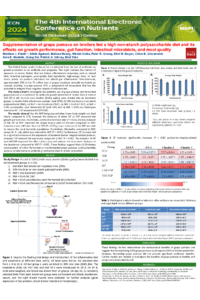
Grape pomace, a byproduct of the wine and juice industry, is rich in bioactive compounds that have been shown to improve intestinal health. Yet, its disposal is costly and contributes to landfill waste and greenhouse gas emissions. With the poultry industry seeking alternatives to antibiotic growth promoters (AGPs) due to rising antibiotic resistance, grape pomace offers a natural, healthier substitute and a valuable ingredient for human food production.
This in vivo feeding trial explored intestinal health parameters using grape pomace and fermented grape pomace as AGP alternatives in broiler feed. A total of 150 Cornish cross broilers were divided into six groups: i) standard diet wheat-corn-soybean meal, ii) 33% rice bran or non-starch polysaccharide (NSP) known to induce chronic low-grade gut inflammation, iii) NSP + zinc bacitracin (AGP), iv) NSP + 0.5% GP (GP), v) NSP + 0.5% Lactobacillus casei fermented GP, and vi) NSP + 0.5% Saccharomyces cerevisiae EC1118 fermented GP. On day 42, 21 birds from each group were euthanized, and blood, duodenum, cecum, and right breast muscle were collected.
Results showed that the NSP-fed group had lower body weight and feed intake, but all treatments mitigated this growth reduction. Breast muscle weights did not differ significantly between STD and both FGP groups, while other treatments resulted in lower weights. Cecal bacterial population changes were similar between the AGP and GP groups. GP inclusion significantly increased (P < 0.05) gut-barrier-integrity-related proteins (OCLN, ZO-2, Claudin-3, Claudin-4). Histological analysis showed variations in villus surface area, muscularis thickness, and crypt depth across different groups.
These findings further demonstrate the nutraceutical benefits of grape pomace and suggest that incorporating 0.5% grape pomace could replace AGPs in broiler production. However, fermenting grape pomace did not provide significant additional benefits. Further studies are needed to investigate the benefits of grape pomace in healthy and compromised intestinal health.
Keywords
bioactive
bioactive compounds
value-added
value-added ingredient
upcycled
sustainability
microbiome
nutraceutical
Poster
sciforum-097675-Matthew Pataki.pdf
Antioxidant Capacity of Hydrolysates from Macauba (Acrocomia aculeata) Kernel Protein Isolate Produced Under Different Conditions
DEVELOPMENT OF METHODOLOGY FOR OBTAINING AND TESTING THE QUALITY OF NATURAL ACTIVE SUBSTANCES FOR INSULIN RESISTANCE THERAPY