Event submissions
Published
This submission belongs to the session S3. Diet and Chronic Disease Management of the event The 4th International Electronic Conference on Nutrients
Published date
11 Oct, 2024
Academic Editor
'%3e%3cpath%20d='M12.6657%2010.9104C12.4185%2010.325%2012.0599%209.79327%2011.6097%209.34482C11.1609%208.89508%2010.6293%208.5365%2010.0442%208.28888C10.0389%208.28626%2010.0337%208.28495%2010.0285%208.28233C10.8446%207.69279%2011.3752%206.73249%2011.3752%205.64904C11.3752%203.8542%209.92103%202.39999%208.1262%202.39999C6.33136%202.39999%204.87715%203.8542%204.87715%205.64904C4.87715%206.73249%205.40774%207.69279%206.22393%208.28364C6.21869%208.28626%206.21345%208.28757%206.20821%208.29019C5.62129%208.5378%205.09463%208.89284%204.64265%209.34613C4.1929%209.79493%203.83432%2010.3266%203.58671%2010.9117C3.34345%2011.4845%203.21226%2012.0987%203.20023%2012.7209C3.19988%2012.7349%203.20233%2012.7488%203.20744%2012.7619C3.21255%2012.7749%203.22022%2012.7867%203.22998%2012.7968C3.23975%2012.8068%203.25142%2012.8147%203.26431%2012.8202C3.2772%2012.8256%203.29105%2012.8284%203.30504%2012.8284H4.09109C4.14874%2012.8284%204.19459%2012.7825%204.1959%2012.7262C4.2221%2011.7148%204.62823%2010.7676%205.34617%2010.0497C6.08899%209.30683%207.0755%208.89808%208.1262%208.89808C9.17689%208.89808%2010.1634%209.30683%2010.9062%2010.0497C11.6242%2010.7676%2012.0303%2011.7148%2012.0565%2012.7262C12.0578%2012.7838%2012.1037%2012.8284%2012.1613%2012.8284H12.9474C12.9613%2012.8284%2012.9752%2012.8256%2012.9881%2012.8202C13.001%2012.8147%2013.0126%2012.8068%2013.0224%2012.7968C13.0322%2012.7867%2013.0398%2012.7749%2013.0449%2012.7619C13.0501%2012.7488%2013.0525%2012.7349%2013.0522%2012.7209C13.0391%2012.0947%2012.9094%2011.4855%2012.6657%2010.9104ZM8.1262%207.9024C7.52486%207.9024%206.9589%207.6679%206.53312%207.24211C6.10733%206.81633%205.87283%206.25037%205.87283%205.64904C5.87283%205.0477%206.10733%204.48174%206.53312%204.05596C6.9589%203.63018%207.52486%203.39567%208.1262%203.39567C8.72753%203.39567%209.29349%203.63018%209.71927%204.05596C10.1451%204.48174%2010.3796%205.0477%2010.3796%205.64904C10.3796%206.25037%2010.1451%206.81633%209.71927%207.24211C9.29349%207.6679%208.72753%207.9024%208.1262%207.9024Z'%20fill='%235D1EE1'/%3e%3c/g%3e%3c/svg%3e) Mauro Lombardo
Mauro LombardoCitation
Rafsan Syabani Cholik, Dominik Jóźwiak, Joanna Suliburska, Evaluation of salicylate intake in pregnant and non-pregnant women, in Proceedings of The 4th International Electronic Conference on Nutrients, 16 October–18 October 2024, MDPI: Basel, Switzerland
Share
Email
Facebook
Twitter
LinkedIn
Evaluation of salicylate intake in pregnant and non-pregnant women
'%3e%3cpath%20d='M12.6647%2010.9104C12.4176%2010.325%2012.0589%209.7933%2011.6088%209.34485C11.16%208.89511%2010.6283%208.53653%2010.0432%208.28891C10.038%208.28629%2010.0327%208.28498%2010.0275%208.28236C10.8437%207.69282%2011.3743%206.73252%2011.3743%205.64907C11.3743%203.85423%209.92005%202.40002%208.12522%202.40002C6.33038%202.40002%204.87618%203.85423%204.87618%205.64907C4.87618%206.73252%205.40677%207.69282%206.22296%208.28367C6.21772%208.28629%206.21248%208.2876%206.20724%208.29022C5.62031%208.53783%205.09365%208.89287%204.64167%209.34616C4.19192%209.79496%203.83334%2010.3266%203.58573%2010.9117C3.34247%2011.4846%203.21128%2012.0987%203.19925%2012.721C3.1989%2012.735%203.20135%2012.7489%203.20646%2012.7619C3.21157%2012.7749%203.21924%2012.7868%203.22901%2012.7968C3.23877%2012.8068%203.25045%2012.8148%203.26334%2012.8202C3.27623%2012.8256%203.29007%2012.8284%203.30406%2012.8284H4.09012C4.14776%2012.8284%204.19362%2012.7825%204.19493%2012.7262C4.22113%2011.7148%204.62726%2010.7676%205.34519%2010.0497C6.08802%209.30686%207.07452%208.89811%208.12522%208.89811C9.17592%208.89811%2010.1624%209.30686%2010.9052%2010.0497C11.6232%2010.7676%2012.0293%2011.7148%2012.0555%2012.7262C12.0568%2012.7839%2012.1027%2012.8284%2012.1603%2012.8284H12.9464C12.9604%2012.8284%2012.9742%2012.8256%2012.9871%2012.8202C13%2012.8148%2013.0117%2012.8068%2013.0214%2012.7968C13.0312%2012.7868%2013.0389%2012.7749%2013.044%2012.7619C13.0491%2012.7489%2013.0515%2012.735%2013.0512%2012.721C13.0381%2012.0947%2012.9084%2011.4856%2012.6647%2010.9104ZM8.12522%207.90243C7.52388%207.90243%206.95792%207.66793%206.53214%207.24215C6.10636%206.81636%205.87185%206.2504%205.87185%205.64907C5.87185%205.04773%206.10636%204.48177%206.53214%204.05599C6.95792%203.63021%207.52388%203.3957%208.12522%203.3957C8.72655%203.3957%209.29252%203.63021%209.7183%204.05599C10.1441%204.48177%2010.3786%205.04773%2010.3786%205.64907C10.3786%206.2504%2010.1441%206.81636%209.7183%207.24215C9.29252%207.66793%208.72655%207.90243%208.12522%207.90243Z'%20fill='%235D1EE1'/%3e%3c/g%3e%3c/svg%3e)
Rafsan Syabani Cholik 1
Dominik Jóźwiak 1

Joanna Suliburska 1
1. Department of Human Nutrition and Dietetics, Poznan University of Life Sciences
Abstract
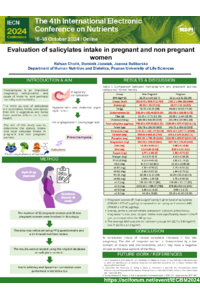
Many plant foods, especially vegetables, herbs, and spices, contain natural salicylates, which are beneficial to health. Thus, this study aimed to determine the dietary and total salicylate intake of pregnant/non-pregnant women.
In this survey, an equal number of non-pregnant and pregnant women (35 each) aged between 18 and 49 years participated. The pregnant group was within 25–38 weeks of gestation. Participants completed a validated FFQ questionnaire and a 24-hour recall nutrition interview. Data were analyzed using an original food database and the Aliant software package. BMI was also determined. Statistical analysis was performed through the use of Mann–Whitney test and the Spearman correlation coefficient in Statistica 13.3.
Data analysis indicated that total salicylate intake in pregnant (P) women was higher, at a mean of 1136.09 ± 577.47 µg/day, than that of non-pregnant (NP) women, at 708.63 ± 427.92 µg/day. While none of the non-pregnant (NP) women used supplements containing salicylates or aspirin, 3% of the pregnant women occasionally used aspirin. The most commonly consumed salicylates in the pregnant (P) group were basil, buckwheat, nuts, and pickled cucumbers, along with oregano, whereas in the non-pregnant (NP) group , basil, buckwheat, cauliflower and oregano were most frequently consumed. The analysis of the obtained results indicated a negative association between general BMI and salicylate intake, R= -0.29, while the correlation between BMI and vitamin C intake was positive, equal to R= 0,25. Also, the nutritional survey analysis showed that the mean intake values of total energy, protein, carbohydrates, potassium, calcium, phosphorus, magnesium, iron, zinc, and copper were considerably lower in the pregnant (P) group than in non-pregnant women (NP). Thus, the diet of pregnant women was found to contain less than the RDA for the majority of the nutrients examined.
In conclusion, the consumption of natural salicylates in pregnancy was rather high, especially in the second stage of pregnancy. However, overall diet during pregnancy showed a comparatively low density of macro- and micronutrients, potentially affecting fetal development negatively.
Keywords
Salicylates
natural salicylates
pregnant
non-pregnant
Poster
sciforum-097696-POSTER_RAFSAN_Cholik.pdf
DEVELOPMENT OF METHODOLOGY FOR OBTAINING AND TESTING THE QUALITY OF NATURAL ACTIVE SUBSTANCES FOR INSULIN RESISTANCE THERAPY
Acute effect of beetroot juice supplements on aerobic performance of
endurance in female athletes: a randomized controlled trial study
endurance in female athletes: a randomized controlled trial study