Event submissions
Published
This submission belongs to the session S1. Plant-Based Diets: Health and Well-Being of the event The 4th International Electronic Conference on Nutrients
Published date
11 Oct, 2024
Academic Editor
'%3e%3cpath%20d='M12.6657%2010.9104C12.4185%2010.325%2012.0599%209.79327%2011.6097%209.34482C11.1609%208.89508%2010.6293%208.5365%2010.0442%208.28888C10.0389%208.28626%2010.0337%208.28495%2010.0285%208.28233C10.8446%207.69279%2011.3752%206.73249%2011.3752%205.64904C11.3752%203.8542%209.92103%202.39999%208.1262%202.39999C6.33136%202.39999%204.87715%203.8542%204.87715%205.64904C4.87715%206.73249%205.40774%207.69279%206.22393%208.28364C6.21869%208.28626%206.21345%208.28757%206.20821%208.29019C5.62129%208.5378%205.09463%208.89284%204.64265%209.34613C4.1929%209.79493%203.83432%2010.3266%203.58671%2010.9117C3.34345%2011.4845%203.21226%2012.0987%203.20023%2012.7209C3.19988%2012.7349%203.20233%2012.7488%203.20744%2012.7619C3.21255%2012.7749%203.22022%2012.7867%203.22998%2012.7968C3.23975%2012.8068%203.25142%2012.8147%203.26431%2012.8202C3.2772%2012.8256%203.29105%2012.8284%203.30504%2012.8284H4.09109C4.14874%2012.8284%204.19459%2012.7825%204.1959%2012.7262C4.2221%2011.7148%204.62823%2010.7676%205.34617%2010.0497C6.08899%209.30683%207.0755%208.89808%208.1262%208.89808C9.17689%208.89808%2010.1634%209.30683%2010.9062%2010.0497C11.6242%2010.7676%2012.0303%2011.7148%2012.0565%2012.7262C12.0578%2012.7838%2012.1037%2012.8284%2012.1613%2012.8284H12.9474C12.9613%2012.8284%2012.9752%2012.8256%2012.9881%2012.8202C13.001%2012.8147%2013.0126%2012.8068%2013.0224%2012.7968C13.0322%2012.7867%2013.0398%2012.7749%2013.0449%2012.7619C13.0501%2012.7488%2013.0525%2012.7349%2013.0522%2012.7209C13.0391%2012.0947%2012.9094%2011.4855%2012.6657%2010.9104ZM8.1262%207.9024C7.52486%207.9024%206.9589%207.6679%206.53312%207.24211C6.10733%206.81633%205.87283%206.25037%205.87283%205.64904C5.87283%205.0477%206.10733%204.48174%206.53312%204.05596C6.9589%203.63018%207.52486%203.39567%208.1262%203.39567C8.72753%203.39567%209.29349%203.63018%209.71927%204.05596C10.1451%204.48174%2010.3796%205.0477%2010.3796%205.64904C10.3796%206.25037%2010.1451%206.81633%209.71927%207.24211C9.29349%207.6679%208.72753%207.9024%208.1262%207.9024Z'%20fill='%235D1EE1'/%3e%3c/g%3e%3c/svg%3e) Mauro Lombardo
Mauro LombardoCitation
Maham Aftab, Mian Kamran Sharif, Aysha Sameen, Development of functional fruit jam using black persimmon and black currant and unveiling its nutritional value, phytochemical profile, and consumer appeal, in Proceedings of The 4th International Electronic Conference on Nutrients, 16 October–18 October 2024, MDPI: Basel, Switzerland
Share
Email
Facebook
Twitter
LinkedIn
Development of functional fruit jam using black persimmon and black currant and unveiling its nutritional value, phytochemical profile, and consumer appeal
'%3e%3cpath%20d='M12.6647%2010.9104C12.4176%2010.325%2012.0589%209.7933%2011.6088%209.34485C11.16%208.89511%2010.6283%208.53653%2010.0432%208.28891C10.038%208.28629%2010.0327%208.28498%2010.0275%208.28236C10.8437%207.69282%2011.3743%206.73252%2011.3743%205.64907C11.3743%203.85423%209.92005%202.40002%208.12522%202.40002C6.33038%202.40002%204.87618%203.85423%204.87618%205.64907C4.87618%206.73252%205.40677%207.69282%206.22296%208.28367C6.21772%208.28629%206.21248%208.2876%206.20724%208.29022C5.62031%208.53783%205.09365%208.89287%204.64167%209.34616C4.19192%209.79496%203.83334%2010.3266%203.58573%2010.9117C3.34247%2011.4846%203.21128%2012.0987%203.19925%2012.721C3.1989%2012.735%203.20135%2012.7489%203.20646%2012.7619C3.21157%2012.7749%203.21924%2012.7868%203.22901%2012.7968C3.23877%2012.8068%203.25045%2012.8148%203.26334%2012.8202C3.27623%2012.8256%203.29007%2012.8284%203.30406%2012.8284H4.09012C4.14776%2012.8284%204.19362%2012.7825%204.19493%2012.7262C4.22113%2011.7148%204.62726%2010.7676%205.34519%2010.0497C6.08802%209.30686%207.07452%208.89811%208.12522%208.89811C9.17592%208.89811%2010.1624%209.30686%2010.9052%2010.0497C11.6232%2010.7676%2012.0293%2011.7148%2012.0555%2012.7262C12.0568%2012.7839%2012.1027%2012.8284%2012.1603%2012.8284H12.9464C12.9604%2012.8284%2012.9742%2012.8256%2012.9871%2012.8202C13%2012.8148%2013.0117%2012.8068%2013.0214%2012.7968C13.0312%2012.7868%2013.0389%2012.7749%2013.044%2012.7619C13.0491%2012.7489%2013.0515%2012.735%2013.0512%2012.721C13.0381%2012.0947%2012.9084%2011.4856%2012.6647%2010.9104ZM8.12522%207.90243C7.52388%207.90243%206.95792%207.66793%206.53214%207.24215C6.10636%206.81636%205.87185%206.2504%205.87185%205.64907C5.87185%205.04773%206.10636%204.48177%206.53214%204.05599C6.95792%203.63021%207.52388%203.3957%208.12522%203.3957C8.72655%203.3957%209.29252%203.63021%209.7183%204.05599C10.1441%204.48177%2010.3786%205.04773%2010.3786%205.64907C10.3786%206.2504%2010.1441%206.81636%209.7183%207.24215C9.29252%207.66793%208.72655%207.90243%208.12522%207.90243Z'%20fill='%235D1EE1'/%3e%3c/g%3e%3c/svg%3e)
Maham Aftab 1

Mian Kamran Sharif 1
Aysha Sameen 2
1. National Institute of Food Science and Technology, University of Agriculture, Faisalabad, 38000, Pakistan
2. Department of Food Science and Technology, Government College, Women University, Faisalabad, 38000, Pakistan
Abstract
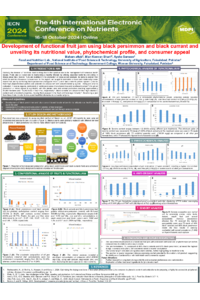
Fruits play a pivotal role in maintaining a healthy lifestyle by offering essential nutrients and aiding in illness prevention. Several fruits are reutilised in the production of value-added products like jams to extend their shelf life and for off-season consumption. In this regard, we sought to formulate a novel and nutritionally dense mixed fruit jam by combining black persimmon (Diospyros lotus L.) and black currants (Ribes nigrum L.) due to their high phytochemical profiles and potential as anti-oxidant and anti-inflammatory agents. Jam was developed by using a conventional thermal process in six treatments with different ratios (%) of black persimmon–black currant, T0 (0:100), T1 (20:80), T2 (40:60), T3 (60:40), T4 (80:20), and T5 (100:0), respectively, and evaluated comprehensively for proximate, mineral, and phytochemical analyses, and sensory evaluation (color, aroma, taste, flavour, appearance, texture, and overall acceptability). The proximate composition of jam formulations showed that carbohydrates were the most abundant component, ranging from 56.2% to 73.33%, with protein content between 2.21 and 11.24%, while the mineral analysis indicated a significant presence of potassium (20.21-608.66 mg/100g), along with other essential minerals like calcium, magnesium, zinc, and iron, demonstrating jam’s conservation ability to preserve nutrients. Through comprehensive in vitro analyses, we found that jam formulation T3 exhibited excellent physicochemical properties with higher total soluble solids (74°brix), titratable acidity (1.63%), optimal pH (3.29), and impressive phytochemical profile, having significantly high levels of phenols (8.9mg/g), flavonoids (1.59mg/g), tannins (35.44%), TPC (3.99g GAE/100g), TFC (0.98g CE/100g), and ascorbic acid (190.64mg/g) as compared to controls (T0 and T5). Interestingly, T3 also possessed good anti-oxidant potential, displaying DPPH radical scavenging activity (37.99%) and FRAP (388.98μmol of Fe2+/g). Sensory assessment showed that T3 received the highest acceptability score. In conclusion, our study highlights that black persimmon–black currant jam enriched with phenols and anti-oxidants could hold significant market potential, offering consumers a delicious and potentially health-promoting product.
Keywords
Black persimmon
black currant
functional jam
antioxidants
phenols
nutrition
Poster
sciforum-097787_Maham_Aftab.pdf
Grape juice pulp and its potential to attenuate dextran sodium sulfate-induced inflammation in ovo (Gallus gallus)
An evaluation of the effect of the incorporation of Nostoc commune (Cushuro) on the nutritional value of a compote for the elderly