Event submissions
Published
This submission belongs to the session S1. Plant-Based Diets: Health and Well-Being of the event The 4th International Electronic Conference on Nutrients
Published date
11 Oct, 2024
Academic Editor
'%3e%3cpath%20d='M12.6657%2010.9104C12.4185%2010.325%2012.0599%209.79327%2011.6097%209.34482C11.1609%208.89508%2010.6293%208.5365%2010.0442%208.28888C10.0389%208.28626%2010.0337%208.28495%2010.0285%208.28233C10.8446%207.69279%2011.3752%206.73249%2011.3752%205.64904C11.3752%203.8542%209.92103%202.39999%208.1262%202.39999C6.33136%202.39999%204.87715%203.8542%204.87715%205.64904C4.87715%206.73249%205.40774%207.69279%206.22393%208.28364C6.21869%208.28626%206.21345%208.28757%206.20821%208.29019C5.62129%208.5378%205.09463%208.89284%204.64265%209.34613C4.1929%209.79493%203.83432%2010.3266%203.58671%2010.9117C3.34345%2011.4845%203.21226%2012.0987%203.20023%2012.7209C3.19988%2012.7349%203.20233%2012.7488%203.20744%2012.7619C3.21255%2012.7749%203.22022%2012.7867%203.22998%2012.7968C3.23975%2012.8068%203.25142%2012.8147%203.26431%2012.8202C3.2772%2012.8256%203.29105%2012.8284%203.30504%2012.8284H4.09109C4.14874%2012.8284%204.19459%2012.7825%204.1959%2012.7262C4.2221%2011.7148%204.62823%2010.7676%205.34617%2010.0497C6.08899%209.30683%207.0755%208.89808%208.1262%208.89808C9.17689%208.89808%2010.1634%209.30683%2010.9062%2010.0497C11.6242%2010.7676%2012.0303%2011.7148%2012.0565%2012.7262C12.0578%2012.7838%2012.1037%2012.8284%2012.1613%2012.8284H12.9474C12.9613%2012.8284%2012.9752%2012.8256%2012.9881%2012.8202C13.001%2012.8147%2013.0126%2012.8068%2013.0224%2012.7968C13.0322%2012.7867%2013.0398%2012.7749%2013.0449%2012.7619C13.0501%2012.7488%2013.0525%2012.7349%2013.0522%2012.7209C13.0391%2012.0947%2012.9094%2011.4855%2012.6657%2010.9104ZM8.1262%207.9024C7.52486%207.9024%206.9589%207.6679%206.53312%207.24211C6.10733%206.81633%205.87283%206.25037%205.87283%205.64904C5.87283%205.0477%206.10733%204.48174%206.53312%204.05596C6.9589%203.63018%207.52486%203.39567%208.1262%203.39567C8.72753%203.39567%209.29349%203.63018%209.71927%204.05596C10.1451%204.48174%2010.3796%205.0477%2010.3796%205.64904C10.3796%206.25037%2010.1451%206.81633%209.71927%207.24211C9.29349%207.6679%208.72753%207.9024%208.1262%207.9024Z'%20fill='%235D1EE1'/%3e%3c/g%3e%3c/svg%3e) Mauro Lombardo
Mauro LombardoCitation
Ewelina Ewa Książek, Zuzanna Goluch, Marta Bochniak, The Impact of Berry Fruits from the Vaccinium Genus on Drug-Metabolizing Enzymes: A Systematic Review, in Proceedings of The 4th International Electronic Conference on Nutrients, 16 October–18 October 2024, MDPI: Basel, Switzerland
Share
Email
Facebook
Twitter
LinkedIn
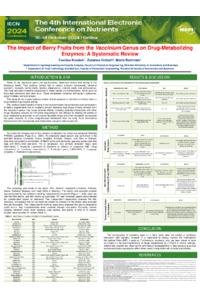
The Impact of Berry Fruits from the Vaccinium Genus on Drug-Metabolizing Enzymes: A Systematic Review

Ewelina Ewa Książek 1

Zuzanna Goluch 2
'%3e%3cpath%20d='M12.6647%2010.9104C12.4176%2010.325%2012.0589%209.7933%2011.6088%209.34485C11.16%208.89511%2010.6283%208.53653%2010.0432%208.28891C10.038%208.28629%2010.0327%208.28498%2010.0275%208.28236C10.8437%207.69282%2011.3743%206.73252%2011.3743%205.64907C11.3743%203.85423%209.92005%202.40002%208.12522%202.40002C6.33038%202.40002%204.87618%203.85423%204.87618%205.64907C4.87618%206.73252%205.40677%207.69282%206.22296%208.28367C6.21772%208.28629%206.21248%208.2876%206.20724%208.29022C5.62031%208.53783%205.09365%208.89287%204.64167%209.34616C4.19192%209.79496%203.83334%2010.3266%203.58573%2010.9117C3.34247%2011.4846%203.21128%2012.0987%203.19925%2012.721C3.1989%2012.735%203.20135%2012.7489%203.20646%2012.7619C3.21157%2012.7749%203.21924%2012.7868%203.22901%2012.7968C3.23877%2012.8068%203.25045%2012.8148%203.26334%2012.8202C3.27623%2012.8256%203.29007%2012.8284%203.30406%2012.8284H4.09012C4.14776%2012.8284%204.19362%2012.7825%204.19493%2012.7262C4.22113%2011.7148%204.62726%2010.7676%205.34519%2010.0497C6.08802%209.30686%207.07452%208.89811%208.12522%208.89811C9.17592%208.89811%2010.1624%209.30686%2010.9052%2010.0497C11.6232%2010.7676%2012.0293%2011.7148%2012.0555%2012.7262C12.0568%2012.7839%2012.1027%2012.8284%2012.1603%2012.8284H12.9464C12.9604%2012.8284%2012.9742%2012.8256%2012.9871%2012.8202C13%2012.8148%2013.0117%2012.8068%2013.0214%2012.7968C13.0312%2012.7868%2013.0389%2012.7749%2013.044%2012.7619C13.0491%2012.7489%2013.0515%2012.735%2013.0512%2012.721C13.0381%2012.0947%2012.9084%2011.4856%2012.6647%2010.9104ZM8.12522%207.90243C7.52388%207.90243%206.95792%207.66793%206.53214%207.24215C6.10636%206.81636%205.87185%206.2504%205.87185%205.64907C5.87185%205.04773%206.10636%204.48177%206.53214%204.05599C6.95792%203.63021%207.52388%203.3957%208.12522%203.3957C8.72655%203.3957%209.29252%203.63021%209.7183%204.05599C10.1441%204.48177%2010.3786%205.04773%2010.3786%205.64907C10.3786%206.2504%2010.1441%206.81636%209.7183%207.24215C9.29252%207.66793%208.72655%207.90243%208.12522%207.90243Z'%20fill='%235D1EE1'/%3e%3c/g%3e%3c/svg%3e)
Marta Bochniak 3
1. Department of Agroenginieering and Quality Analysis, Faculty of Production Engineering, Wroclaw University of Economics and Business,
2. Wroclaw University of Economics and Business, Faculty of Production Engineering, Department of Food Technology and Nutrition
3. Department of Agroenginieering and Quality Analysis, Faculty of Production Engineering,
Wroclaw University of Economics and Business,
Abstract
Plants of the Vaccinium genus are low-branched, deciduous shrubs that belong to the Ericaceae family. They produce berries rich in various phenolic compounds, including quercetin, myricetin, isorhamnetin, tannins, ellagitannins, phenolic acids, and anthocyanins. The most abundant bioactive compounds in these berries are anthocyanins, which give the fruits their distinctive dark blue color. These metabolites comprise anthocyanin aglycones, sugar moieties, and acyl groups.
This study aimed to systematically review clinical research on the effects of berry fruits on drug-metabolizing enzyme activity.
This review followed the PRISMA guidelines. We conducted electronic searches in academic databases such as Cochrane, Ebsco, PubMed, Embase, Scopus, and Web of Science. The primary inclusion criteria for all databases included the following: 1. keywords (Vaccinium, blueberry, bilberry, cranberry) and (“drug interactions” or “medicines interactions”), 2. publication years (1993–2022), 3. language (English), 4. publication type (article). Three reviewers independently conducted the search and selection process. Initial searches yielded 249 results. Two independent researchers then reviewed titles, abstracts, and full papers, excluding those not meeting the inclusion criteria through discussion. A total of 31 original studies were selected for review.
The positive health benefits of berry fruits have increased the production and consumption of dietary supplements rich in blueberry extract. However, high doses of berry extracts from the Vaccinium genus may cause adverse effects, including potential interactions with other drugs. Blueberry extracts can influence drug behavior and efficacy by altering the activity of drug-metabolizing enzymes, which convert lipophilic drugs and other xenobiotic compounds into polar products for more straightforward elimination from the body. Such interactions between berry fruit compounds and medications can pose risks to patients.
Keywords
cranberry
bilberry
blueberry
drug interactions
Poster
sciforum-097869 - Książek E..pdf
The potential influence of children's sex on the association between prenatal Mediterranean diet and offspring behavior.
Substitution of dairy with plant-based alternatives in German children and adolescents:
A modelling analysis on the nutritional and ecological sustainability impact
A modelling analysis on the nutritional and ecological sustainability impact