Event submissions
Published
This submission belongs to the session 1. Regenerative and Tissue Engineering of the event The 1st International Online Conference on Bioengineering
Published date
11 Oct, 2024
Academic Editor
'%3e%3cpath%20d='M12.6657%2010.9104C12.4185%2010.325%2012.0599%209.79327%2011.6097%209.34482C11.1609%208.89508%2010.6293%208.5365%2010.0442%208.28888C10.0389%208.28626%2010.0337%208.28495%2010.0285%208.28233C10.8446%207.69279%2011.3752%206.73249%2011.3752%205.64904C11.3752%203.8542%209.92103%202.39999%208.1262%202.39999C6.33136%202.39999%204.87715%203.8542%204.87715%205.64904C4.87715%206.73249%205.40774%207.69279%206.22393%208.28364C6.21869%208.28626%206.21345%208.28757%206.20821%208.29019C5.62129%208.5378%205.09463%208.89284%204.64265%209.34613C4.1929%209.79493%203.83432%2010.3266%203.58671%2010.9117C3.34345%2011.4845%203.21226%2012.0987%203.20023%2012.7209C3.19988%2012.7349%203.20233%2012.7488%203.20744%2012.7619C3.21255%2012.7749%203.22022%2012.7867%203.22998%2012.7968C3.23975%2012.8068%203.25142%2012.8147%203.26431%2012.8202C3.2772%2012.8256%203.29105%2012.8284%203.30504%2012.8284H4.09109C4.14874%2012.8284%204.19459%2012.7825%204.1959%2012.7262C4.2221%2011.7148%204.62823%2010.7676%205.34617%2010.0497C6.08899%209.30683%207.0755%208.89808%208.1262%208.89808C9.17689%208.89808%2010.1634%209.30683%2010.9062%2010.0497C11.6242%2010.7676%2012.0303%2011.7148%2012.0565%2012.7262C12.0578%2012.7838%2012.1037%2012.8284%2012.1613%2012.8284H12.9474C12.9613%2012.8284%2012.9752%2012.8256%2012.9881%2012.8202C13.001%2012.8147%2013.0126%2012.8068%2013.0224%2012.7968C13.0322%2012.7867%2013.0398%2012.7749%2013.0449%2012.7619C13.0501%2012.7488%2013.0525%2012.7349%2013.0522%2012.7209C13.0391%2012.0947%2012.9094%2011.4855%2012.6657%2010.9104ZM8.1262%207.9024C7.52486%207.9024%206.9589%207.6679%206.53312%207.24211C6.10733%206.81633%205.87283%206.25037%205.87283%205.64904C5.87283%205.0477%206.10733%204.48174%206.53312%204.05596C6.9589%203.63018%207.52486%203.39567%208.1262%203.39567C8.72753%203.39567%209.29349%203.63018%209.71927%204.05596C10.1451%204.48174%2010.3796%205.0477%2010.3796%205.64904C10.3796%206.25037%2010.1451%206.81633%209.71927%207.24211C9.29349%207.6679%208.72753%207.9024%208.1262%207.9024Z'%20fill='%235D1EE1'/%3e%3c/g%3e%3c/svg%3e) Elena A Jones
Elena A JonesCitation
Anna Kern, Natasha Maurmann, Maria Dahlem, Renato Siqueira, Patricia Pranke, Fibers made from the blend of PCL and bioglass powder through the electrospinning technique for bone regeneration , in Proceedings of The 1st International Online Conference on Bioengineering, 16 October–18 October 2024, MDPI: Basel, Switzerland
Share
Email
Facebook
Twitter
LinkedIn
Fibers made from the blend of PCL and bioglass powder through the electrospinning technique for bone regeneration
'%3e%3cpath%20d='M12.6647%2010.9104C12.4176%2010.325%2012.0589%209.7933%2011.6088%209.34485C11.16%208.89511%2010.6283%208.53653%2010.0432%208.28891C10.038%208.28629%2010.0327%208.28498%2010.0275%208.28236C10.8437%207.69282%2011.3743%206.73252%2011.3743%205.64907C11.3743%203.85423%209.92005%202.40002%208.12522%202.40002C6.33038%202.40002%204.87618%203.85423%204.87618%205.64907C4.87618%206.73252%205.40677%207.69282%206.22296%208.28367C6.21772%208.28629%206.21248%208.2876%206.20724%208.29022C5.62031%208.53783%205.09365%208.89287%204.64167%209.34616C4.19192%209.79496%203.83334%2010.3266%203.58573%2010.9117C3.34247%2011.4846%203.21128%2012.0987%203.19925%2012.721C3.1989%2012.735%203.20135%2012.7489%203.20646%2012.7619C3.21157%2012.7749%203.21924%2012.7868%203.22901%2012.7968C3.23877%2012.8068%203.25045%2012.8148%203.26334%2012.8202C3.27623%2012.8256%203.29007%2012.8284%203.30406%2012.8284H4.09012C4.14776%2012.8284%204.19362%2012.7825%204.19493%2012.7262C4.22113%2011.7148%204.62726%2010.7676%205.34519%2010.0497C6.08802%209.30686%207.07452%208.89811%208.12522%208.89811C9.17592%208.89811%2010.1624%209.30686%2010.9052%2010.0497C11.6232%2010.7676%2012.0293%2011.7148%2012.0555%2012.7262C12.0568%2012.7839%2012.1027%2012.8284%2012.1603%2012.8284H12.9464C12.9604%2012.8284%2012.9742%2012.8256%2012.9871%2012.8202C13%2012.8148%2013.0117%2012.8068%2013.0214%2012.7968C13.0312%2012.7868%2013.0389%2012.7749%2013.044%2012.7619C13.0491%2012.7489%2013.0515%2012.735%2013.0512%2012.721C13.0381%2012.0947%2012.9084%2011.4856%2012.6647%2010.9104ZM8.12522%207.90243C7.52388%207.90243%206.95792%207.66793%206.53214%207.24215C6.10636%206.81636%205.87185%206.2504%205.87185%205.64907C5.87185%205.04773%206.10636%204.48177%206.53214%204.05599C6.95792%203.63021%207.52388%203.3957%208.12522%203.3957C8.72655%203.3957%209.29252%203.63021%209.7183%204.05599C10.1441%204.48177%2010.3786%205.04773%2010.3786%205.64907C10.3786%206.2504%2010.1441%206.81636%209.7183%207.24215C9.29252%207.66793%208.72655%207.90243%208.12522%207.90243Z'%20fill='%235D1EE1'/%3e%3c/g%3e%3c/svg%3e)
Anna Kern 1
Natasha Maurmann 1
Maria Dahlem 1
Renato Siqueira 2
Patricia Pranke 1,3
1. Laboratório de Hematologia e Células-tronco, Faculdade de Farmácia, Universidade Federal do Rio Grande do Sul, Brazil
2. Pesquisador Independente
3. Instituto de Pesquisa com Células-tronco (IPCT), Brazil
Abstract
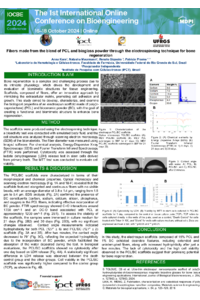
The development of novel scaffolds for bone tissue engineering offers a promising approach to promote bone regeneration. This study aimed to develop a support structure using electrospinning, combining PCL fibers and bioglass powder for bone regeneration. The solution contained 15% PCL/1% bioglass. Tests analyzed the structure's chemical and biological properties. Support structures were produced using electrospinning, and fiber diameter was measured using ImageJ on scanning electron microscopy (SEM) images. Chemical analysis used Energy-Dispersive X-ray Spectroscopy (EDS) and Fourier Transform Infrared Spectroscopy (FTIR) spectroscopy. Cytotoxicity was assessed through a lactate dehydrogenase (LDH) release test on tooth stem cells. Cell viability was analyzed using the 3-4,5-Dimethyl-2-thiazolyl)-2,5-diphenyl-2H-tetrazolium bromide (MTT) assay, and alkaline phosphatase activity evaluated osteogenic differentiation. The PCL/BC scaffolds exhibited elongated, granule-free fibers, with a mean diameter and standard deviation of 3.8 ± 1.4 µm. EDS revealed BC constituents (carbon, sodium, calcium, silicon, phosphorus and oxygen), indicating the incorporation of BC powder into the fibers. FTIR spectroscopy showed C=O and OC-O interactions. The contact angle indicated hydrophobicity in PCL, PCL/BC, but after two minutes, the PCL/BC scaffold exhibited the expected hydrophilicity. PCL/BC scaffolds did not show cytotoxicity based on LDH release. In osteogenic media, cell viability was higher in PCL/BC compared to PCL and standard well plates after six days, while lactate dehydrogenase levels remained similar across the plate, PCL, and PCL/BC groups, showing higher activity than the undifferentiated control. This study demonstrated that electrospun PCL/BC structures with 15% PCL and 1% BC had advantageous properties, including long fibers and increased hydrophilicity. These structures showed no cytotoxicity and high cell viability, suggesting their potential for bone regeneration.
Support: The Office of Naval Research Global (ONRG Award N62909-21-1-2026); National Institute of Science and Technology for Regenerative Medicine (INCT-Regenera); Stem Cell Research Institute (IPCT).
Keywords
bioceramics
composites
stem/stromal cells
tissue engineering.
Poster
097781.pdf
Exploratory simulation study on high-frequency detection of cell internal structures
Characterization of Cortical Patterns Using High-Density EEG in Motor Tasks Related to Musical Note Execution