Event submissions
Published
This submission belongs to the session S1. Plant-Based Diets: Health and Well-Being of the event The 4th International Electronic Conference on Nutrients
Published date
11 Oct, 2024
Academic Editor
'%3e%3cpath%20d='M12.6657%2010.9104C12.4185%2010.325%2012.0599%209.79327%2011.6097%209.34482C11.1609%208.89508%2010.6293%208.5365%2010.0442%208.28888C10.0389%208.28626%2010.0337%208.28495%2010.0285%208.28233C10.8446%207.69279%2011.3752%206.73249%2011.3752%205.64904C11.3752%203.8542%209.92103%202.39999%208.1262%202.39999C6.33136%202.39999%204.87715%203.8542%204.87715%205.64904C4.87715%206.73249%205.40774%207.69279%206.22393%208.28364C6.21869%208.28626%206.21345%208.28757%206.20821%208.29019C5.62129%208.5378%205.09463%208.89284%204.64265%209.34613C4.1929%209.79493%203.83432%2010.3266%203.58671%2010.9117C3.34345%2011.4845%203.21226%2012.0987%203.20023%2012.7209C3.19988%2012.7349%203.20233%2012.7488%203.20744%2012.7619C3.21255%2012.7749%203.22022%2012.7867%203.22998%2012.7968C3.23975%2012.8068%203.25142%2012.8147%203.26431%2012.8202C3.2772%2012.8256%203.29105%2012.8284%203.30504%2012.8284H4.09109C4.14874%2012.8284%204.19459%2012.7825%204.1959%2012.7262C4.2221%2011.7148%204.62823%2010.7676%205.34617%2010.0497C6.08899%209.30683%207.0755%208.89808%208.1262%208.89808C9.17689%208.89808%2010.1634%209.30683%2010.9062%2010.0497C11.6242%2010.7676%2012.0303%2011.7148%2012.0565%2012.7262C12.0578%2012.7838%2012.1037%2012.8284%2012.1613%2012.8284H12.9474C12.9613%2012.8284%2012.9752%2012.8256%2012.9881%2012.8202C13.001%2012.8147%2013.0126%2012.8068%2013.0224%2012.7968C13.0322%2012.7867%2013.0398%2012.7749%2013.0449%2012.7619C13.0501%2012.7488%2013.0525%2012.7349%2013.0522%2012.7209C13.0391%2012.0947%2012.9094%2011.4855%2012.6657%2010.9104ZM8.1262%207.9024C7.52486%207.9024%206.9589%207.6679%206.53312%207.24211C6.10733%206.81633%205.87283%206.25037%205.87283%205.64904C5.87283%205.0477%206.10733%204.48174%206.53312%204.05596C6.9589%203.63018%207.52486%203.39567%208.1262%203.39567C8.72753%203.39567%209.29349%203.63018%209.71927%204.05596C10.1451%204.48174%2010.3796%205.0477%2010.3796%205.64904C10.3796%206.25037%2010.1451%206.81633%209.71927%207.24211C9.29349%207.6679%208.72753%207.9024%208.1262%207.9024Z'%20fill='%235D1EE1'/%3e%3c/g%3e%3c/svg%3e) Mauro Lombardo
Mauro LombardoCitation
Giulia Carioni, Federica Fiori, Rachele Bianco, Nicoletta Pellegrini, Maria Parpinel, Patrizia Gnagnarella, Updating the Italian Food Composition Database (BDA) for a more accurate nutritional assessment of plant-based diets., in Proceedings of The 4th International Electronic Conference on Nutrients, 16 October–18 October 2024, MDPI: Basel, Switzerland
Share
Email
Facebook
Twitter
LinkedIn
Updating the Italian Food Composition Database (BDA) for a more accurate nutritional assessment of plant-based diets.
'%3e%3cpath%20d='M12.6647%2010.9104C12.4176%2010.325%2012.0589%209.7933%2011.6088%209.34485C11.16%208.89511%2010.6283%208.53653%2010.0432%208.28891C10.038%208.28629%2010.0327%208.28498%2010.0275%208.28236C10.8437%207.69282%2011.3743%206.73252%2011.3743%205.64907C11.3743%203.85423%209.92005%202.40002%208.12522%202.40002C6.33038%202.40002%204.87618%203.85423%204.87618%205.64907C4.87618%206.73252%205.40677%207.69282%206.22296%208.28367C6.21772%208.28629%206.21248%208.2876%206.20724%208.29022C5.62031%208.53783%205.09365%208.89287%204.64167%209.34616C4.19192%209.79496%203.83334%2010.3266%203.58573%2010.9117C3.34247%2011.4846%203.21128%2012.0987%203.19925%2012.721C3.1989%2012.735%203.20135%2012.7489%203.20646%2012.7619C3.21157%2012.7749%203.21924%2012.7868%203.22901%2012.7968C3.23877%2012.8068%203.25045%2012.8148%203.26334%2012.8202C3.27623%2012.8256%203.29007%2012.8284%203.30406%2012.8284H4.09012C4.14776%2012.8284%204.19362%2012.7825%204.19493%2012.7262C4.22113%2011.7148%204.62726%2010.7676%205.34519%2010.0497C6.08802%209.30686%207.07452%208.89811%208.12522%208.89811C9.17592%208.89811%2010.1624%209.30686%2010.9052%2010.0497C11.6232%2010.7676%2012.0293%2011.7148%2012.0555%2012.7262C12.0568%2012.7839%2012.1027%2012.8284%2012.1603%2012.8284H12.9464C12.9604%2012.8284%2012.9742%2012.8256%2012.9871%2012.8202C13%2012.8148%2013.0117%2012.8068%2013.0214%2012.7968C13.0312%2012.7868%2013.0389%2012.7749%2013.044%2012.7619C13.0491%2012.7489%2013.0515%2012.735%2013.0512%2012.721C13.0381%2012.0947%2012.9084%2011.4856%2012.6647%2010.9104ZM8.12522%207.90243C7.52388%207.90243%206.95792%207.66793%206.53214%207.24215C6.10636%206.81636%205.87185%206.2504%205.87185%205.64907C5.87185%205.04773%206.10636%204.48177%206.53214%204.05599C6.95792%203.63021%207.52388%203.3957%208.12522%203.3957C8.72655%203.3957%209.29252%203.63021%209.7183%204.05599C10.1441%204.48177%2010.3786%205.04773%2010.3786%205.64907C10.3786%206.2504%2010.1441%206.81636%209.7183%207.24215C9.29252%207.66793%208.72655%207.90243%208.12522%207.90243Z'%20fill='%235D1EE1'/%3e%3c/g%3e%3c/svg%3e)
Giulia Carioni 1,2
Federica Fiori 2
Rachele Bianco 2
Nicoletta Pellegrini 3
Maria Parpinel 2
Patrizia Gnagnarella 1
1. Division of Epidemiology and Biostatistics, European Institute of Oncology IRCCS, Milan, 20141, Italy.
2. Department of Medicine (DMED), University of Udine, Udine, 33100, Italy.
3. Department of Agricultural, Food, Environmental and Animal Sciences, University of Udine, Udine, 33100, Italy
Abstract
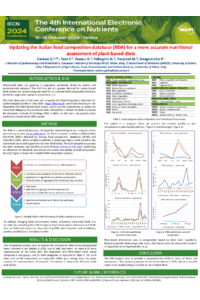
Introduction. Plant-based diets are growing in popularity worldwide, driven by health and environmental concerns. This has led to a greater demand for plant substitutes for animal-based foods (e.g., meat analogues), emphasizing the need for an up-to-date food composition database (FCDB) for vegetables and plant-based foods. Our aim is to update the Food Composition Database for Epidemiological Studies in Italy (BDA, https://bda.ieo.it), focusing on the Vegetables and plant-based foods group, and to use this updated tool to assess the nutritional adequacy of plant-based diets followed by a sample of adults accessing the European Institute of Oncology in Milan. In this work, we present some preliminary results of the BDA update.
Methods. The BDA is compiled according to international standards (www.eurofir.org) and involves the use of data from pre-existing sources: national and international FCDBs, scientific articles, nutritional labels, analyses from food industries and laboratories. When no data are available, the recipe approach is implemented.
Results. The Vegetables and plant-based foods group comprises 6 sub-groups and 23 food categories, currently including 175 items. Efforts will be needed to update the composition data of pre-existing food items, and to add others by consulting the latest consumption data and verifying the availability of foods in the Italian market. For each food item, data on 89 components will be compiled: edible part, energy (kcal, kJ), water, 17 macronutrients, 13 minerals, 15 vitamins, 21 fatty acids, 18 amino acids and alcohol. This new BDA update will be integrated into a web application to measure dietary intake.
Conclusions. The BDA project aims to offer an inclusive FCDB in terms of items and components. This update will serve as a valuable resource for epidemiological studies focused on plant-based diets. The dietary assessment results will support the development of recommendations to promote the consumption of nutritionally balanced plant-based diets.
Keywords
Food Composition Database
Plant-based foods
Dietary intake
Poster
Sciforum-097872_Carioni Giulia.pdf
Plant-Based Nutrients as Therapeutic Agents in Neurodegenerative Diseases
In-silico investigation of Phyllanthus niruri phytochemicals as Hepatic Fibrosis modulators