Event submissions
Published
This submission belongs to the session 3. Biomedical Biomaterials of the event The 1st International Online Conference on Bioengineering
Published date
11 Oct, 2024
Academic Editor
'%3e%3cpath%20d='M12.6657%2010.9104C12.4185%2010.325%2012.0599%209.79327%2011.6097%209.34482C11.1609%208.89508%2010.6293%208.5365%2010.0442%208.28888C10.0389%208.28626%2010.0337%208.28495%2010.0285%208.28233C10.8446%207.69279%2011.3752%206.73249%2011.3752%205.64904C11.3752%203.8542%209.92103%202.39999%208.1262%202.39999C6.33136%202.39999%204.87715%203.8542%204.87715%205.64904C4.87715%206.73249%205.40774%207.69279%206.22393%208.28364C6.21869%208.28626%206.21345%208.28757%206.20821%208.29019C5.62129%208.5378%205.09463%208.89284%204.64265%209.34613C4.1929%209.79493%203.83432%2010.3266%203.58671%2010.9117C3.34345%2011.4845%203.21226%2012.0987%203.20023%2012.7209C3.19988%2012.7349%203.20233%2012.7488%203.20744%2012.7619C3.21255%2012.7749%203.22022%2012.7867%203.22998%2012.7968C3.23975%2012.8068%203.25142%2012.8147%203.26431%2012.8202C3.2772%2012.8256%203.29105%2012.8284%203.30504%2012.8284H4.09109C4.14874%2012.8284%204.19459%2012.7825%204.1959%2012.7262C4.2221%2011.7148%204.62823%2010.7676%205.34617%2010.0497C6.08899%209.30683%207.0755%208.89808%208.1262%208.89808C9.17689%208.89808%2010.1634%209.30683%2010.9062%2010.0497C11.6242%2010.7676%2012.0303%2011.7148%2012.0565%2012.7262C12.0578%2012.7838%2012.1037%2012.8284%2012.1613%2012.8284H12.9474C12.9613%2012.8284%2012.9752%2012.8256%2012.9881%2012.8202C13.001%2012.8147%2013.0126%2012.8068%2013.0224%2012.7968C13.0322%2012.7867%2013.0398%2012.7749%2013.0449%2012.7619C13.0501%2012.7488%2013.0525%2012.7349%2013.0522%2012.7209C13.0391%2012.0947%2012.9094%2011.4855%2012.6657%2010.9104ZM8.1262%207.9024C7.52486%207.9024%206.9589%207.6679%206.53312%207.24211C6.10733%206.81633%205.87283%206.25037%205.87283%205.64904C5.87283%205.0477%206.10733%204.48174%206.53312%204.05596C6.9589%203.63018%207.52486%203.39567%208.1262%203.39567C8.72753%203.39567%209.29349%203.63018%209.71927%204.05596C10.1451%204.48174%2010.3796%205.0477%2010.3796%205.64904C10.3796%206.25037%2010.1451%206.81633%209.71927%207.24211C9.29349%207.6679%208.72753%207.9024%208.1262%207.9024Z'%20fill='%235D1EE1'/%3e%3c/g%3e%3c/svg%3e) Gary Bowlin
Gary BowlinCitation
Chaymaa Hachimi Alaoui, Gildas Rethore, Pierre Weiss, Ahmed Fatimi, Naturally derived biopolymers in 3D bioprinting for biomedical applications, in Proceedings of The 1st International Online Conference on Bioengineering, 16 October–18 October 2024, MDPI: Basel, Switzerland
Share
Email
Facebook
Twitter
LinkedIn
Naturally derived biopolymers in 3D bioprinting for biomedical applications
'%3e%3cpath%20d='M12.6647%2010.9104C12.4176%2010.325%2012.0589%209.7933%2011.6088%209.34485C11.16%208.89511%2010.6283%208.53653%2010.0432%208.28891C10.038%208.28629%2010.0327%208.28498%2010.0275%208.28236C10.8437%207.69282%2011.3743%206.73252%2011.3743%205.64907C11.3743%203.85423%209.92005%202.40002%208.12522%202.40002C6.33038%202.40002%204.87618%203.85423%204.87618%205.64907C4.87618%206.73252%205.40677%207.69282%206.22296%208.28367C6.21772%208.28629%206.21248%208.2876%206.20724%208.29022C5.62031%208.53783%205.09365%208.89287%204.64167%209.34616C4.19192%209.79496%203.83334%2010.3266%203.58573%2010.9117C3.34247%2011.4846%203.21128%2012.0987%203.19925%2012.721C3.1989%2012.735%203.20135%2012.7489%203.20646%2012.7619C3.21157%2012.7749%203.21924%2012.7868%203.22901%2012.7968C3.23877%2012.8068%203.25045%2012.8148%203.26334%2012.8202C3.27623%2012.8256%203.29007%2012.8284%203.30406%2012.8284H4.09012C4.14776%2012.8284%204.19362%2012.7825%204.19493%2012.7262C4.22113%2011.7148%204.62726%2010.7676%205.34519%2010.0497C6.08802%209.30686%207.07452%208.89811%208.12522%208.89811C9.17592%208.89811%2010.1624%209.30686%2010.9052%2010.0497C11.6232%2010.7676%2012.0293%2011.7148%2012.0555%2012.7262C12.0568%2012.7839%2012.1027%2012.8284%2012.1603%2012.8284H12.9464C12.9604%2012.8284%2012.9742%2012.8256%2012.9871%2012.8202C13%2012.8148%2013.0117%2012.8068%2013.0214%2012.7968C13.0312%2012.7868%2013.0389%2012.7749%2013.044%2012.7619C13.0491%2012.7489%2013.0515%2012.735%2013.0512%2012.721C13.0381%2012.0947%2012.9084%2011.4856%2012.6647%2010.9104ZM8.12522%207.90243C7.52388%207.90243%206.95792%207.66793%206.53214%207.24215C6.10636%206.81636%205.87185%206.2504%205.87185%205.64907C5.87185%205.04773%206.10636%204.48177%206.53214%204.05599C6.95792%203.63021%207.52388%203.3957%208.12522%203.3957C8.72655%203.3957%209.29252%203.63021%209.7183%204.05599C10.1441%204.48177%2010.3786%205.04773%2010.3786%205.64907C10.3786%206.2504%2010.1441%206.81636%209.7183%207.24215C9.29252%207.66793%208.72655%207.90243%208.12522%207.90243Z'%20fill='%235D1EE1'/%3e%3c/g%3e%3c/svg%3e)
Chaymaa Hachimi Alaoui 1,2
Gildas Rethore 3
Pierre Weiss 3

Ahmed Fatimi 1
1. Chemical Science and Engineering Research Team (ERSIC), Department of Chemistry, Polydisciplinary Faculty of Beni Mellal (FPBM), Sultan Moulay Slimane University (USMS), P.O. Box 592 Mghila, Beni Mellal 23000, Morocco
2. Nantes Université, Oniris, Univ Angers, INSERM, Regenerative Medicine and Skeleton, RmeS, UMR1229, F-44000 Nantes, France
3. Nantes Université, Oniris, Univ Angers, CHU Nantes, INSERM, Regenerative Medicine and Skeleton, RmeS, UMR1229, F-44000 Nantes, France
Abstract
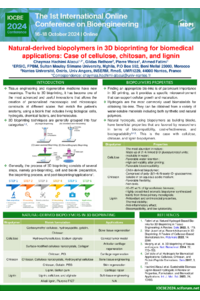
Tissue engineering and regenerative medicine have new meanings. Three-dimensional bioprinting has become one of the most advanced and useful innovations that allows the creation of personalized macroscopic and microscopic constructs at different scales that match a patient’s anatomy. Generally, the process of 3D bioprinting consists of several steps, namely pre-bioprinting, cell and bioink preparation, the bioprinting process, and post-bioprinting/applications. Intensive research efforts are currently underway to develop highly printable and biocompatible materials. Among the variety of bioprinting materials (i.e., biomaterial inks), naturally derived hydrogels have attracted great interest due to their beneficial properties in terms of biocompatibility, cost effectiveness, and biodegradability. Among them are cellulose, chitosan, and lignin. Cellulose is the most abundant biopolymer in nature; it has various advantages over others, such as good mechanical and barrier properties. Moreover, chitosan biopolymer constitutes a promising candidate for the preparation of hydrogels for application in this field due to its beneficial properties, such as its antimicrobial activity and structural resemblance to natural glycosaminoglycans. Furthermore, due to the non-cytotoxicity, biocompatibility, biodegradability, mechanical strength, and reactivity of the lignin biopolymer, it has been considered an excellent candidate to manufacture hydrogels for 3D bioprinting applications. The capacity of 3D bioprinting of these biopolymer-based hydrogels has been demonstrated in the regeneration of different damaged tissues, including cartilage, bone, muscle, skin, blood vessels, and other biological tissues. In this study, we provide a comprehensive review of the formulation and use of three functional biomaterials as ink-based hydrogels. Cellulose, chitosan, and lignin are comprehensively discussed, and an examination of the status of the biomedical application of these biopolymer-based hydrogels for 3D bioprinting is then provided.
Keywords
3D bioprinting
hydrogels
cellulose
chitosan
lignin
biomedical applications
Poster
097773.pdf
Characterization of Cortical Patterns Using High-Density EEG in Motor Tasks Related to Musical Note Execution
Cutting-Edge Bioink Technology: Using Decellularized Skin for Enhanced 3D Bioprinting