Event submissions
Published
This submission belongs to the session 6. Biochemical Engineering of the event The 1st International Online Conference on Bioengineering
Published date
11 Oct, 2024
Academic Editor
'%3e%3cpath%20d='M12.6657%2010.9104C12.4185%2010.325%2012.0599%209.79327%2011.6097%209.34482C11.1609%208.89508%2010.6293%208.5365%2010.0442%208.28888C10.0389%208.28626%2010.0337%208.28495%2010.0285%208.28233C10.8446%207.69279%2011.3752%206.73249%2011.3752%205.64904C11.3752%203.8542%209.92103%202.39999%208.1262%202.39999C6.33136%202.39999%204.87715%203.8542%204.87715%205.64904C4.87715%206.73249%205.40774%207.69279%206.22393%208.28364C6.21869%208.28626%206.21345%208.28757%206.20821%208.29019C5.62129%208.5378%205.09463%208.89284%204.64265%209.34613C4.1929%209.79493%203.83432%2010.3266%203.58671%2010.9117C3.34345%2011.4845%203.21226%2012.0987%203.20023%2012.7209C3.19988%2012.7349%203.20233%2012.7488%203.20744%2012.7619C3.21255%2012.7749%203.22022%2012.7867%203.22998%2012.7968C3.23975%2012.8068%203.25142%2012.8147%203.26431%2012.8202C3.2772%2012.8256%203.29105%2012.8284%203.30504%2012.8284H4.09109C4.14874%2012.8284%204.19459%2012.7825%204.1959%2012.7262C4.2221%2011.7148%204.62823%2010.7676%205.34617%2010.0497C6.08899%209.30683%207.0755%208.89808%208.1262%208.89808C9.17689%208.89808%2010.1634%209.30683%2010.9062%2010.0497C11.6242%2010.7676%2012.0303%2011.7148%2012.0565%2012.7262C12.0578%2012.7838%2012.1037%2012.8284%2012.1613%2012.8284H12.9474C12.9613%2012.8284%2012.9752%2012.8256%2012.9881%2012.8202C13.001%2012.8147%2013.0126%2012.8068%2013.0224%2012.7968C13.0322%2012.7867%2013.0398%2012.7749%2013.0449%2012.7619C13.0501%2012.7488%2013.0525%2012.7349%2013.0522%2012.7209C13.0391%2012.0947%2012.9094%2011.4855%2012.6657%2010.9104ZM8.1262%207.9024C7.52486%207.9024%206.9589%207.6679%206.53312%207.24211C6.10733%206.81633%205.87283%206.25037%205.87283%205.64904C5.87283%205.0477%206.10733%204.48174%206.53312%204.05596C6.9589%203.63018%207.52486%203.39567%208.1262%203.39567C8.72753%203.39567%209.29349%203.63018%209.71927%204.05596C10.1451%204.48174%2010.3796%205.0477%2010.3796%205.64904C10.3796%206.25037%2010.1451%206.81633%209.71927%207.24211C9.29349%207.6679%208.72753%207.9024%208.1262%207.9024Z'%20fill='%235D1EE1'/%3e%3c/g%3e%3c/svg%3e) Liang Luo
Liang LuoCitation
Grzegorz Karpiński, Kamil Wierzchowski, Mateusz Bartczak, Mateusz Kawka, Antonina Kawka, Jakub Kornatowski, Katarzyna Sykłowska-Baranek, Maciej Pilarek, Transfected Nicotiana tabacum BY-2 cell cultivation in a bioreactor with wave-induced agitation, in Proceedings of The 1st International Online Conference on Bioengineering, 16 October–18 October 2024, MDPI: Basel, Switzerland
Share
Email
Facebook
Twitter
LinkedIn
Transfected Nicotiana tabacum BY-2 cell cultivation in a bioreactor with wave-induced agitation
'%3e%3cpath%20d='M12.6647%2010.9104C12.4176%2010.325%2012.0589%209.7933%2011.6088%209.34485C11.16%208.89511%2010.6283%208.53653%2010.0432%208.28891C10.038%208.28629%2010.0327%208.28498%2010.0275%208.28236C10.8437%207.69282%2011.3743%206.73252%2011.3743%205.64907C11.3743%203.85423%209.92005%202.40002%208.12522%202.40002C6.33038%202.40002%204.87618%203.85423%204.87618%205.64907C4.87618%206.73252%205.40677%207.69282%206.22296%208.28367C6.21772%208.28629%206.21248%208.2876%206.20724%208.29022C5.62031%208.53783%205.09365%208.89287%204.64167%209.34616C4.19192%209.79496%203.83334%2010.3266%203.58573%2010.9117C3.34247%2011.4846%203.21128%2012.0987%203.19925%2012.721C3.1989%2012.735%203.20135%2012.7489%203.20646%2012.7619C3.21157%2012.7749%203.21924%2012.7868%203.22901%2012.7968C3.23877%2012.8068%203.25045%2012.8148%203.26334%2012.8202C3.27623%2012.8256%203.29007%2012.8284%203.30406%2012.8284H4.09012C4.14776%2012.8284%204.19362%2012.7825%204.19493%2012.7262C4.22113%2011.7148%204.62726%2010.7676%205.34519%2010.0497C6.08802%209.30686%207.07452%208.89811%208.12522%208.89811C9.17592%208.89811%2010.1624%209.30686%2010.9052%2010.0497C11.6232%2010.7676%2012.0293%2011.7148%2012.0555%2012.7262C12.0568%2012.7839%2012.1027%2012.8284%2012.1603%2012.8284H12.9464C12.9604%2012.8284%2012.9742%2012.8256%2012.9871%2012.8202C13%2012.8148%2013.0117%2012.8068%2013.0214%2012.7968C13.0312%2012.7868%2013.0389%2012.7749%2013.044%2012.7619C13.0491%2012.7489%2013.0515%2012.735%2013.0512%2012.721C13.0381%2012.0947%2012.9084%2011.4856%2012.6647%2010.9104ZM8.12522%207.90243C7.52388%207.90243%206.95792%207.66793%206.53214%207.24215C6.10636%206.81636%205.87185%206.2504%205.87185%205.64907C5.87185%205.04773%206.10636%204.48177%206.53214%204.05599C6.95792%203.63021%207.52388%203.3957%208.12522%203.3957C8.72655%203.3957%209.29252%203.63021%209.7183%204.05599C10.1441%204.48177%2010.3786%205.04773%2010.3786%205.64907C10.3786%206.2504%2010.1441%206.81636%209.7183%207.24215C9.29252%207.66793%208.72655%207.90243%208.12522%207.90243Z'%20fill='%235D1EE1'/%3e%3c/g%3e%3c/svg%3e)
Grzegorz Karpiński 1
Kamil Wierzchowski 1
Mateusz Bartczak 1
Mateusz Kawka 2
Antonina Kawka 2
Jakub Kornatowski 2
Katarzyna Sykłowska-Baranek 2
Maciej Pilarek 1
1. Faculty of Chemical and Process Engineering, Warsaw University of Technology, Warsaw, Poland
2. Faculty of Pharmacy, Medical University of Warsaw, Warsaw, Poland
Abstract
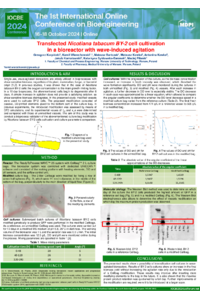
Plant biotechnology has presented the scientific world with a plethora of challenges and possibilities for decades. One of the most meticulously studied features of plant biomass is callus—unorganised, undifferentiated cells with the ability to heal wounded plant tissues or even regenerate whole organisms. Nicotiana tabacum Bright Yellow-2 (BY-2) is one of the most commonly used callus cell lines in research. These cells are able to grow as a suspension, and given their eukaryotic nature, with genetic modifications, they are able to produce mammalian proteins. This feature makes them extremely interesting, as they are likely to be used in biosimilar product manufacturing in the future. They are, however, prone to shear stress, which is the reason a bubble–free, wave–agitated bioreactor was used in this study.
ReadyToProcess WAVE 25 was used, along with a 2 L culture vessel, and cultures were performed, monitoring the effect of changing the angle (α) and frequency (ω) of the oscillations on the BY-2 cells. The dissolved oxygen level was monitored, and the biomass concentration was measured. Moreover, Western blotting was conducted to determine the presence of a protein product.
It was determined that the highest product activity and biomass proliferation was obtained at 0–2 days at α = 6° and ω = 20 min-1, 3–5 days at α = 8° and ω = 26 min-1, and 6–10 days at α = 12° and ω = 30 min-1.
In conclusion, a correlation between the mixing conditions and the process’s efficiency was observed. However, further research is needed to establish the exact nature of the observed effects.
Keywords
BY-2 cells
single-use bioreactors
wave-type agitation
bioprocess intensification
Poster
IOCBE_2024_sciforum-097736_KW.pdf
Cutting-Edge Bioink Technology: Using Decellularized Skin for Enhanced 3D Bioprinting
Investigating the Role of Insulin-like Growth Factor (IGF) Axis in the Osteogenic Differentiation of Osteoporotic Periodontal Stem Cells