Event submissions
Published
This submission belongs to the session S2. Innovation in Dietary Choices of the event The 4th International Electronic Conference on Nutrients
Published date
11 Oct, 2024
Academic Editor
'%3e%3cpath%20d='M12.6657%2010.9104C12.4185%2010.325%2012.0599%209.79327%2011.6097%209.34482C11.1609%208.89508%2010.6293%208.5365%2010.0442%208.28888C10.0389%208.28626%2010.0337%208.28495%2010.0285%208.28233C10.8446%207.69279%2011.3752%206.73249%2011.3752%205.64904C11.3752%203.8542%209.92103%202.39999%208.1262%202.39999C6.33136%202.39999%204.87715%203.8542%204.87715%205.64904C4.87715%206.73249%205.40774%207.69279%206.22393%208.28364C6.21869%208.28626%206.21345%208.28757%206.20821%208.29019C5.62129%208.5378%205.09463%208.89284%204.64265%209.34613C4.1929%209.79493%203.83432%2010.3266%203.58671%2010.9117C3.34345%2011.4845%203.21226%2012.0987%203.20023%2012.7209C3.19988%2012.7349%203.20233%2012.7488%203.20744%2012.7619C3.21255%2012.7749%203.22022%2012.7867%203.22998%2012.7968C3.23975%2012.8068%203.25142%2012.8147%203.26431%2012.8202C3.2772%2012.8256%203.29105%2012.8284%203.30504%2012.8284H4.09109C4.14874%2012.8284%204.19459%2012.7825%204.1959%2012.7262C4.2221%2011.7148%204.62823%2010.7676%205.34617%2010.0497C6.08899%209.30683%207.0755%208.89808%208.1262%208.89808C9.17689%208.89808%2010.1634%209.30683%2010.9062%2010.0497C11.6242%2010.7676%2012.0303%2011.7148%2012.0565%2012.7262C12.0578%2012.7838%2012.1037%2012.8284%2012.1613%2012.8284H12.9474C12.9613%2012.8284%2012.9752%2012.8256%2012.9881%2012.8202C13.001%2012.8147%2013.0126%2012.8068%2013.0224%2012.7968C13.0322%2012.7867%2013.0398%2012.7749%2013.0449%2012.7619C13.0501%2012.7488%2013.0525%2012.7349%2013.0522%2012.7209C13.0391%2012.0947%2012.9094%2011.4855%2012.6657%2010.9104ZM8.1262%207.9024C7.52486%207.9024%206.9589%207.6679%206.53312%207.24211C6.10733%206.81633%205.87283%206.25037%205.87283%205.64904C5.87283%205.0477%206.10733%204.48174%206.53312%204.05596C6.9589%203.63018%207.52486%203.39567%208.1262%203.39567C8.72753%203.39567%209.29349%203.63018%209.71927%204.05596C10.1451%204.48174%2010.3796%205.0477%2010.3796%205.64904C10.3796%206.25037%2010.1451%206.81633%209.71927%207.24211C9.29349%207.6679%208.72753%207.9024%208.1262%207.9024Z'%20fill='%235D1EE1'/%3e%3c/g%3e%3c/svg%3e) Elad Tako
Elad TakoCitation
Stephanie Lopes Morais, Eduarda Perreira, Michelle Castanheira, Marlene Santos, Valentina Domingues, Cristina Delerue-Matos, Maria Fátima Barroso, Plant honey origin authentication: Use of Electrochemical Genosensors for Food Safety and Quality Control, in Proceedings of The 4th International Electronic Conference on Nutrients, 16 October–18 October 2024, MDPI: Basel, Switzerland
Share
Email
Facebook
Twitter
LinkedIn
Plant honey origin authentication: Use of Electrochemical Genosensors for Food Safety and Quality Control
'%3e%3cpath%20d='M12.6647%2010.9104C12.4176%2010.325%2012.0589%209.7933%2011.6088%209.34485C11.16%208.89511%2010.6283%208.53653%2010.0432%208.28891C10.038%208.28629%2010.0327%208.28498%2010.0275%208.28236C10.8437%207.69282%2011.3743%206.73252%2011.3743%205.64907C11.3743%203.85423%209.92005%202.40002%208.12522%202.40002C6.33038%202.40002%204.87618%203.85423%204.87618%205.64907C4.87618%206.73252%205.40677%207.69282%206.22296%208.28367C6.21772%208.28629%206.21248%208.2876%206.20724%208.29022C5.62031%208.53783%205.09365%208.89287%204.64167%209.34616C4.19192%209.79496%203.83334%2010.3266%203.58573%2010.9117C3.34247%2011.4846%203.21128%2012.0987%203.19925%2012.721C3.1989%2012.735%203.20135%2012.7489%203.20646%2012.7619C3.21157%2012.7749%203.21924%2012.7868%203.22901%2012.7968C3.23877%2012.8068%203.25045%2012.8148%203.26334%2012.8202C3.27623%2012.8256%203.29007%2012.8284%203.30406%2012.8284H4.09012C4.14776%2012.8284%204.19362%2012.7825%204.19493%2012.7262C4.22113%2011.7148%204.62726%2010.7676%205.34519%2010.0497C6.08802%209.30686%207.07452%208.89811%208.12522%208.89811C9.17592%208.89811%2010.1624%209.30686%2010.9052%2010.0497C11.6232%2010.7676%2012.0293%2011.7148%2012.0555%2012.7262C12.0568%2012.7839%2012.1027%2012.8284%2012.1603%2012.8284H12.9464C12.9604%2012.8284%2012.9742%2012.8256%2012.9871%2012.8202C13%2012.8148%2013.0117%2012.8068%2013.0214%2012.7968C13.0312%2012.7868%2013.0389%2012.7749%2013.044%2012.7619C13.0491%2012.7489%2013.0515%2012.735%2013.0512%2012.721C13.0381%2012.0947%2012.9084%2011.4856%2012.6647%2010.9104ZM8.12522%207.90243C7.52388%207.90243%206.95792%207.66793%206.53214%207.24215C6.10636%206.81636%205.87185%206.2504%205.87185%205.64907C5.87185%205.04773%206.10636%204.48177%206.53214%204.05599C6.95792%203.63021%207.52388%203.3957%208.12522%203.3957C8.72655%203.3957%209.29252%203.63021%209.7183%204.05599C10.1441%204.48177%2010.3786%205.04773%2010.3786%205.64907C10.3786%206.2504%2010.1441%206.81636%209.7183%207.24215C9.29252%207.66793%208.72655%207.90243%208.12522%207.90243Z'%20fill='%235D1EE1'/%3e%3c/g%3e%3c/svg%3e)
Stephanie Lopes Morais 1
Eduarda Perreira 2
Michelle Castanheira 1
Marlene Santos 2
Valentina Domingues 1

Cristina Delerue-Matos 1

Maria Fátima Barroso 1
1. REQUIMTE|LAQV, Instituto Superior de Engenharia do Porto, Instituto Politécnico do Porto, Porto, Portugal
2. REQUIMTE|LAQV, Escola Superior de Saúde, Instituto Politécnico do Porto, Porto, Portugal
Abstract
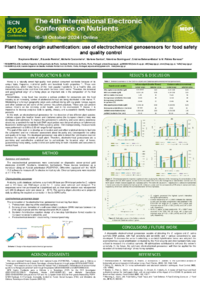
Honey is a natural high-quality food product consumed worldwide due to its diverse nutritional profile and beneficial medical properties. These factors, along with honey’s unique sweet taste and odour, make it one of the most popular products for a healthy diet. Nevertheless, food fraud is an increasing problem with various impacts on the economy, health, and in the environment, as honey prices are established based on its botanical origin and nutritional composition. In the European Union, honey is one of the most adulterated products found in the market. Mislabeling of a honey’s geographic origin and unethical mixing with low-grade honeys, sugars, and other substances are some of the common fraudulent practices. Hence, it is imperative to develop analytical tools to quickly, cheaply, and successfully identify fraudulent products. In this work, an electrochemical genosensor for the detection of two different plant species, Calluna vulgaris (the heather flower) and Castanea sativa (the chestnut tree), was developed and optimized. Analyzing public database platforms, a 98 base pair DNA target probe for Calluna vulgaris and a 103 base pair DNA target probe for Castanea sativa were selected and designed. The developed genosensor resulted from a linear self-assembled monolayer of the DNA capture probe of each respective species immobilized onto screen-printed gold electrodes and mercaptohexanol. To improve the genosensor’s selectivity and avoid strong secondary structures, a sandwich format for both DNA target probes was designed using a complementary fluorescein isothiocyanate-labelled DNA signaling probe. Chronoamperometry measurements were performed in a 0.13 to 2.00 nM range for both species. The developed genosensor was able to detect the hybridization reaction between the synthetic strands of each plant. Therefore, electrochemical genosensors offer a promising and cost-effective analytical tool to authenticate the botanical origin of honey, guaranteeing honey safety, quality control, and authenticity for both industries and consumers and showing potential for application in combatting fraud.
Keywords
Chronoamperometry
Electrochemical genosensor
Food fraud
Honey authenticity
Quality control
Poster
sciforum-097900-Morais.pdf
Content of manganese in the wild edible mushroom species of Agaricus bitorquis in the English city of Leicester.
Nutritional Supplement Potential of Cyperus rotundus for Metabolic Syndrome