Event submissions
Published
This submission belongs to the session S1. Plant-Based Diets: Health and Well-Being of the event The 4th International Electronic Conference on Nutrients
Published date
11 Oct, 2024
Academic Editor
'%3e%3cpath%20d='M12.6657%2010.9104C12.4185%2010.325%2012.0599%209.79327%2011.6097%209.34482C11.1609%208.89508%2010.6293%208.5365%2010.0442%208.28888C10.0389%208.28626%2010.0337%208.28495%2010.0285%208.28233C10.8446%207.69279%2011.3752%206.73249%2011.3752%205.64904C11.3752%203.8542%209.92103%202.39999%208.1262%202.39999C6.33136%202.39999%204.87715%203.8542%204.87715%205.64904C4.87715%206.73249%205.40774%207.69279%206.22393%208.28364C6.21869%208.28626%206.21345%208.28757%206.20821%208.29019C5.62129%208.5378%205.09463%208.89284%204.64265%209.34613C4.1929%209.79493%203.83432%2010.3266%203.58671%2010.9117C3.34345%2011.4845%203.21226%2012.0987%203.20023%2012.7209C3.19988%2012.7349%203.20233%2012.7488%203.20744%2012.7619C3.21255%2012.7749%203.22022%2012.7867%203.22998%2012.7968C3.23975%2012.8068%203.25142%2012.8147%203.26431%2012.8202C3.2772%2012.8256%203.29105%2012.8284%203.30504%2012.8284H4.09109C4.14874%2012.8284%204.19459%2012.7825%204.1959%2012.7262C4.2221%2011.7148%204.62823%2010.7676%205.34617%2010.0497C6.08899%209.30683%207.0755%208.89808%208.1262%208.89808C9.17689%208.89808%2010.1634%209.30683%2010.9062%2010.0497C11.6242%2010.7676%2012.0303%2011.7148%2012.0565%2012.7262C12.0578%2012.7838%2012.1037%2012.8284%2012.1613%2012.8284H12.9474C12.9613%2012.8284%2012.9752%2012.8256%2012.9881%2012.8202C13.001%2012.8147%2013.0126%2012.8068%2013.0224%2012.7968C13.0322%2012.7867%2013.0398%2012.7749%2013.0449%2012.7619C13.0501%2012.7488%2013.0525%2012.7349%2013.0522%2012.7209C13.0391%2012.0947%2012.9094%2011.4855%2012.6657%2010.9104ZM8.1262%207.9024C7.52486%207.9024%206.9589%207.6679%206.53312%207.24211C6.10733%206.81633%205.87283%206.25037%205.87283%205.64904C5.87283%205.0477%206.10733%204.48174%206.53312%204.05596C6.9589%203.63018%207.52486%203.39567%208.1262%203.39567C8.72753%203.39567%209.29349%203.63018%209.71927%204.05596C10.1451%204.48174%2010.3796%205.0477%2010.3796%205.64904C10.3796%206.25037%2010.1451%206.81633%209.71927%207.24211C9.29349%207.6679%208.72753%207.9024%208.1262%207.9024Z'%20fill='%235D1EE1'/%3e%3c/g%3e%3c/svg%3e) Mauro Lombardo
Mauro LombardoCitation
Amarachi Goodness Mmezi, Oluchi Judith Osuala, Chinyere Constance Ezemba, Chukwuma Chukwuemeka Chukwuma, Charles Nnadi Okeke, The Antimicrobial Activity of Curry Leaf (Murraya keonigii) Extracts: An In Vitro Study, in Proceedings of The 4th International Electronic Conference on Nutrients, 16 October–18 October 2024, MDPI: Basel, Switzerland
Share
Email
Facebook
Twitter
LinkedIn
The Antimicrobial Activity of Curry Leaf (Murraya keonigii) Extracts: An In Vitro Study
'%3e%3cpath%20d='M12.6647%2010.9104C12.4176%2010.325%2012.0589%209.7933%2011.6088%209.34485C11.16%208.89511%2010.6283%208.53653%2010.0432%208.28891C10.038%208.28629%2010.0327%208.28498%2010.0275%208.28236C10.8437%207.69282%2011.3743%206.73252%2011.3743%205.64907C11.3743%203.85423%209.92005%202.40002%208.12522%202.40002C6.33038%202.40002%204.87618%203.85423%204.87618%205.64907C4.87618%206.73252%205.40677%207.69282%206.22296%208.28367C6.21772%208.28629%206.21248%208.2876%206.20724%208.29022C5.62031%208.53783%205.09365%208.89287%204.64167%209.34616C4.19192%209.79496%203.83334%2010.3266%203.58573%2010.9117C3.34247%2011.4846%203.21128%2012.0987%203.19925%2012.721C3.1989%2012.735%203.20135%2012.7489%203.20646%2012.7619C3.21157%2012.7749%203.21924%2012.7868%203.22901%2012.7968C3.23877%2012.8068%203.25045%2012.8148%203.26334%2012.8202C3.27623%2012.8256%203.29007%2012.8284%203.30406%2012.8284H4.09012C4.14776%2012.8284%204.19362%2012.7825%204.19493%2012.7262C4.22113%2011.7148%204.62726%2010.7676%205.34519%2010.0497C6.08802%209.30686%207.07452%208.89811%208.12522%208.89811C9.17592%208.89811%2010.1624%209.30686%2010.9052%2010.0497C11.6232%2010.7676%2012.0293%2011.7148%2012.0555%2012.7262C12.0568%2012.7839%2012.1027%2012.8284%2012.1603%2012.8284H12.9464C12.9604%2012.8284%2012.9742%2012.8256%2012.9871%2012.8202C13%2012.8148%2013.0117%2012.8068%2013.0214%2012.7968C13.0312%2012.7868%2013.0389%2012.7749%2013.044%2012.7619C13.0491%2012.7489%2013.0515%2012.735%2013.0512%2012.721C13.0381%2012.0947%2012.9084%2011.4856%2012.6647%2010.9104ZM8.12522%207.90243C7.52388%207.90243%206.95792%207.66793%206.53214%207.24215C6.10636%206.81636%205.87185%206.2504%205.87185%205.64907C5.87185%205.04773%206.10636%204.48177%206.53214%204.05599C6.95792%203.63021%207.52388%203.3957%208.12522%203.3957C8.72655%203.3957%209.29252%203.63021%209.7183%204.05599C10.1441%204.48177%2010.3786%205.04773%2010.3786%205.64907C10.3786%206.2504%2010.1441%206.81636%209.7183%207.24215C9.29252%207.66793%208.72655%207.90243%208.12522%207.90243Z'%20fill='%235D1EE1'/%3e%3c/g%3e%3c/svg%3e)
Amarachi Goodness Mmezi 1
Oluchi Judith Osuala 2
Chinyere Constance Ezemba 3
Chukwuma Chukwuemeka Chukwuma 4

Charles Nnadi Okeke 5
1. Department of pharmaceutical microbiology and biotechnology, Madonna University Elele Rivers State Nigeria
2. Department of Pharmaceutical Microbiology and Biotechnology, Faculty of Pharmacy, Madonna University, Elele, Rivers State, Nigeria, 511101, Nigeria
3. Microbiology, Chychy Gilgal laboratory and consultancy services, Ichida Anambra State Nigeria
4. Department of biochemistry, Madonna University Elele Rivers State Nigeria
5. Department of Pharmaceutical Chemistry, University of Nigeria Nsukka Nigeria
Abstract
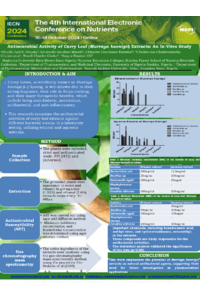
Introduction: Curry leaves, scientifically known as Murraya keonigii (L.) Spreng, are well known for their strong fragrance, their role in Asian cooking, and their many therapeutic benefits, which include their anti-diabetic, antioxidant, antibacterial, and anti-inflammatory properties.
Aim: This research study examines the antibacterial activities of curry leaf extracts against different bacterial strains in a laboratory setting utilizing ethanol and aqueous solvents.
Methodology: The curry leaves were dried using air, ground into a powder, and soaked in ethanol and water to produce extracts. The antibacterial activity of these extracts was assessed using the agar well diffusion technique against Staphylococcus aureus, Bacillus subtilis, Escherichia coli, Salmonella spp, and Candida albicans. The extracts were analyzed using gas chromatography–mass spectrometry (GC-MS) to identify bioactive chemicals.
Results: The findings indicated substantial antibacterial activity, with ethanol extracts demonstrating higher effectiveness. The Minimum Inhibitory Concentration (MIC) and Minimum Bactericidal Concentration (MBC) were measured to assess the efficacy of the ethanol extract, particularly against Bacillus sp. and Candida albicans. The GC-MS analysis revealed the presence of important chemicals, including hexadecanoic acid, methyl ester, cyclotetrasiloxane, and octamethyl, in the extracts. These compounds are likely responsible for the extracts' antibacterial activities. Statistical analysis validated the significance of the data (p<0.05).
Conclusions: This work emphasizes the potential of Murraya keonigii extracts as natural antibacterial agents, supporting the need for future investigation of their pharmaceutical applications.
Keywords
Murranya koenigii
Antimicrobial agent
Gas Chromatography-Mass Spectrometry
Minimum Inhibitory Concentration
Minimum Bactericidal Concentaration
Poster
poster presentation Amara publication.pdf
A Comparison of the Pharmacognostic, Nutritional, and Phytochemical Parameters of Moringa Concanensis from Three Different Geographical Sources in India
Nutritional characterization of neglected and unexploited seed (oil) from Klainedoxa gabonesis (Shrew African bush mango): A novel study