Event submissions
Published
This submission belongs to the session S1. Plant-Based Diets: Health and Well-Being of the event The 4th International Electronic Conference on Nutrients
Published date
11 Oct, 2024
Academic Editor
'%3e%3cpath%20d='M12.6657%2010.9104C12.4185%2010.325%2012.0599%209.79327%2011.6097%209.34482C11.1609%208.89508%2010.6293%208.5365%2010.0442%208.28888C10.0389%208.28626%2010.0337%208.28495%2010.0285%208.28233C10.8446%207.69279%2011.3752%206.73249%2011.3752%205.64904C11.3752%203.8542%209.92103%202.39999%208.1262%202.39999C6.33136%202.39999%204.87715%203.8542%204.87715%205.64904C4.87715%206.73249%205.40774%207.69279%206.22393%208.28364C6.21869%208.28626%206.21345%208.28757%206.20821%208.29019C5.62129%208.5378%205.09463%208.89284%204.64265%209.34613C4.1929%209.79493%203.83432%2010.3266%203.58671%2010.9117C3.34345%2011.4845%203.21226%2012.0987%203.20023%2012.7209C3.19988%2012.7349%203.20233%2012.7488%203.20744%2012.7619C3.21255%2012.7749%203.22022%2012.7867%203.22998%2012.7968C3.23975%2012.8068%203.25142%2012.8147%203.26431%2012.8202C3.2772%2012.8256%203.29105%2012.8284%203.30504%2012.8284H4.09109C4.14874%2012.8284%204.19459%2012.7825%204.1959%2012.7262C4.2221%2011.7148%204.62823%2010.7676%205.34617%2010.0497C6.08899%209.30683%207.0755%208.89808%208.1262%208.89808C9.17689%208.89808%2010.1634%209.30683%2010.9062%2010.0497C11.6242%2010.7676%2012.0303%2011.7148%2012.0565%2012.7262C12.0578%2012.7838%2012.1037%2012.8284%2012.1613%2012.8284H12.9474C12.9613%2012.8284%2012.9752%2012.8256%2012.9881%2012.8202C13.001%2012.8147%2013.0126%2012.8068%2013.0224%2012.7968C13.0322%2012.7867%2013.0398%2012.7749%2013.0449%2012.7619C13.0501%2012.7488%2013.0525%2012.7349%2013.0522%2012.7209C13.0391%2012.0947%2012.9094%2011.4855%2012.6657%2010.9104ZM8.1262%207.9024C7.52486%207.9024%206.9589%207.6679%206.53312%207.24211C6.10733%206.81633%205.87283%206.25037%205.87283%205.64904C5.87283%205.0477%206.10733%204.48174%206.53312%204.05596C6.9589%203.63018%207.52486%203.39567%208.1262%203.39567C8.72753%203.39567%209.29349%203.63018%209.71927%204.05596C10.1451%204.48174%2010.3796%205.0477%2010.3796%205.64904C10.3796%206.25037%2010.1451%206.81633%209.71927%207.24211C9.29349%207.6679%208.72753%207.9024%208.1262%207.9024Z'%20fill='%235D1EE1'/%3e%3c/g%3e%3c/svg%3e) Mauro Lombardo
Mauro LombardoCitation
Gypsy Mallam, Chawalit Kocharunchitt, Enzo Palombo, Vandana Gulati, The antimicrobial and antioxidant properties of Syzygium smithii, an Australian bush food , in Proceedings of The 4th International Electronic Conference on Nutrients, 16 October–18 October 2024, MDPI: Basel, Switzerland
Share
Email
Facebook
Twitter
LinkedIn
The antimicrobial and antioxidant properties of Syzygium smithii, an Australian bush food
'%3e%3cpath%20d='M12.6647%2010.9104C12.4176%2010.325%2012.0589%209.7933%2011.6088%209.34485C11.16%208.89511%2010.6283%208.53653%2010.0432%208.28891C10.038%208.28629%2010.0327%208.28498%2010.0275%208.28236C10.8437%207.69282%2011.3743%206.73252%2011.3743%205.64907C11.3743%203.85423%209.92005%202.40002%208.12522%202.40002C6.33038%202.40002%204.87618%203.85423%204.87618%205.64907C4.87618%206.73252%205.40677%207.69282%206.22296%208.28367C6.21772%208.28629%206.21248%208.2876%206.20724%208.29022C5.62031%208.53783%205.09365%208.89287%204.64167%209.34616C4.19192%209.79496%203.83334%2010.3266%203.58573%2010.9117C3.34247%2011.4846%203.21128%2012.0987%203.19925%2012.721C3.1989%2012.735%203.20135%2012.7489%203.20646%2012.7619C3.21157%2012.7749%203.21924%2012.7868%203.22901%2012.7968C3.23877%2012.8068%203.25045%2012.8148%203.26334%2012.8202C3.27623%2012.8256%203.29007%2012.8284%203.30406%2012.8284H4.09012C4.14776%2012.8284%204.19362%2012.7825%204.19493%2012.7262C4.22113%2011.7148%204.62726%2010.7676%205.34519%2010.0497C6.08802%209.30686%207.07452%208.89811%208.12522%208.89811C9.17592%208.89811%2010.1624%209.30686%2010.9052%2010.0497C11.6232%2010.7676%2012.0293%2011.7148%2012.0555%2012.7262C12.0568%2012.7839%2012.1027%2012.8284%2012.1603%2012.8284H12.9464C12.9604%2012.8284%2012.9742%2012.8256%2012.9871%2012.8202C13%2012.8148%2013.0117%2012.8068%2013.0214%2012.7968C13.0312%2012.7868%2013.0389%2012.7749%2013.044%2012.7619C13.0491%2012.7489%2013.0515%2012.735%2013.0512%2012.721C13.0381%2012.0947%2012.9084%2011.4856%2012.6647%2010.9104ZM8.12522%207.90243C7.52388%207.90243%206.95792%207.66793%206.53214%207.24215C6.10636%206.81636%205.87185%206.2504%205.87185%205.64907C5.87185%205.04773%206.10636%204.48177%206.53214%204.05599C6.95792%203.63021%207.52388%203.3957%208.12522%203.3957C8.72655%203.3957%209.29252%203.63021%209.7183%204.05599C10.1441%204.48177%2010.3786%205.04773%2010.3786%205.64907C10.3786%206.2504%2010.1441%206.81636%209.7183%207.24215C9.29252%207.66793%208.72655%207.90243%208.12522%207.90243Z'%20fill='%235D1EE1'/%3e%3c/g%3e%3c/svg%3e)
Gypsy Mallam 1,2
Chawalit Kocharunchitt 2
Enzo Palombo 3
Vandana Gulati 1
1. Biomedical Science, School of Science and Technology, University of New England, Armidale, NSW 2351
2. Tasmanian Institute of Agriculture, University of Tasmania, Sandy Bay Campus, Tasmania 7005
3. School of Science, Computing, Engineering and Technologies, Swinburne University of Technology, Hawthorn, Victoria 3122
Abstract
Introduction
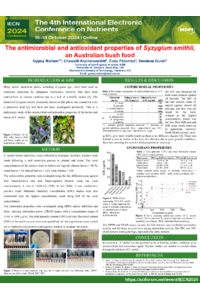
Many native Australian plants, including Syzygium spp., have been used as traditional medicines by indigenous Australians; however, they have been underutilised in modern medicine due to a lack of scientific studies. The berries of Syzygium smithii, commonly known as lilly pilly, are considered to be a protective food and have not been investigated previously. This is a preliminary study of the antimicrobial and antioxidant properties of the berries and leaves of Syzygium smithii.
Method
Syzygium smithii berries and leaves were extracted using an in-house cold extraction method in ethanol and water. Their antimicrobial properties were investigated using disc diffusion and minimum inhibitory concentration (MIC) assays against Gram-positive (Bacillus cereus, Enterococcus faecalis, Listeria monocytogenes, Staphylococcus aureus) and Gram-negative (Escherichia coli, Klebsiella pneumoniae, Pseudomonas aeruginosa, Salmonella enterica) bacteria. Their antioxidant capacity was investigated using 2,2-diphenyl-1-picrylhydrazyl (DPPH) radical inhibition, ferric reducing antioxidant power (FRAP), total phenolic content (TPC), and total flavonoid content (TFC) assays.
Results
During the disc diffusion assay, the ethanolic berry and leaf extracts showed inhibitory potential against all Gram-positive bacteria, except for S. aureus for the berry extract. The MIC of the ethanolic leaf extract was found to be 25 mg/ml against all bacteria excluding S. enterica, and that of the aqueous leaf extract was between 12.5 and 25 mg/ml against all bacteria excluding K. pneumoniae and S. enterica. TPC and TFC were found to be 663.44 µg gallic acid/mg and 489.80 µg quercetin/mg, respectively, and the antioxidant capacity of the aqueous berry extract had an IC50 of 38.79 µg/ml against DPPH.
Conclusion
In conclusion, Syzygium smithii has the potential to be utilised by modern medicine as a potential antimicrobial and antioxidant agent. Further studies are needed to confirm these biological activities of Syzygium smithii.
Keywords
Syzygium smithii
antimicrobial
antioxidant
medicinal
Poster
sciforum-098329-Gypsy Mallam.pdf
Unveiling Consumer Preferences for Whole-Wheat and White Bread in Kosovo
Integrative Approaches in Renal Nutrition: Combining Conventional Dietetics with Ayurveda Nutrition Practices