Event submissions
Published
This submission belongs to the session S2. Innovation in Dietary Choices of the event The 4th International Electronic Conference on Nutrients
Published date
11 Oct, 2024
Academic Editor
'%3e%3cpath%20d='M12.6657%2010.9104C12.4185%2010.325%2012.0599%209.79327%2011.6097%209.34482C11.1609%208.89508%2010.6293%208.5365%2010.0442%208.28888C10.0389%208.28626%2010.0337%208.28495%2010.0285%208.28233C10.8446%207.69279%2011.3752%206.73249%2011.3752%205.64904C11.3752%203.8542%209.92103%202.39999%208.1262%202.39999C6.33136%202.39999%204.87715%203.8542%204.87715%205.64904C4.87715%206.73249%205.40774%207.69279%206.22393%208.28364C6.21869%208.28626%206.21345%208.28757%206.20821%208.29019C5.62129%208.5378%205.09463%208.89284%204.64265%209.34613C4.1929%209.79493%203.83432%2010.3266%203.58671%2010.9117C3.34345%2011.4845%203.21226%2012.0987%203.20023%2012.7209C3.19988%2012.7349%203.20233%2012.7488%203.20744%2012.7619C3.21255%2012.7749%203.22022%2012.7867%203.22998%2012.7968C3.23975%2012.8068%203.25142%2012.8147%203.26431%2012.8202C3.2772%2012.8256%203.29105%2012.8284%203.30504%2012.8284H4.09109C4.14874%2012.8284%204.19459%2012.7825%204.1959%2012.7262C4.2221%2011.7148%204.62823%2010.7676%205.34617%2010.0497C6.08899%209.30683%207.0755%208.89808%208.1262%208.89808C9.17689%208.89808%2010.1634%209.30683%2010.9062%2010.0497C11.6242%2010.7676%2012.0303%2011.7148%2012.0565%2012.7262C12.0578%2012.7838%2012.1037%2012.8284%2012.1613%2012.8284H12.9474C12.9613%2012.8284%2012.9752%2012.8256%2012.9881%2012.8202C13.001%2012.8147%2013.0126%2012.8068%2013.0224%2012.7968C13.0322%2012.7867%2013.0398%2012.7749%2013.0449%2012.7619C13.0501%2012.7488%2013.0525%2012.7349%2013.0522%2012.7209C13.0391%2012.0947%2012.9094%2011.4855%2012.6657%2010.9104ZM8.1262%207.9024C7.52486%207.9024%206.9589%207.6679%206.53312%207.24211C6.10733%206.81633%205.87283%206.25037%205.87283%205.64904C5.87283%205.0477%206.10733%204.48174%206.53312%204.05596C6.9589%203.63018%207.52486%203.39567%208.1262%203.39567C8.72753%203.39567%209.29349%203.63018%209.71927%204.05596C10.1451%204.48174%2010.3796%205.0477%2010.3796%205.64904C10.3796%206.25037%2010.1451%206.81633%209.71927%207.24211C9.29349%207.6679%208.72753%207.9024%208.1262%207.9024Z'%20fill='%235D1EE1'/%3e%3c/g%3e%3c/svg%3e) Elad Tako
Elad TakoCitation
Claudia Valqui, María Laura Gonzales, Mayra Anticona, Saby Zegarra, Melissa Vivanco, Nutritional composition of kimchi made from Oryza sativa (rice) and Solanum tuberosum L. (peruvian potato), in Proceedings of The 4th International Electronic Conference on Nutrients, 16 October–18 October 2024, MDPI: Basel, Switzerland
Share
Email
Facebook
Twitter
LinkedIn
Nutritional composition of kimchi made from Oryza sativa (rice) and Solanum tuberosum L. (peruvian potato)
'%3e%3cpath%20d='M12.6647%2010.9104C12.4176%2010.325%2012.0589%209.7933%2011.6088%209.34485C11.16%208.89511%2010.6283%208.53653%2010.0432%208.28891C10.038%208.28629%2010.0327%208.28498%2010.0275%208.28236C10.8437%207.69282%2011.3743%206.73252%2011.3743%205.64907C11.3743%203.85423%209.92005%202.40002%208.12522%202.40002C6.33038%202.40002%204.87618%203.85423%204.87618%205.64907C4.87618%206.73252%205.40677%207.69282%206.22296%208.28367C6.21772%208.28629%206.21248%208.2876%206.20724%208.29022C5.62031%208.53783%205.09365%208.89287%204.64167%209.34616C4.19192%209.79496%203.83334%2010.3266%203.58573%2010.9117C3.34247%2011.4846%203.21128%2012.0987%203.19925%2012.721C3.1989%2012.735%203.20135%2012.7489%203.20646%2012.7619C3.21157%2012.7749%203.21924%2012.7868%203.22901%2012.7968C3.23877%2012.8068%203.25045%2012.8148%203.26334%2012.8202C3.27623%2012.8256%203.29007%2012.8284%203.30406%2012.8284H4.09012C4.14776%2012.8284%204.19362%2012.7825%204.19493%2012.7262C4.22113%2011.7148%204.62726%2010.7676%205.34519%2010.0497C6.08802%209.30686%207.07452%208.89811%208.12522%208.89811C9.17592%208.89811%2010.1624%209.30686%2010.9052%2010.0497C11.6232%2010.7676%2012.0293%2011.7148%2012.0555%2012.7262C12.0568%2012.7839%2012.1027%2012.8284%2012.1603%2012.8284H12.9464C12.9604%2012.8284%2012.9742%2012.8256%2012.9871%2012.8202C13%2012.8148%2013.0117%2012.8068%2013.0214%2012.7968C13.0312%2012.7868%2013.0389%2012.7749%2013.044%2012.7619C13.0491%2012.7489%2013.0515%2012.735%2013.0512%2012.721C13.0381%2012.0947%2012.9084%2011.4856%2012.6647%2010.9104ZM8.12522%207.90243C7.52388%207.90243%206.95792%207.66793%206.53214%207.24215C6.10636%206.81636%205.87185%206.2504%205.87185%205.64907C5.87185%205.04773%206.10636%204.48177%206.53214%204.05599C6.95792%203.63021%207.52388%203.3957%208.12522%203.3957C8.72655%203.3957%209.29252%203.63021%209.7183%204.05599C10.1441%204.48177%2010.3786%205.04773%2010.3786%205.64907C10.3786%206.2504%2010.1441%206.81636%209.7183%207.24215C9.29252%207.66793%208.72655%207.90243%208.12522%207.90243Z'%20fill='%235D1EE1'/%3e%3c/g%3e%3c/svg%3e)
Claudia Valqui 1
María Laura Gonzales 1

Mayra Anticona 2,3
Saby Zegarra 1
Melissa Vivanco 1
1. Carrera de Nutrición y Dietética, Facultad de Ciencias de la Salud, Universidad Peruana de Ciencias Aplicadas, Av. Alameda San Marcos 370, 15067, Chorrillos, Lima, Perú.
2. Unidad de Investigación en Nutrición, Salud, Alimentos Funcionales y Nutracéuticos, Universidad San Ignacio de Loyola (UNUSAN-USIL), Av. La Fontana 550, 15024, Lima Perú.
3. Carrera de Nutrición y Dietética, Facultad de Ciencias de la Salud, Universidad San Ignacio de Loyola, Av. La Fontana 550, 15024, Lima Perú.
Abstract
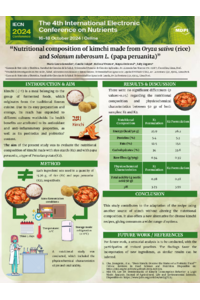
Introduction: Kimchi (김치) is a meal belonging to the group of fermented foods which originates from traditional Korean cuisine. Due to its easy preparation and storage, its reach has expanded to different cultures worldwide. Its health benefits are attributed to its antioxidant and anti-inflammatory properties, as well as its probiotic and prebiotic content. The objective of the present study was to evaluate the nutritional composition of kimchi made with rice starch (K1) and with Peruvian potato (K2).
Methodology: The two formulations of kimchi were prepared with the same ingredients and fermented in the same conditions. The only difference in ingredients was the portion of starch from rice (K1) and Peruvian potato (K2). Each ingredient was used in a quantity of 15.76 g, contributing to a total final product weight of 1970g. A nutritional study was conducted, which included the physicochemical characteristics of pH and total acidity.
Results: There were no significant differences (p values>0.05) in nutritional composition and physicochemical characteristics between samples K1 and K2. The results of the nutritional composition analysis were described for 50 g of the product. Formulation K1 had a content of 25.9 kcal, and the distribution of macronutrients was 5.4% proteins, 12.5% fats, 34% carbohydrates, and 0.34 g raw fiber. The other formulation K2 presented a content of 26.2 kcal, 5.3% proteins, 13.1% fats, 33.6% carbohydrates, and 0.39 g of raw fiber.
Conclusions: The analysis revealed that there are no statistically significant differences in nutritional values between the two formulations (p values>0.05). Nonetheless, this study contributes to the diversification of kimchi recipes, offering a broader range of options for consumers.
Keywords
fermented food
kimchi
peruvian potato
starch
nutritional study.
Poster
sciforum-097794-Gonzáles_Valqui.pdf
Edible oils in the diet of high school students: How judo training and physical activity shape healthy habits.
The Mediterranean Diet as a Sustainable Dietary Pattern for Sports Nutrition: from the Tradition of Typical Products to the Athletes’ Nutritional Requirements