Event submissions
Published
This submission belongs to the session 5. Biosignal Processing of the event The 1st International Online Conference on Bioengineering
Published date
11 Oct, 2024
Academic Editor
'%3e%3cpath%20d='M12.6657%2010.9104C12.4185%2010.325%2012.0599%209.79327%2011.6097%209.34482C11.1609%208.89508%2010.6293%208.5365%2010.0442%208.28888C10.0389%208.28626%2010.0337%208.28495%2010.0285%208.28233C10.8446%207.69279%2011.3752%206.73249%2011.3752%205.64904C11.3752%203.8542%209.92103%202.39999%208.1262%202.39999C6.33136%202.39999%204.87715%203.8542%204.87715%205.64904C4.87715%206.73249%205.40774%207.69279%206.22393%208.28364C6.21869%208.28626%206.21345%208.28757%206.20821%208.29019C5.62129%208.5378%205.09463%208.89284%204.64265%209.34613C4.1929%209.79493%203.83432%2010.3266%203.58671%2010.9117C3.34345%2011.4845%203.21226%2012.0987%203.20023%2012.7209C3.19988%2012.7349%203.20233%2012.7488%203.20744%2012.7619C3.21255%2012.7749%203.22022%2012.7867%203.22998%2012.7968C3.23975%2012.8068%203.25142%2012.8147%203.26431%2012.8202C3.2772%2012.8256%203.29105%2012.8284%203.30504%2012.8284H4.09109C4.14874%2012.8284%204.19459%2012.7825%204.1959%2012.7262C4.2221%2011.7148%204.62823%2010.7676%205.34617%2010.0497C6.08899%209.30683%207.0755%208.89808%208.1262%208.89808C9.17689%208.89808%2010.1634%209.30683%2010.9062%2010.0497C11.6242%2010.7676%2012.0303%2011.7148%2012.0565%2012.7262C12.0578%2012.7838%2012.1037%2012.8284%2012.1613%2012.8284H12.9474C12.9613%2012.8284%2012.9752%2012.8256%2012.9881%2012.8202C13.001%2012.8147%2013.0126%2012.8068%2013.0224%2012.7968C13.0322%2012.7867%2013.0398%2012.7749%2013.0449%2012.7619C13.0501%2012.7488%2013.0525%2012.7349%2013.0522%2012.7209C13.0391%2012.0947%2012.9094%2011.4855%2012.6657%2010.9104ZM8.1262%207.9024C7.52486%207.9024%206.9589%207.6679%206.53312%207.24211C6.10733%206.81633%205.87283%206.25037%205.87283%205.64904C5.87283%205.0477%206.10733%204.48174%206.53312%204.05596C6.9589%203.63018%207.52486%203.39567%208.1262%203.39567C8.72753%203.39567%209.29349%203.63018%209.71927%204.05596C10.1451%204.48174%2010.3796%205.0477%2010.3796%205.64904C10.3796%206.25037%2010.1451%206.81633%209.71927%207.24211C9.29349%207.6679%208.72753%207.9024%208.1262%207.9024Z'%20fill='%235D1EE1'/%3e%3c/g%3e%3c/svg%3e) Andrea Cataldo
Andrea CataldoCitation
Ana Lía Albarracin Bava, Fernando Daniel Farfán, Juan David Romero-Ante, Juan Sebastián Montenegro-Bravo, Eduardo Fernández-Jover, Characterization of contractile dynamics in postural control during demanding balance tests, in Proceedings of The 1st International Online Conference on Bioengineering, 16 October–18 October 2024, MDPI: Basel, Switzerland
Share
Email
Facebook
Twitter
LinkedIn
Characterization of contractile dynamics in postural control during demanding balance tests

Ana Lía Albarracin Bava 1

Fernando Daniel Farfán 1,2

Juan David Romero-Ante 3
'%3e%3cpath%20d='M12.6647%2010.9104C12.4176%2010.325%2012.0589%209.7933%2011.6088%209.34485C11.16%208.89511%2010.6283%208.53653%2010.0432%208.28891C10.038%208.28629%2010.0327%208.28498%2010.0275%208.28236C10.8437%207.69282%2011.3743%206.73252%2011.3743%205.64907C11.3743%203.85423%209.92005%202.40002%208.12522%202.40002C6.33038%202.40002%204.87618%203.85423%204.87618%205.64907C4.87618%206.73252%205.40677%207.69282%206.22296%208.28367C6.21772%208.28629%206.21248%208.2876%206.20724%208.29022C5.62031%208.53783%205.09365%208.89287%204.64167%209.34616C4.19192%209.79496%203.83334%2010.3266%203.58573%2010.9117C3.34247%2011.4846%203.21128%2012.0987%203.19925%2012.721C3.1989%2012.735%203.20135%2012.7489%203.20646%2012.7619C3.21157%2012.7749%203.21924%2012.7868%203.22901%2012.7968C3.23877%2012.8068%203.25045%2012.8148%203.26334%2012.8202C3.27623%2012.8256%203.29007%2012.8284%203.30406%2012.8284H4.09012C4.14776%2012.8284%204.19362%2012.7825%204.19493%2012.7262C4.22113%2011.7148%204.62726%2010.7676%205.34519%2010.0497C6.08802%209.30686%207.07452%208.89811%208.12522%208.89811C9.17592%208.89811%2010.1624%209.30686%2010.9052%2010.0497C11.6232%2010.7676%2012.0293%2011.7148%2012.0555%2012.7262C12.0568%2012.7839%2012.1027%2012.8284%2012.1603%2012.8284H12.9464C12.9604%2012.8284%2012.9742%2012.8256%2012.9871%2012.8202C13%2012.8148%2013.0117%2012.8068%2013.0214%2012.7968C13.0312%2012.7868%2013.0389%2012.7749%2013.044%2012.7619C13.0491%2012.7489%2013.0515%2012.735%2013.0512%2012.721C13.0381%2012.0947%2012.9084%2011.4856%2012.6647%2010.9104ZM8.12522%207.90243C7.52388%207.90243%206.95792%207.66793%206.53214%207.24215C6.10636%206.81636%205.87185%206.2504%205.87185%205.64907C5.87185%205.04773%206.10636%204.48177%206.53214%204.05599C6.95792%203.63021%207.52388%203.3957%208.12522%203.3957C8.72655%203.3957%209.29252%203.63021%209.7183%204.05599C10.1441%204.48177%2010.3786%205.04773%2010.3786%205.64907C10.3786%206.2504%2010.1441%206.81636%209.7183%207.24215C9.29252%207.66793%208.72655%207.90243%208.12522%207.90243Z'%20fill='%235D1EE1'/%3e%3c/g%3e%3c/svg%3e)
Juan Sebastián Montenegro-Bravo 3

Eduardo Fernández-Jover 2,4
1. Neuroscience and Applied Technologies Laboratory (LINTEC), Bioengineering Department, Faculty of Exact Sciences and Technology (FACET), National University of Tucuman, Instituto Superior de Investigaciones Biológicas (INSIBIO), National Scientific and Tec
2. Institute of Bioengineering, Universidad Miguel Hernández of Elche, Spain
3. Unidad de Investigación en Robótica Médica, Instituto de Bioingeniería, Universidad Miguel Hernández, Avenida de la Universidad, s/n, 03202, Elche, España.
4. Research Networking Center in Bioengineering, Biomaterials and Nanomedicine (CIBER-BBN), Madrid, Spain.
Abstract
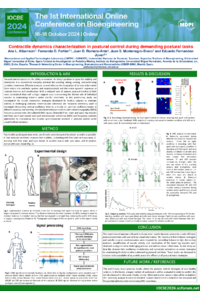
Introduction: Postural stability results from an effective interaction between sensory feedback integration and muscle modulation. However, the propensity for falls increases with age and has been extensively described for neuromuscular disorders. The comprehension of the muscle modulation mechanisms involved in postural control could help for handle balance deficits and fall prevention. In this study, we investigate the muscle contractile dynamics generated by challenging postures and how the balance is affected by the feedback visual privation.
Methods: This exploratory study examined muscle activation during different postural stability conditions. Postural conditions included three items of the Berg Balance Scale and were administrated in increasing difficulty order with both open and close eyes. Electromyographic (EMG) signals were obtained bilaterally from lower and upper leg muscles (tibialis anterior, gastrocnemius medialis, vastus medialis, rectus femoris, biceps femoris, and tensor fasciae latae) and from one trunk muscle. EMG recordings were synchronized with plantar sensors (F-Scan64 system) to extract Center of Force and pressure data. EMG amplitude, spectral analysis and intramuscular coherence were examined in relation to body movement during destabilizing postures.
Results and Discussion: This experimental approach allowed us to characterize muscle dynamic contraction under different postural conditions with and without visual information. We have found that different strategies and specific modulations were required for controlling balance in highly demanding postures. The amplification of muscle activity and coactivation of lower leg muscles were observed during the most challenging posture and without visual information. Also, specific behaviors consisting of intermittent muscle activity along the postural tasks were observed, especially in the muscles of the dominant leg.
Conclusions: In this study, we describe characteristic oscillatory modulations and synergistic activations as motor strategies for maintaining the balance after a demanding postural condition. These results are discussed in relation to the possibility of accurately assess the efficiency of postural motor strategies.
Keywords
Balance
Postural control
Muscle activations
Motor strategies
Poster
097667.pdf
Assessing the Relationship between Gesture Intuitiveness and Muscle Network Efficiency: A Comparison of Non-Negative Matrix Factorization and Intermuscular Coherence Analysis Methods
Alzheimer’s Detection through Structural MRI Texture Analysis