Event submissions
Published
This submission belongs to the session S1. Plant-Based Diets: Health and Well-Being of the event The 4th International Electronic Conference on Nutrients
Published date
11 Oct, 2024
Academic Editor
'%3e%3cpath%20d='M12.6657%2010.9104C12.4185%2010.325%2012.0599%209.79327%2011.6097%209.34482C11.1609%208.89508%2010.6293%208.5365%2010.0442%208.28888C10.0389%208.28626%2010.0337%208.28495%2010.0285%208.28233C10.8446%207.69279%2011.3752%206.73249%2011.3752%205.64904C11.3752%203.8542%209.92103%202.39999%208.1262%202.39999C6.33136%202.39999%204.87715%203.8542%204.87715%205.64904C4.87715%206.73249%205.40774%207.69279%206.22393%208.28364C6.21869%208.28626%206.21345%208.28757%206.20821%208.29019C5.62129%208.5378%205.09463%208.89284%204.64265%209.34613C4.1929%209.79493%203.83432%2010.3266%203.58671%2010.9117C3.34345%2011.4845%203.21226%2012.0987%203.20023%2012.7209C3.19988%2012.7349%203.20233%2012.7488%203.20744%2012.7619C3.21255%2012.7749%203.22022%2012.7867%203.22998%2012.7968C3.23975%2012.8068%203.25142%2012.8147%203.26431%2012.8202C3.2772%2012.8256%203.29105%2012.8284%203.30504%2012.8284H4.09109C4.14874%2012.8284%204.19459%2012.7825%204.1959%2012.7262C4.2221%2011.7148%204.62823%2010.7676%205.34617%2010.0497C6.08899%209.30683%207.0755%208.89808%208.1262%208.89808C9.17689%208.89808%2010.1634%209.30683%2010.9062%2010.0497C11.6242%2010.7676%2012.0303%2011.7148%2012.0565%2012.7262C12.0578%2012.7838%2012.1037%2012.8284%2012.1613%2012.8284H12.9474C12.9613%2012.8284%2012.9752%2012.8256%2012.9881%2012.8202C13.001%2012.8147%2013.0126%2012.8068%2013.0224%2012.7968C13.0322%2012.7867%2013.0398%2012.7749%2013.0449%2012.7619C13.0501%2012.7488%2013.0525%2012.7349%2013.0522%2012.7209C13.0391%2012.0947%2012.9094%2011.4855%2012.6657%2010.9104ZM8.1262%207.9024C7.52486%207.9024%206.9589%207.6679%206.53312%207.24211C6.10733%206.81633%205.87283%206.25037%205.87283%205.64904C5.87283%205.0477%206.10733%204.48174%206.53312%204.05596C6.9589%203.63018%207.52486%203.39567%208.1262%203.39567C8.72753%203.39567%209.29349%203.63018%209.71927%204.05596C10.1451%204.48174%2010.3796%205.0477%2010.3796%205.64904C10.3796%206.25037%2010.1451%206.81633%209.71927%207.24211C9.29349%207.6679%208.72753%207.9024%208.1262%207.9024Z'%20fill='%235D1EE1'/%3e%3c/g%3e%3c/svg%3e) Mauro Lombardo
Mauro LombardoCitation
Tripti Joshi, PR Deepa, Pankaj Kumar Sharma, Chromatographic Analysis of Bioactive Metabolites from a Traditional Food Combination of (semi) Arid Regions—Panchkuta: Insights for Sustainable Functional Foods Development, in Proceedings of The 4th International Electronic Conference on Nutrients, 16 October–18 October 2024, MDPI: Basel, Switzerland
Share
Email
Facebook
Twitter
LinkedIn
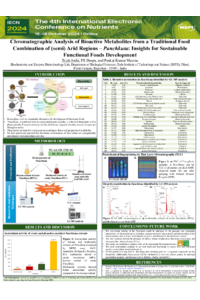
Chromatographic Analysis of Bioactive Metabolites from a Traditional Food Combination of (semi) Arid Regions—Panchkuta: Insights for Sustainable Functional Foods Development
'%3e%3cpath%20d='M12.6647%2010.9104C12.4176%2010.325%2012.0589%209.7933%2011.6088%209.34485C11.16%208.89511%2010.6283%208.53653%2010.0432%208.28891C10.038%208.28629%2010.0327%208.28498%2010.0275%208.28236C10.8437%207.69282%2011.3743%206.73252%2011.3743%205.64907C11.3743%203.85423%209.92005%202.40002%208.12522%202.40002C6.33038%202.40002%204.87618%203.85423%204.87618%205.64907C4.87618%206.73252%205.40677%207.69282%206.22296%208.28367C6.21772%208.28629%206.21248%208.2876%206.20724%208.29022C5.62031%208.53783%205.09365%208.89287%204.64167%209.34616C4.19192%209.79496%203.83334%2010.3266%203.58573%2010.9117C3.34247%2011.4846%203.21128%2012.0987%203.19925%2012.721C3.1989%2012.735%203.20135%2012.7489%203.20646%2012.7619C3.21157%2012.7749%203.21924%2012.7868%203.22901%2012.7968C3.23877%2012.8068%203.25045%2012.8148%203.26334%2012.8202C3.27623%2012.8256%203.29007%2012.8284%203.30406%2012.8284H4.09012C4.14776%2012.8284%204.19362%2012.7825%204.19493%2012.7262C4.22113%2011.7148%204.62726%2010.7676%205.34519%2010.0497C6.08802%209.30686%207.07452%208.89811%208.12522%208.89811C9.17592%208.89811%2010.1624%209.30686%2010.9052%2010.0497C11.6232%2010.7676%2012.0293%2011.7148%2012.0555%2012.7262C12.0568%2012.7839%2012.1027%2012.8284%2012.1603%2012.8284H12.9464C12.9604%2012.8284%2012.9742%2012.8256%2012.9871%2012.8202C13%2012.8148%2013.0117%2012.8068%2013.0214%2012.7968C13.0312%2012.7868%2013.0389%2012.7749%2013.044%2012.7619C13.0491%2012.7489%2013.0515%2012.735%2013.0512%2012.721C13.0381%2012.0947%2012.9084%2011.4856%2012.6647%2010.9104ZM8.12522%207.90243C7.52388%207.90243%206.95792%207.66793%206.53214%207.24215C6.10636%206.81636%205.87185%206.2504%205.87185%205.64907C5.87185%205.04773%206.10636%204.48177%206.53214%204.05599C6.95792%203.63021%207.52388%203.3957%208.12522%203.3957C8.72655%203.3957%209.29252%203.63021%209.7183%204.05599C10.1441%204.48177%2010.3786%205.04773%2010.3786%205.64907C10.3786%206.2504%2010.1441%206.81636%209.7183%207.24215C9.29252%207.66793%208.72655%207.90243%208.12522%207.90243Z'%20fill='%235D1EE1'/%3e%3c/g%3e%3c/svg%3e)
Tripti Joshi 1
PR Deepa 1
Pankaj Kumar Sharma 1
1. Department of Biological Sciences, Birla Institute of Technology and Science (BITS), Pilani Campus, Pilani, Rajasthan – 333031, India
Abstract
Introduction—Conventional agriculture may not meet the needs of growing human populations and sustainable development in future. These issues necessitate a shift towards traditional foods and underutilized desert plants, offering promising sustainable agricultural and food security alternatives. The ethnomedicinal and nutraceutical properties of these plants further underscore their potential. ‘Panchkuta’, a blend of five plants, namely, Prosopis cineraria, Cordia dichotoma, Capparis decidua, Acacia senegal, and Mangifera indica, is a traditional food combination of (semi) arid regions.
Methods—In this study, P. cineraria, A. senegal, C. decidua, C. dichotoma, and M. indica were mixed in a 14:13:8:4:1 ratio, respectively. The powdered mixture was extracted with hexane and methanol. Further, we tested the antioxidant activity of the hexane extract using a (2,2-diphenyl-1-picrylhydrazyl) DPPH assay. The bioactive metabolites were identified through analytical techniques, including TLC and GC-MS analysis.
Results—The hexane extract showed the presence of different classes of phytochemicals, such as hydrocarbons (heneicosane), fatty acids (palmitic acid, oleic acid), phytosterols (campesterol, stigmasterol), monoterpenes (p-cymene), triterpenes (squalene), and vitamins (gamma-tocopherol). The TLC analysis of methanolic extract showed the presence of various classes of phenolics (flavonols, isoflavones, and flavones) when sprayed with Natural Product Reagent (NPR) and observed under 254 and 365 nm. The antioxidant capacity of these plants, quantified through the DPPH assay, highlights their ability to scavenge free radicals, thus playing a pivotal role in preventing chronic diseases.
Conclusions—The antioxidant activity of the Panchkuta hexane extract could be attributed to the presence of phytoconstituents characterized through GC-MS analysis. Integrating ethnic foods into modern diets aligns with the Sustainable Development Goals (SDG —aims to achieve food security, end hunger, and promote sustainable agriculture; SDG 13—aims to take urgent actions to combat the impacts of climate change). Tapping these underexplored plants can help design and develop healthy functional foods and nutraceutical products.
Keywords
Traditional food
underutilised desert plants
antioxidant
nutraceutical
functional food
Poster
sciforum-097801-Tripti Joshi.pdf
Personalized Nutrition—A trend gaining momentum: Hope or Hype?
Dietary β-hydroxybutyric acid alters rumen microbiome and nutrient metabolism in the rumen epithelium of pre-weaned goats