Event submissions
Published
This submission belongs to the session S2. Innovation in Dietary Choices of the event The 4th International Electronic Conference on Nutrients
Published date
11 Oct, 2024
Academic Editor
'%3e%3cpath%20d='M12.6657%2010.9104C12.4185%2010.325%2012.0599%209.79327%2011.6097%209.34482C11.1609%208.89508%2010.6293%208.5365%2010.0442%208.28888C10.0389%208.28626%2010.0337%208.28495%2010.0285%208.28233C10.8446%207.69279%2011.3752%206.73249%2011.3752%205.64904C11.3752%203.8542%209.92103%202.39999%208.1262%202.39999C6.33136%202.39999%204.87715%203.8542%204.87715%205.64904C4.87715%206.73249%205.40774%207.69279%206.22393%208.28364C6.21869%208.28626%206.21345%208.28757%206.20821%208.29019C5.62129%208.5378%205.09463%208.89284%204.64265%209.34613C4.1929%209.79493%203.83432%2010.3266%203.58671%2010.9117C3.34345%2011.4845%203.21226%2012.0987%203.20023%2012.7209C3.19988%2012.7349%203.20233%2012.7488%203.20744%2012.7619C3.21255%2012.7749%203.22022%2012.7867%203.22998%2012.7968C3.23975%2012.8068%203.25142%2012.8147%203.26431%2012.8202C3.2772%2012.8256%203.29105%2012.8284%203.30504%2012.8284H4.09109C4.14874%2012.8284%204.19459%2012.7825%204.1959%2012.7262C4.2221%2011.7148%204.62823%2010.7676%205.34617%2010.0497C6.08899%209.30683%207.0755%208.89808%208.1262%208.89808C9.17689%208.89808%2010.1634%209.30683%2010.9062%2010.0497C11.6242%2010.7676%2012.0303%2011.7148%2012.0565%2012.7262C12.0578%2012.7838%2012.1037%2012.8284%2012.1613%2012.8284H12.9474C12.9613%2012.8284%2012.9752%2012.8256%2012.9881%2012.8202C13.001%2012.8147%2013.0126%2012.8068%2013.0224%2012.7968C13.0322%2012.7867%2013.0398%2012.7749%2013.0449%2012.7619C13.0501%2012.7488%2013.0525%2012.7349%2013.0522%2012.7209C13.0391%2012.0947%2012.9094%2011.4855%2012.6657%2010.9104ZM8.1262%207.9024C7.52486%207.9024%206.9589%207.6679%206.53312%207.24211C6.10733%206.81633%205.87283%206.25037%205.87283%205.64904C5.87283%205.0477%206.10733%204.48174%206.53312%204.05596C6.9589%203.63018%207.52486%203.39567%208.1262%203.39567C8.72753%203.39567%209.29349%203.63018%209.71927%204.05596C10.1451%204.48174%2010.3796%205.0477%2010.3796%205.64904C10.3796%206.25037%2010.1451%206.81633%209.71927%207.24211C9.29349%207.6679%208.72753%207.9024%208.1262%207.9024Z'%20fill='%235D1EE1'/%3e%3c/g%3e%3c/svg%3e) Elad Tako
Elad TakoCitation
JIANMIN CHAI, yimin zhuang, naifeng zhang, Dietary β-hydroxybutyric acid alters rumen microbiome and nutrient metabolism in the rumen epithelium of pre-weaned goats, in Proceedings of The 4th International Electronic Conference on Nutrients, 16 October–18 October 2024, MDPI: Basel, Switzerland
Share
Email
Facebook
Twitter
LinkedIn
Dietary β-hydroxybutyric acid alters rumen microbiome and nutrient metabolism in the rumen epithelium of pre-weaned goats
'%3e%3cpath%20d='M12.6647%2010.9104C12.4176%2010.325%2012.0589%209.7933%2011.6088%209.34485C11.16%208.89511%2010.6283%208.53653%2010.0432%208.28891C10.038%208.28629%2010.0327%208.28498%2010.0275%208.28236C10.8437%207.69282%2011.3743%206.73252%2011.3743%205.64907C11.3743%203.85423%209.92005%202.40002%208.12522%202.40002C6.33038%202.40002%204.87618%203.85423%204.87618%205.64907C4.87618%206.73252%205.40677%207.69282%206.22296%208.28367C6.21772%208.28629%206.21248%208.2876%206.20724%208.29022C5.62031%208.53783%205.09365%208.89287%204.64167%209.34616C4.19192%209.79496%203.83334%2010.3266%203.58573%2010.9117C3.34247%2011.4846%203.21128%2012.0987%203.19925%2012.721C3.1989%2012.735%203.20135%2012.7489%203.20646%2012.7619C3.21157%2012.7749%203.21924%2012.7868%203.22901%2012.7968C3.23877%2012.8068%203.25045%2012.8148%203.26334%2012.8202C3.27623%2012.8256%203.29007%2012.8284%203.30406%2012.8284H4.09012C4.14776%2012.8284%204.19362%2012.7825%204.19493%2012.7262C4.22113%2011.7148%204.62726%2010.7676%205.34519%2010.0497C6.08802%209.30686%207.07452%208.89811%208.12522%208.89811C9.17592%208.89811%2010.1624%209.30686%2010.9052%2010.0497C11.6232%2010.7676%2012.0293%2011.7148%2012.0555%2012.7262C12.0568%2012.7839%2012.1027%2012.8284%2012.1603%2012.8284H12.9464C12.9604%2012.8284%2012.9742%2012.8256%2012.9871%2012.8202C13%2012.8148%2013.0117%2012.8068%2013.0214%2012.7968C13.0312%2012.7868%2013.0389%2012.7749%2013.044%2012.7619C13.0491%2012.7489%2013.0515%2012.735%2013.0512%2012.721C13.0381%2012.0947%2012.9084%2011.4856%2012.6647%2010.9104ZM8.12522%207.90243C7.52388%207.90243%206.95792%207.66793%206.53214%207.24215C6.10636%206.81636%205.87185%206.2504%205.87185%205.64907C5.87185%205.04773%206.10636%204.48177%206.53214%204.05599C6.95792%203.63021%207.52388%203.3957%208.12522%203.3957C8.72655%203.3957%209.29252%203.63021%209.7183%204.05599C10.1441%204.48177%2010.3786%205.04773%2010.3786%205.64907C10.3786%206.2504%2010.1441%206.81636%209.7183%207.24215C9.29252%207.66793%208.72655%207.90243%208.12522%207.90243Z'%20fill='%235D1EE1'/%3e%3c/g%3e%3c/svg%3e)
JIANMIN CHAI 1
yimin zhuang 2
naifeng zhang 2
1. Guangdong Provincial Key Laboratory of Animal Molecular Design and Precise Breeding, School of Animal Science and Technology, Foshan University, Foshan, China
2. Key laboratory of Feed Biotechnology of the Ministry of Agriculture and Rural Affairs, Institute of Feed Research, Chinese Academy of Agricultural Sciences
Abstract
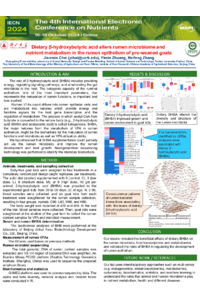
Introduction: The role of β-hydroxybutyric acid (BHBA) includes providing energy, regulating signaling pathways, and ameliorating the gut microbiota in the host, while its nutrient mechanism to improve rumen epithelium development in young ruminants is still unclear.
Methods: In this study, a joint analysis of multi-omics, including rumen microbiota, rumen epithelial transcriptome and rumen epithelial metabolomics in a pre-weaned goat model, was performed to systematically investigate the effect of dietary BHBA on rumen development.
Results: We found that dietary BHBA increased the weight of metabolic organs (rumen and liver), and promoted the growth of rumen epithelium development (P < 0.05). The concentration of BHBA and α-amylase (α-AMY) was also increased while lipopolysaccharide (LPS) was decreased (P < 0.05). The abundance of several beneficial bacteria was increased (Fibrobacter, Succinivibrio, Clostridiales, etc.). The rumen epithelium transcriptome and metabolomics indicated that BHBA supplementation showed a remarkable effect on the nutrient metabolism of the rumen epithelium. Specifically, the pathways of “fatty acid metabolism”, “cholesterol homeostasis” , “reactive oxygen species (ROS) pathway” and “peroxisome” were activated in response to BHBA addition. Moreover, the genes (HMGCS2, ECSH1, ACAA2, ECH1, ACADS etc.) and metabolites (succinic acid, alpha-ketoisovaleric acid, etc.) involved in these pathways were also regulated positively. The rumen epithelium obtained the energy necessary for its development from the process of volatile fatty acids (VFAs) decomposition. Finally, we observed the close correlations among the phenotypes, ruminal microbiota, host genes and epithelial metabolites, suggesting the mechanism of BHBA promotion in the rumen development.
Conclusions: Overall, our results revealed the beneficial effects of dietary BHBA on the rumen microbiota, host transcriptome and metabolomics and validated the roles of BHBA in regulating the development of rumen epithelium, which could provide new evidence for the potential positive effects of dietary BHBA on the rumen development of young ruminants.
Keywords
ruminants
β-hydroxybutyrate acid
rumen microbiota
host transcriptome
rumen epithelial metabolomic
ketogenesis
Poster
sciforum-097918-Jianmin Chai.pdf
Chromatographic Analysis of Bioactive Metabolites from a Traditional Food Combination of (semi) Arid Regions—Panchkuta: Insights for Sustainable Functional Foods Development
INTESTINAL MICROBIOTA, METABOLIC SYNDROME AND MEDITERRANEAN DIET: PATHOPHYSIOLOGICAL MECHANISMS AND NEW POTENTIAL THERAPEUTIC APPROACHES.