Event submissions
Published
This submission belongs to the session S3. Diet and Chronic Disease Management of the event The 4th International Electronic Conference on Nutrients
Published date
11 Oct, 2024
Academic Editor
'%3e%3cpath%20d='M12.6657%2010.9104C12.4185%2010.325%2012.0599%209.79327%2011.6097%209.34482C11.1609%208.89508%2010.6293%208.5365%2010.0442%208.28888C10.0389%208.28626%2010.0337%208.28495%2010.0285%208.28233C10.8446%207.69279%2011.3752%206.73249%2011.3752%205.64904C11.3752%203.8542%209.92103%202.39999%208.1262%202.39999C6.33136%202.39999%204.87715%203.8542%204.87715%205.64904C4.87715%206.73249%205.40774%207.69279%206.22393%208.28364C6.21869%208.28626%206.21345%208.28757%206.20821%208.29019C5.62129%208.5378%205.09463%208.89284%204.64265%209.34613C4.1929%209.79493%203.83432%2010.3266%203.58671%2010.9117C3.34345%2011.4845%203.21226%2012.0987%203.20023%2012.7209C3.19988%2012.7349%203.20233%2012.7488%203.20744%2012.7619C3.21255%2012.7749%203.22022%2012.7867%203.22998%2012.7968C3.23975%2012.8068%203.25142%2012.8147%203.26431%2012.8202C3.2772%2012.8256%203.29105%2012.8284%203.30504%2012.8284H4.09109C4.14874%2012.8284%204.19459%2012.7825%204.1959%2012.7262C4.2221%2011.7148%204.62823%2010.7676%205.34617%2010.0497C6.08899%209.30683%207.0755%208.89808%208.1262%208.89808C9.17689%208.89808%2010.1634%209.30683%2010.9062%2010.0497C11.6242%2010.7676%2012.0303%2011.7148%2012.0565%2012.7262C12.0578%2012.7838%2012.1037%2012.8284%2012.1613%2012.8284H12.9474C12.9613%2012.8284%2012.9752%2012.8256%2012.9881%2012.8202C13.001%2012.8147%2013.0126%2012.8068%2013.0224%2012.7968C13.0322%2012.7867%2013.0398%2012.7749%2013.0449%2012.7619C13.0501%2012.7488%2013.0525%2012.7349%2013.0522%2012.7209C13.0391%2012.0947%2012.9094%2011.4855%2012.6657%2010.9104ZM8.1262%207.9024C7.52486%207.9024%206.9589%207.6679%206.53312%207.24211C6.10733%206.81633%205.87283%206.25037%205.87283%205.64904C5.87283%205.0477%206.10733%204.48174%206.53312%204.05596C6.9589%203.63018%207.52486%203.39567%208.1262%203.39567C8.72753%203.39567%209.29349%203.63018%209.71927%204.05596C10.1451%204.48174%2010.3796%205.0477%2010.3796%205.64904C10.3796%206.25037%2010.1451%206.81633%209.71927%207.24211C9.29349%207.6679%208.72753%207.9024%208.1262%207.9024Z'%20fill='%235D1EE1'/%3e%3c/g%3e%3c/svg%3e) Jaime Uribarri
Jaime UribarriCitation
Ferdinando Calabrò, Giuseppe Lorello, Carmela Morace, Lucio D'Ambrogio, Luigi Amoroso, Giovanni Squadrito, Herbert Ryan Marini, INTESTINAL MICROBIOTA, METABOLIC SYNDROME AND MEDITERRANEAN DIET: PATHOPHYSIOLOGICAL MECHANISMS AND NEW POTENTIAL THERAPEUTIC APPROACHES., in Proceedings of The 4th International Electronic Conference on Nutrients, 16 October–18 October 2024, MDPI: Basel, Switzerland
Share
Email
Facebook
Twitter
LinkedIn
INTESTINAL MICROBIOTA, METABOLIC SYNDROME AND MEDITERRANEAN DIET: PATHOPHYSIOLOGICAL MECHANISMS AND NEW POTENTIAL THERAPEUTIC APPROACHES.
'%3e%3cpath%20d='M12.6647%2010.9104C12.4176%2010.325%2012.0589%209.7933%2011.6088%209.34485C11.16%208.89511%2010.6283%208.53653%2010.0432%208.28891C10.038%208.28629%2010.0327%208.28498%2010.0275%208.28236C10.8437%207.69282%2011.3743%206.73252%2011.3743%205.64907C11.3743%203.85423%209.92005%202.40002%208.12522%202.40002C6.33038%202.40002%204.87618%203.85423%204.87618%205.64907C4.87618%206.73252%205.40677%207.69282%206.22296%208.28367C6.21772%208.28629%206.21248%208.2876%206.20724%208.29022C5.62031%208.53783%205.09365%208.89287%204.64167%209.34616C4.19192%209.79496%203.83334%2010.3266%203.58573%2010.9117C3.34247%2011.4846%203.21128%2012.0987%203.19925%2012.721C3.1989%2012.735%203.20135%2012.7489%203.20646%2012.7619C3.21157%2012.7749%203.21924%2012.7868%203.22901%2012.7968C3.23877%2012.8068%203.25045%2012.8148%203.26334%2012.8202C3.27623%2012.8256%203.29007%2012.8284%203.30406%2012.8284H4.09012C4.14776%2012.8284%204.19362%2012.7825%204.19493%2012.7262C4.22113%2011.7148%204.62726%2010.7676%205.34519%2010.0497C6.08802%209.30686%207.07452%208.89811%208.12522%208.89811C9.17592%208.89811%2010.1624%209.30686%2010.9052%2010.0497C11.6232%2010.7676%2012.0293%2011.7148%2012.0555%2012.7262C12.0568%2012.7839%2012.1027%2012.8284%2012.1603%2012.8284H12.9464C12.9604%2012.8284%2012.9742%2012.8256%2012.9871%2012.8202C13%2012.8148%2013.0117%2012.8068%2013.0214%2012.7968C13.0312%2012.7868%2013.0389%2012.7749%2013.044%2012.7619C13.0491%2012.7489%2013.0515%2012.735%2013.0512%2012.721C13.0381%2012.0947%2012.9084%2011.4856%2012.6647%2010.9104ZM8.12522%207.90243C7.52388%207.90243%206.95792%207.66793%206.53214%207.24215C6.10636%206.81636%205.87185%206.2504%205.87185%205.64907C5.87185%205.04773%206.10636%204.48177%206.53214%204.05599C6.95792%203.63021%207.52388%203.3957%208.12522%203.3957C8.72655%203.3957%209.29252%203.63021%209.7183%204.05599C10.1441%204.48177%2010.3786%205.04773%2010.3786%205.64907C10.3786%206.2504%2010.1441%206.81636%209.7183%207.24215C9.29252%207.66793%208.72655%207.90243%208.12522%207.90243Z'%20fill='%235D1EE1'/%3e%3c/g%3e%3c/svg%3e)
Ferdinando Calabrò 1
Giuseppe Lorello 1
Carmela Morace 2
Lucio D'Ambrogio 1
Luigi Amoroso 1

Giovanni Squadrito 2

Herbert Ryan Marini 2
1. Department of Medical Sciences, Internal Medicine Division, University Hospital “G. Martino”, Messina, Italy
2. Department of Clinical and Experimental Medicine, University of Messina, Messina, Italy
Abstract
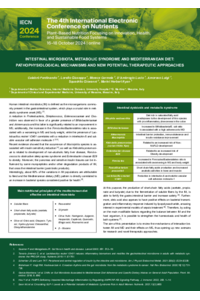
The human intestinal microbiota (IM) is defined as the microorganisms community present in the gastrointestinal system, which plays a crucial role in metabolic syndrome (MS) onset. A reduction in Proteobacteria, Streptococcus, Enterococcaceae and Clostridium was observed in favor of a greater presence of Bifidobacteriaceae and Akkermansia; the latter is significantly related to an improvement in MS. Additionally, the increase in the Firmicutes/Bacteroidetes ratio is associated with a worsening in MS and body weight, while the presence of Lactobacillus reuteri V3401 correlates with a reduction in IL-6 and sVCAM-1. Recent evidence showed that the occurrence of Muciniphila species is associated with insulin sensitivity reduction, as well as Klebsiella pneumoniae is related to development of non-alcoholic fatty liver disease, Ruminococcus to obstructive sleep apnea syndrome and Enterobacter cloacae B29 to obesity. Moreover, the pancreas and sensitive insulin tissues can be influenced by muropeptides and other degradation products of IM, that cross the intestinal barrier (post-biotic products). Interestingly, about several variations in IM populations are attributable to feed, and the Mediterranean dietary (MD) pattern is correlated to an increase in bacterial species considered positive for health. At this purpose, the production of short-chain fatty acids due to the fermentation of soluble fibers by the IM, is able to fortify the gastro-intestinal barrier and increase satiety. Furthermore, oleic acid also appears to have positive effects on bacterial transmigration and inflammatory response induced by lipopolysaccharide, arousing interest in experimental models of sepsis treatment. Therefore, by acting on the main modifiable factors regarding the balance between IM and the host organism, it is possible to strengthen the homeostasis and health of both systems. The aim of this presentation is to review the mechanisms of interaction between IM and MD and their effects on MS, thus opening up new avenues for research and novel therapeutic approaches.
Keywords
Microbiota
metabolic syndrome
mediterranean diet
Poster
sciforum-099607-Calabro et. al.pdf
Dietary β-hydroxybutyric acid alters rumen microbiome and nutrient metabolism in the rumen epithelium of pre-weaned goats
Plant-Based Diets and Migraine Management: Current Evidence and Future Directions