Event submissions
Published
This submission belongs to the session S3. Diet and Chronic Disease Management of the event The 4th International Electronic Conference on Nutrients
Published date
11 Oct, 2024
Academic Editor
'%3e%3cpath%20d='M12.6657%2010.9104C12.4185%2010.325%2012.0599%209.79327%2011.6097%209.34482C11.1609%208.89508%2010.6293%208.5365%2010.0442%208.28888C10.0389%208.28626%2010.0337%208.28495%2010.0285%208.28233C10.8446%207.69279%2011.3752%206.73249%2011.3752%205.64904C11.3752%203.8542%209.92103%202.39999%208.1262%202.39999C6.33136%202.39999%204.87715%203.8542%204.87715%205.64904C4.87715%206.73249%205.40774%207.69279%206.22393%208.28364C6.21869%208.28626%206.21345%208.28757%206.20821%208.29019C5.62129%208.5378%205.09463%208.89284%204.64265%209.34613C4.1929%209.79493%203.83432%2010.3266%203.58671%2010.9117C3.34345%2011.4845%203.21226%2012.0987%203.20023%2012.7209C3.19988%2012.7349%203.20233%2012.7488%203.20744%2012.7619C3.21255%2012.7749%203.22022%2012.7867%203.22998%2012.7968C3.23975%2012.8068%203.25142%2012.8147%203.26431%2012.8202C3.2772%2012.8256%203.29105%2012.8284%203.30504%2012.8284H4.09109C4.14874%2012.8284%204.19459%2012.7825%204.1959%2012.7262C4.2221%2011.7148%204.62823%2010.7676%205.34617%2010.0497C6.08899%209.30683%207.0755%208.89808%208.1262%208.89808C9.17689%208.89808%2010.1634%209.30683%2010.9062%2010.0497C11.6242%2010.7676%2012.0303%2011.7148%2012.0565%2012.7262C12.0578%2012.7838%2012.1037%2012.8284%2012.1613%2012.8284H12.9474C12.9613%2012.8284%2012.9752%2012.8256%2012.9881%2012.8202C13.001%2012.8147%2013.0126%2012.8068%2013.0224%2012.7968C13.0322%2012.7867%2013.0398%2012.7749%2013.0449%2012.7619C13.0501%2012.7488%2013.0525%2012.7349%2013.0522%2012.7209C13.0391%2012.0947%2012.9094%2011.4855%2012.6657%2010.9104ZM8.1262%207.9024C7.52486%207.9024%206.9589%207.6679%206.53312%207.24211C6.10733%206.81633%205.87283%206.25037%205.87283%205.64904C5.87283%205.0477%206.10733%204.48174%206.53312%204.05596C6.9589%203.63018%207.52486%203.39567%208.1262%203.39567C8.72753%203.39567%209.29349%203.63018%209.71927%204.05596C10.1451%204.48174%2010.3796%205.0477%2010.3796%205.64904C10.3796%206.25037%2010.1451%206.81633%209.71927%207.24211C9.29349%207.6679%208.72753%207.9024%208.1262%207.9024Z'%20fill='%235D1EE1'/%3e%3c/g%3e%3c/svg%3e) Mauro Lombardo
Mauro LombardoCitation
Jaya Patel, Ashutosh Agrawal, Parixit Prajapati, Nutraceutical plant Fagonia cretica aerial parts standardization, in Proceedings of The 4th International Electronic Conference on Nutrients, 16 October–18 October 2024, MDPI: Basel, Switzerland
Share
Email
Facebook
Twitter
LinkedIn
Nutraceutical plant Fagonia cretica aerial parts standardization
'%3e%3cpath%20d='M12.6647%2010.9104C12.4176%2010.325%2012.0589%209.7933%2011.6088%209.34485C11.16%208.89511%2010.6283%208.53653%2010.0432%208.28891C10.038%208.28629%2010.0327%208.28498%2010.0275%208.28236C10.8437%207.69282%2011.3743%206.73252%2011.3743%205.64907C11.3743%203.85423%209.92005%202.40002%208.12522%202.40002C6.33038%202.40002%204.87618%203.85423%204.87618%205.64907C4.87618%206.73252%205.40677%207.69282%206.22296%208.28367C6.21772%208.28629%206.21248%208.2876%206.20724%208.29022C5.62031%208.53783%205.09365%208.89287%204.64167%209.34616C4.19192%209.79496%203.83334%2010.3266%203.58573%2010.9117C3.34247%2011.4846%203.21128%2012.0987%203.19925%2012.721C3.1989%2012.735%203.20135%2012.7489%203.20646%2012.7619C3.21157%2012.7749%203.21924%2012.7868%203.22901%2012.7968C3.23877%2012.8068%203.25045%2012.8148%203.26334%2012.8202C3.27623%2012.8256%203.29007%2012.8284%203.30406%2012.8284H4.09012C4.14776%2012.8284%204.19362%2012.7825%204.19493%2012.7262C4.22113%2011.7148%204.62726%2010.7676%205.34519%2010.0497C6.08802%209.30686%207.07452%208.89811%208.12522%208.89811C9.17592%208.89811%2010.1624%209.30686%2010.9052%2010.0497C11.6232%2010.7676%2012.0293%2011.7148%2012.0555%2012.7262C12.0568%2012.7839%2012.1027%2012.8284%2012.1603%2012.8284H12.9464C12.9604%2012.8284%2012.9742%2012.8256%2012.9871%2012.8202C13%2012.8148%2013.0117%2012.8068%2013.0214%2012.7968C13.0312%2012.7868%2013.0389%2012.7749%2013.044%2012.7619C13.0491%2012.7489%2013.0515%2012.735%2013.0512%2012.721C13.0381%2012.0947%2012.9084%2011.4856%2012.6647%2010.9104ZM8.12522%207.90243C7.52388%207.90243%206.95792%207.66793%206.53214%207.24215C6.10636%206.81636%205.87185%206.2504%205.87185%205.64907C5.87185%205.04773%206.10636%204.48177%206.53214%204.05599C6.95792%203.63021%207.52388%203.3957%208.12522%203.3957C8.72655%203.3957%209.29252%203.63021%209.7183%204.05599C10.1441%204.48177%2010.3786%205.04773%2010.3786%205.64907C10.3786%206.2504%2010.1441%206.81636%209.7183%207.24215C9.29252%207.66793%208.72655%207.90243%208.12522%207.90243Z'%20fill='%235D1EE1'/%3e%3c/g%3e%3c/svg%3e)
Jaya Patel 1
Ashutosh Agrawal 2
Parixit Prajapati 2
1. Department of Pharmacognosy,Parul Institute of Pharmacy and Research,Parul University,Vadodara,Gujarat
2. SSR College of Pharmacy, Sayli, Silvassa, 396230, Union Territory of Dadra and Nagar Haveli and Daman and Diu, India
Abstract
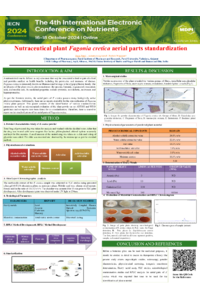
Background: Fagonia cretica is commonly known as Dhamaso and it belongs to the zygophyllaceae family. It has medicinal properties, such as being cytotoxic, anti-diabetic, anti-tumour, and hepatoprotective. The aerial parts of the plant contain phytoconsituents like quinine, harmine, stigmasterol, rosmarinic acid, and ursoliic acid, and no reports have been found for its standardization. Therefore, there is a need to report on the standardization of the aerial parts of Fagonia cretica.
Methods: The organoleptic properties were evaluated, powder microscopy was carried out, and a physicochemical evaluation of Fagonia cretic was performed . TLC was carried out using Silica gel 60 F254 plates as the stationary phase, and toluene: ethyl acetate: formic acid (1:8: 0.2, v/v/v) as the mobile phase. Heavy metals were evaluated using ICP-OES. Microbiological contamination studies were also carried out. HPLC analysis was conducted for the methanolic extract of F. cretica.
Results: Powder microscopy revealed the presence of well-defined cellular structures. The ethanol-soluble extract and water-soluble extract values were 24.0% w/w and 22.8%w/w, respectively. The total ash, acid-insoluble ash, and water-soluble ash were found to be 14.5% w/w, 2.0% w/w, and 5.0% w/w, respectively. The moisture content and pH were found to be 10.3% w/w and 5.04, respectively. The bulk density, tapped density, angle of repose, Hausner's ratio, and Carr’s index were 0.459±0.042, 0.563±0.037, 45.99±0.747, 1.49±0.355, and 27.33±0.57, respectively. Inorganic constituents like iron, sulphate, phosphate, and chloride were also found to be present in the plant material. The heavy metals were within permissible limits. The microbiological contamination of the plant material under study revealed the growth of fungi and S. aureus. An HPLC analysis of the F. cretica extract was carried out using a C-18 column (150 mm x 4.6 mm, 5µm), with a mobile phase of acetonitrile and 0.1% v/v trifluoracetic acid (40: 60 % v/v) and a retention time of 19.67 and 1.968 for the standard and sample solutions, respectively.
Conclusion: The present study covers organoleptic studies, powder characteristics, inorganic constituent determination, heavy metal assays, TLC studies, microbiological contamination studies, and HPLC analysis for the characterization of the aerial parts of F. cretica.
Keywords
Fagonia cretica
Standardization
Zygophyllaceae
Marketed formulation
HPLC analysis
Poster
sciforum-099801-Dr.Jaya Patel_Poster International conference.pdf
Evaluation of Preliminary Pharmacognostical and Phytochemical Properties of leaves and stems of Momordica charantia.
A systematic review of maternal and neonatal sialic acid status and infant neural development