Event submissions
Published
This submission belongs to the session S5. Numerical and Experimental Methods, Data Analyses, Digital Twin, IoT Machine Learning and AI in Water Sciences of the event The 8th International Electronic Conference on Water Sciences
Published date
11 Oct, 2024
Academic Editor
'%3e%3cpath%20d='M12.6657%2010.9104C12.4185%2010.325%2012.0599%209.79327%2011.6097%209.34482C11.1609%208.89508%2010.6293%208.5365%2010.0442%208.28888C10.0389%208.28626%2010.0337%208.28495%2010.0285%208.28233C10.8446%207.69279%2011.3752%206.73249%2011.3752%205.64904C11.3752%203.8542%209.92103%202.39999%208.1262%202.39999C6.33136%202.39999%204.87715%203.8542%204.87715%205.64904C4.87715%206.73249%205.40774%207.69279%206.22393%208.28364C6.21869%208.28626%206.21345%208.28757%206.20821%208.29019C5.62129%208.5378%205.09463%208.89284%204.64265%209.34613C4.1929%209.79493%203.83432%2010.3266%203.58671%2010.9117C3.34345%2011.4845%203.21226%2012.0987%203.20023%2012.7209C3.19988%2012.7349%203.20233%2012.7488%203.20744%2012.7619C3.21255%2012.7749%203.22022%2012.7867%203.22998%2012.7968C3.23975%2012.8068%203.25142%2012.8147%203.26431%2012.8202C3.2772%2012.8256%203.29105%2012.8284%203.30504%2012.8284H4.09109C4.14874%2012.8284%204.19459%2012.7825%204.1959%2012.7262C4.2221%2011.7148%204.62823%2010.7676%205.34617%2010.0497C6.08899%209.30683%207.0755%208.89808%208.1262%208.89808C9.17689%208.89808%2010.1634%209.30683%2010.9062%2010.0497C11.6242%2010.7676%2012.0303%2011.7148%2012.0565%2012.7262C12.0578%2012.7838%2012.1037%2012.8284%2012.1613%2012.8284H12.9474C12.9613%2012.8284%2012.9752%2012.8256%2012.9881%2012.8202C13.001%2012.8147%2013.0126%2012.8068%2013.0224%2012.7968C13.0322%2012.7867%2013.0398%2012.7749%2013.0449%2012.7619C13.0501%2012.7488%2013.0525%2012.7349%2013.0522%2012.7209C13.0391%2012.0947%2012.9094%2011.4855%2012.6657%2010.9104ZM8.1262%207.9024C7.52486%207.9024%206.9589%207.6679%206.53312%207.24211C6.10733%206.81633%205.87283%206.25037%205.87283%205.64904C5.87283%205.0477%206.10733%204.48174%206.53312%204.05596C6.9589%203.63018%207.52486%203.39567%208.1262%203.39567C8.72753%203.39567%209.29349%203.63018%209.71927%204.05596C10.1451%204.48174%2010.3796%205.0477%2010.3796%205.64904C10.3796%206.25037%2010.1451%206.81633%209.71927%207.24211C9.29349%207.6679%208.72753%207.9024%208.1262%207.9024Z'%20fill='%235D1EE1'/%3e%3c/g%3e%3c/svg%3e) Junye Wang
Junye WangCitation
Fatemeh Amiresmaeili, Faramarz Doulati Ardejani, Amirreza Heydarzade, Mohammad Yavarzadeh, Reza Taherdangkoo, Christoph Butscher, Numerical Modeling of Metal Pollutant Dispersion from the Khatunabad Smelting Chimney Using Satellite Images and the ERA Database, in Proceedings of The 8th International Electronic Conference on Water Sciences, 14 October–16 October 2024, MDPI: Basel, Switzerland
Share
Email
Facebook
Twitter
LinkedIn
Numerical Modeling of Metal Pollutant Dispersion from the Khatunabad Smelting Chimney Using Satellite Images and the ERA Database
'%3e%3cpath%20d='M12.6647%2010.9104C12.4176%2010.325%2012.0589%209.7933%2011.6088%209.34485C11.16%208.89511%2010.6283%208.53653%2010.0432%208.28891C10.038%208.28629%2010.0327%208.28498%2010.0275%208.28236C10.8437%207.69282%2011.3743%206.73252%2011.3743%205.64907C11.3743%203.85423%209.92005%202.40002%208.12522%202.40002C6.33038%202.40002%204.87618%203.85423%204.87618%205.64907C4.87618%206.73252%205.40677%207.69282%206.22296%208.28367C6.21772%208.28629%206.21248%208.2876%206.20724%208.29022C5.62031%208.53783%205.09365%208.89287%204.64167%209.34616C4.19192%209.79496%203.83334%2010.3266%203.58573%2010.9117C3.34247%2011.4846%203.21128%2012.0987%203.19925%2012.721C3.1989%2012.735%203.20135%2012.7489%203.20646%2012.7619C3.21157%2012.7749%203.21924%2012.7868%203.22901%2012.7968C3.23877%2012.8068%203.25045%2012.8148%203.26334%2012.8202C3.27623%2012.8256%203.29007%2012.8284%203.30406%2012.8284H4.09012C4.14776%2012.8284%204.19362%2012.7825%204.19493%2012.7262C4.22113%2011.7148%204.62726%2010.7676%205.34519%2010.0497C6.08802%209.30686%207.07452%208.89811%208.12522%208.89811C9.17592%208.89811%2010.1624%209.30686%2010.9052%2010.0497C11.6232%2010.7676%2012.0293%2011.7148%2012.0555%2012.7262C12.0568%2012.7839%2012.1027%2012.8284%2012.1603%2012.8284H12.9464C12.9604%2012.8284%2012.9742%2012.8256%2012.9871%2012.8202C13%2012.8148%2013.0117%2012.8068%2013.0214%2012.7968C13.0312%2012.7868%2013.0389%2012.7749%2013.044%2012.7619C13.0491%2012.7489%2013.0515%2012.735%2013.0512%2012.721C13.0381%2012.0947%2012.9084%2011.4856%2012.6647%2010.9104ZM8.12522%207.90243C7.52388%207.90243%206.95792%207.66793%206.53214%207.24215C6.10636%206.81636%205.87185%206.2504%205.87185%205.64907C5.87185%205.04773%206.10636%204.48177%206.53214%204.05599C6.95792%203.63021%207.52388%203.3957%208.12522%203.3957C8.72655%203.3957%209.29252%203.63021%209.7183%204.05599C10.1441%204.48177%2010.3786%205.04773%2010.3786%205.64907C10.3786%206.2504%2010.1441%206.81636%209.7183%207.24215C9.29252%207.66793%208.72655%207.90243%208.12522%207.90243Z'%20fill='%235D1EE1'/%3e%3c/g%3e%3c/svg%3e)
Fatemeh Amiresmaeili 1

Faramarz Doulati Ardejani 1
Amirreza Heydarzade 2
Mohammad Yavarzadeh 3

Reza Taherdangkoo 4
Christoph Butscher 5
1. School of Mining Engineering, College of Engineering, University of Tehran, Tehran 15614, Iran
2. Shahid Bahonar University of Kerman, Kerman, Iran
3. Research & Development Branch, National Iranian Copper Industries Company, Sharebabak, Iran
4. TU Bergakademie Freiberg, Institute of Geotechnics, Germany
5. Institute of Geotechnics, TU Bergakademie Freiberg, Gustav-Zeuner-Str. 1, 09599, Freiberg, Germany
Abstract
The chemical pollutants and particulate matter resulting from the copper smelting process have severe impacts on air quality and human health. In this context, modeling air pollution from copper smelting plants has been recognized as a powerful tool for analyzing and predicting the dispersion of pollutants and assessing their effects on the environment and public health. This study aims to present optimization and control methods for mitigating air pollution from copper smelting plants and to examine the impacts of the Khatunabad smelting plant on the climatic parameters of the Khatunabad plain. The climatic parameters such as temperature, precipitation, soil moisture, and wind, derived from the ERA5-Land database, along with vegetation data from MODIS sensors, were analyzed in the Khatunabad plain. Subsequently, the dispersion of pollutants emitted from the Khatunabad smelting plant's chimney was modeled using climatic data and the AERMOD software. The results indicated that the concentration and behavior of pollutants were strongly correlated with wind components. Therefore, modeling the behavior of pollutants while accounting for wind patterns at different hours, months, and seasons can serve as an effective tool for analyzing and predicting the dispersion of pollutants from the copper smelting plant in the Khatunabad plain. The maximum concentration of total suspended particulate matter in this modeling was estimated at 0.48 μg/m³, while the maximum concentration of SO2 was estimated at 0.95 μg/m³. Additionally, based on the modeling results, the highest accumulation of pollution was observed in the northeastern and southwestern sections of the plant.
Keywords
air pollution
copper smelting
pollutant dispersion
AERMOD modeling
climatic impact
Poster
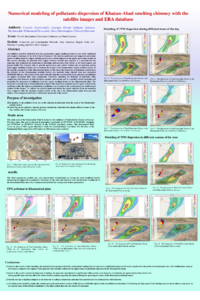
air_final_poster.pdf
Green Synthesis of Silver Nanoparticles Using Phyllanthus emblica and Adhatoda vasica Leaf Extract and comparative study on microbes
Numerical modeling used to create a digital twin for mollusk farming: exploratory studies with MOHID BIVALVES in the bays of Santa Catarina Island, Brazil