Event submissions
Published
This submission belongs to the session S1. Plant-Based Diets: Health and Well-Being of the event The 4th International Electronic Conference on Nutrients
Published date
11 Oct, 2024
Academic Editor
'%3e%3cpath%20d='M12.6657%2010.9104C12.4185%2010.325%2012.0599%209.79327%2011.6097%209.34482C11.1609%208.89508%2010.6293%208.5365%2010.0442%208.28888C10.0389%208.28626%2010.0337%208.28495%2010.0285%208.28233C10.8446%207.69279%2011.3752%206.73249%2011.3752%205.64904C11.3752%203.8542%209.92103%202.39999%208.1262%202.39999C6.33136%202.39999%204.87715%203.8542%204.87715%205.64904C4.87715%206.73249%205.40774%207.69279%206.22393%208.28364C6.21869%208.28626%206.21345%208.28757%206.20821%208.29019C5.62129%208.5378%205.09463%208.89284%204.64265%209.34613C4.1929%209.79493%203.83432%2010.3266%203.58671%2010.9117C3.34345%2011.4845%203.21226%2012.0987%203.20023%2012.7209C3.19988%2012.7349%203.20233%2012.7488%203.20744%2012.7619C3.21255%2012.7749%203.22022%2012.7867%203.22998%2012.7968C3.23975%2012.8068%203.25142%2012.8147%203.26431%2012.8202C3.2772%2012.8256%203.29105%2012.8284%203.30504%2012.8284H4.09109C4.14874%2012.8284%204.19459%2012.7825%204.1959%2012.7262C4.2221%2011.7148%204.62823%2010.7676%205.34617%2010.0497C6.08899%209.30683%207.0755%208.89808%208.1262%208.89808C9.17689%208.89808%2010.1634%209.30683%2010.9062%2010.0497C11.6242%2010.7676%2012.0303%2011.7148%2012.0565%2012.7262C12.0578%2012.7838%2012.1037%2012.8284%2012.1613%2012.8284H12.9474C12.9613%2012.8284%2012.9752%2012.8256%2012.9881%2012.8202C13.001%2012.8147%2013.0126%2012.8068%2013.0224%2012.7968C13.0322%2012.7867%2013.0398%2012.7749%2013.0449%2012.7619C13.0501%2012.7488%2013.0525%2012.7349%2013.0522%2012.7209C13.0391%2012.0947%2012.9094%2011.4855%2012.6657%2010.9104ZM8.1262%207.9024C7.52486%207.9024%206.9589%207.6679%206.53312%207.24211C6.10733%206.81633%205.87283%206.25037%205.87283%205.64904C5.87283%205.0477%206.10733%204.48174%206.53312%204.05596C6.9589%203.63018%207.52486%203.39567%208.1262%203.39567C8.72753%203.39567%209.29349%203.63018%209.71927%204.05596C10.1451%204.48174%2010.3796%205.0477%2010.3796%205.64904C10.3796%206.25037%2010.1451%206.81633%209.71927%207.24211C9.29349%207.6679%208.72753%207.9024%208.1262%207.9024Z'%20fill='%235D1EE1'/%3e%3c/g%3e%3c/svg%3e) Mauro Lombardo
Mauro LombardoCitation
Hui Cao, Improved self-microemulsifying system enhances quercetin bioavailability, in Proceedings of The 4th International Electronic Conference on Nutrients, 16 October–18 October 2024, MDPI: Basel, Switzerland
Share
Email
Facebook
Twitter
LinkedIn
Improved self-microemulsifying system enhances quercetin bioavailability
'%3e%3cpath%20d='M12.6647%2010.9104C12.4176%2010.325%2012.0589%209.7933%2011.6088%209.34485C11.16%208.89511%2010.6283%208.53653%2010.0432%208.28891C10.038%208.28629%2010.0327%208.28498%2010.0275%208.28236C10.8437%207.69282%2011.3743%206.73252%2011.3743%205.64907C11.3743%203.85423%209.92005%202.40002%208.12522%202.40002C6.33038%202.40002%204.87618%203.85423%204.87618%205.64907C4.87618%206.73252%205.40677%207.69282%206.22296%208.28367C6.21772%208.28629%206.21248%208.2876%206.20724%208.29022C5.62031%208.53783%205.09365%208.89287%204.64167%209.34616C4.19192%209.79496%203.83334%2010.3266%203.58573%2010.9117C3.34247%2011.4846%203.21128%2012.0987%203.19925%2012.721C3.1989%2012.735%203.20135%2012.7489%203.20646%2012.7619C3.21157%2012.7749%203.21924%2012.7868%203.22901%2012.7968C3.23877%2012.8068%203.25045%2012.8148%203.26334%2012.8202C3.27623%2012.8256%203.29007%2012.8284%203.30406%2012.8284H4.09012C4.14776%2012.8284%204.19362%2012.7825%204.19493%2012.7262C4.22113%2011.7148%204.62726%2010.7676%205.34519%2010.0497C6.08802%209.30686%207.07452%208.89811%208.12522%208.89811C9.17592%208.89811%2010.1624%209.30686%2010.9052%2010.0497C11.6232%2010.7676%2012.0293%2011.7148%2012.0555%2012.7262C12.0568%2012.7839%2012.1027%2012.8284%2012.1603%2012.8284H12.9464C12.9604%2012.8284%2012.9742%2012.8256%2012.9871%2012.8202C13%2012.8148%2013.0117%2012.8068%2013.0214%2012.7968C13.0312%2012.7868%2013.0389%2012.7749%2013.044%2012.7619C13.0491%2012.7489%2013.0515%2012.735%2013.0512%2012.721C13.0381%2012.0947%2012.9084%2011.4856%2012.6647%2010.9104ZM8.12522%207.90243C7.52388%207.90243%206.95792%207.66793%206.53214%207.24215C6.10636%206.81636%205.87185%206.2504%205.87185%205.64907C5.87185%205.04773%206.10636%204.48177%206.53214%204.05599C6.95792%203.63021%207.52388%203.3957%208.12522%203.3957C8.72655%203.3957%209.29252%203.63021%209.7183%204.05599C10.1441%204.48177%2010.3786%205.04773%2010.3786%205.64907C10.3786%206.2504%2010.1441%206.81636%209.7183%207.24215C9.29252%207.66793%208.72655%207.90243%208.12522%207.90243Z'%20fill='%235D1EE1'/%3e%3c/g%3e%3c/svg%3e)
Hui Cao 1
1. University of Vigo, Pontevedra, Spain
Abstract
Introduction:
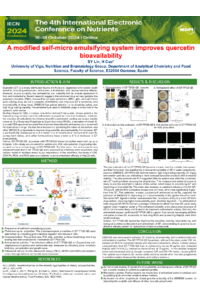
Quercetin (QT) is an important dietary flavonoid in vegetables, fruits, seeds, nuts, tea, and red wine. It has significant biological functions in terms of tumor prevention. However, its application in the food industry has been limited due to its poor solubility and low bioavailability. In this study, a self-microemulsion system (TPGS-QS) was designed to improve the solubility and bioavailability of QT.
Methods:
The self-micro-emulsifying system was prepared according to our previous study. We evaluated particle characteristics such as size, zeta potential, PDI, the stability of in vitro digestion and release, and encapsulation efficiency. Additionally, the antibacterial and antioxidant potential of the system were assessed.
Results:
The appearance of QT-TPGS-QS was clear, with a loading ratio of 2.1%. The liposome was uniform, spherical, and regular (<100 nm). In simulated in vitro digestion, the cumulative release rate of QT-QS-TPGS nanoparticles reached 85.61±0.32%. In antibacterial experiment, the flavonoid microemulsion exhibited a better antibacterial effect on Escherichia coli, Staphylococcus aureus, and Salmonella compared to QT alone. In vitro antioxidant evaluation confirmed that the QT-TPGS-QS showed a significantly higher free radical scavenging ability. Additionally, QT-TPGS-QS (15 μg/mL) effectively protected cells from oxidative stress induced by H2O2. Catalase (CAT) and glutathione peroxidase (GSH-Px) levels were significantly increased, while malondialdehyde (MDA) levels were dominantly reduced by QT-TPGS-QS treatment, suggesting that QT-TPGS-QS may be effective in inhibiting the production of intracellular reactive oxygen species (ROS).
Conclusions:
The TPGS-QS could be considered as a suitable carrier and reliable method to improve the solubility of QT with retained antioxidant potential, and it is also expected that the same system might be suitable for other dissolvable polyphenols as well to develop relative natural antioxidant products.
Keywords
microemulsion
quercetin
flavonoid
antibacterial capacity
antioxidant capacity
Poster
sciforum-098458-Hui Cao.pdf
Functional Foods based on Medicinal Plants of the Family Lamiaceae: a patent analysis overview
Attenuation of muscle loss and functionality through diet in patients with muscle atrophy-associated inflammation: a bibliographic review