Event submissions
Published
This submission belongs to the session S1. Animal Diversity of the event The 3rd International Electronic Conference on Diversity
Published date
11 Oct, 2024
Academic Editor
'%3e%3cpath%20d='M12.6657%2010.9104C12.4185%2010.325%2012.0599%209.79327%2011.6097%209.34482C11.1609%208.89508%2010.6293%208.5365%2010.0442%208.28888C10.0389%208.28626%2010.0337%208.28495%2010.0285%208.28233C10.8446%207.69279%2011.3752%206.73249%2011.3752%205.64904C11.3752%203.8542%209.92103%202.39999%208.1262%202.39999C6.33136%202.39999%204.87715%203.8542%204.87715%205.64904C4.87715%206.73249%205.40774%207.69279%206.22393%208.28364C6.21869%208.28626%206.21345%208.28757%206.20821%208.29019C5.62129%208.5378%205.09463%208.89284%204.64265%209.34613C4.1929%209.79493%203.83432%2010.3266%203.58671%2010.9117C3.34345%2011.4845%203.21226%2012.0987%203.20023%2012.7209C3.19988%2012.7349%203.20233%2012.7488%203.20744%2012.7619C3.21255%2012.7749%203.22022%2012.7867%203.22998%2012.7968C3.23975%2012.8068%203.25142%2012.8147%203.26431%2012.8202C3.2772%2012.8256%203.29105%2012.8284%203.30504%2012.8284H4.09109C4.14874%2012.8284%204.19459%2012.7825%204.1959%2012.7262C4.2221%2011.7148%204.62823%2010.7676%205.34617%2010.0497C6.08899%209.30683%207.0755%208.89808%208.1262%208.89808C9.17689%208.89808%2010.1634%209.30683%2010.9062%2010.0497C11.6242%2010.7676%2012.0303%2011.7148%2012.0565%2012.7262C12.0578%2012.7838%2012.1037%2012.8284%2012.1613%2012.8284H12.9474C12.9613%2012.8284%2012.9752%2012.8256%2012.9881%2012.8202C13.001%2012.8147%2013.0126%2012.8068%2013.0224%2012.7968C13.0322%2012.7867%2013.0398%2012.7749%2013.0449%2012.7619C13.0501%2012.7488%2013.0525%2012.7349%2013.0522%2012.7209C13.0391%2012.0947%2012.9094%2011.4855%2012.6657%2010.9104ZM8.1262%207.9024C7.52486%207.9024%206.9589%207.6679%206.53312%207.24211C6.10733%206.81633%205.87283%206.25037%205.87283%205.64904C5.87283%205.0477%206.10733%204.48174%206.53312%204.05596C6.9589%203.63018%207.52486%203.39567%208.1262%203.39567C8.72753%203.39567%209.29349%203.63018%209.71927%204.05596C10.1451%204.48174%2010.3796%205.0477%2010.3796%205.64904C10.3796%206.25037%2010.1451%206.81633%209.71927%207.24211C9.29349%207.6679%208.72753%207.9024%208.1262%207.9024Z'%20fill='%235D1EE1'/%3e%3c/g%3e%3c/svg%3e) Luc Legal
Luc LegalCitation
Olga A. Loginova, Diversity of helminths in reindeer (Rangifer tarandus) in Russia, in Proceedings of The 3rd International Electronic Conference on Diversity, 15 October–17 October 2024, MDPI: Basel, Switzerland
Share
Email
Facebook
Twitter
LinkedIn
Diversity of helminths in reindeer (Rangifer tarandus) in Russia

Olga A. Loginova 1
1. Parasitology Center, A. N. Severtsov Intstiture of Ecology and Evolution of the Russian Academy of Sciences, IEE RAS, Moscow 119171, Russia
Abstract
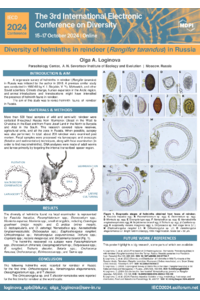
A large-scale survey of helminths in reindeer (Rangifer tarandus) in Russia was initiated by the author in 2018. A previous similar study was conducted in 1930-60 by K. I. Skrjabin, V. Yu. Mizkewich, and other Soviet scientists. Climate change, human expansion in the Arctic region, and animal introductions and translocations might have intensified the presence of helminth fauna in reindeer.
More than 500 fecal samples of wild and semi-wild reindeer were collected throughout Russia from Murmansk Oblast in the West to Chukotka in the East and from Franz Josef Land in the North to Buryatia and Altai in the South. This research covered nature reserves, agricultural units, and all the zoos in Russia. When possible, autopsy was also performed. In total, about 200 reindeer were examined post mortem. Fecal samples were processed via larvoscopic and ovoscopic (flotation and sedimentation) techniques, along with fecal examination (in order to find macrohelminths). DNA analyses were made of adult worms and larvae primarily by targeting the internal transcribed spacer region.
The diversity of helminths found via fecal examination is represented by Fasciola hepatica; Paramphistomum spp.; Dicrocoelium spp.; Moniezia expansa; Moniezia spp.; small strongylids, including Ostertagia gruehneri (major morph) and O. arctica (minor morph), O. leptospicularis, and O. ostertagi; Nematodirus spp.; Nematodirella longissimespiculata; Dictyocaulus spp.; Elaphostrongylus rangiferi; Orthostrongylus spp.; Varestrongylus eleguneniensis; Trichuris spp.; Capillaria spp.; Ascaris mosgovoyi; and Skrjabinema tarandi. The helminths recovered via autopsy were Paramphistomum spp.; Dicrocoelium chinensis; Oesophagostomum; Dictyocaulus spp.; E. rangiferi; Trichuris discolor; Setaria spp.; Onchocerca flexuosa; Onchocerca spp.; Echinococcus spp.; and Taenia spp.
The following helminths were reported for reindeer in Russia for the first time: Orthostrongylus spp., Varestrongylus eleguneniensis, Oesophagostomum spp., and T. discolor. The Orthostrongylus spp. and T. discolor nematodes were reported for the first time for reindeer at the world scale.
Keywords
helminths
reindeer
Rangifer
Russia
Orthostrongylus
Verestrongylus eleguneniensis
Oesophagostomum
Trichuris discolor
Poster
sciforum-096804 Loginova - IECD poster.pdf
Cryptic species of Bombus lucorum-complex in Northern European Russia
Germplasm characterization and conservation of the silkworm, Bombyx mori, in a changing climate