Event submissions
Published
This submission belongs to the session S1. Animal Diversity of the event The 3rd International Electronic Conference on Diversity
Published date
11 Oct, 2024
Academic Editor
'%3e%3cpath%20d='M12.6657%2010.9104C12.4185%2010.325%2012.0599%209.79327%2011.6097%209.34482C11.1609%208.89508%2010.6293%208.5365%2010.0442%208.28888C10.0389%208.28626%2010.0337%208.28495%2010.0285%208.28233C10.8446%207.69279%2011.3752%206.73249%2011.3752%205.64904C11.3752%203.8542%209.92103%202.39999%208.1262%202.39999C6.33136%202.39999%204.87715%203.8542%204.87715%205.64904C4.87715%206.73249%205.40774%207.69279%206.22393%208.28364C6.21869%208.28626%206.21345%208.28757%206.20821%208.29019C5.62129%208.5378%205.09463%208.89284%204.64265%209.34613C4.1929%209.79493%203.83432%2010.3266%203.58671%2010.9117C3.34345%2011.4845%203.21226%2012.0987%203.20023%2012.7209C3.19988%2012.7349%203.20233%2012.7488%203.20744%2012.7619C3.21255%2012.7749%203.22022%2012.7867%203.22998%2012.7968C3.23975%2012.8068%203.25142%2012.8147%203.26431%2012.8202C3.2772%2012.8256%203.29105%2012.8284%203.30504%2012.8284H4.09109C4.14874%2012.8284%204.19459%2012.7825%204.1959%2012.7262C4.2221%2011.7148%204.62823%2010.7676%205.34617%2010.0497C6.08899%209.30683%207.0755%208.89808%208.1262%208.89808C9.17689%208.89808%2010.1634%209.30683%2010.9062%2010.0497C11.6242%2010.7676%2012.0303%2011.7148%2012.0565%2012.7262C12.0578%2012.7838%2012.1037%2012.8284%2012.1613%2012.8284H12.9474C12.9613%2012.8284%2012.9752%2012.8256%2012.9881%2012.8202C13.001%2012.8147%2013.0126%2012.8068%2013.0224%2012.7968C13.0322%2012.7867%2013.0398%2012.7749%2013.0449%2012.7619C13.0501%2012.7488%2013.0525%2012.7349%2013.0522%2012.7209C13.0391%2012.0947%2012.9094%2011.4855%2012.6657%2010.9104ZM8.1262%207.9024C7.52486%207.9024%206.9589%207.6679%206.53312%207.24211C6.10733%206.81633%205.87283%206.25037%205.87283%205.64904C5.87283%205.0477%206.10733%204.48174%206.53312%204.05596C6.9589%203.63018%207.52486%203.39567%208.1262%203.39567C8.72753%203.39567%209.29349%203.63018%209.71927%204.05596C10.1451%204.48174%2010.3796%205.0477%2010.3796%205.64904C10.3796%206.25037%2010.1451%206.81633%209.71927%207.24211C9.29349%207.6679%208.72753%207.9024%208.1262%207.9024Z'%20fill='%235D1EE1'/%3e%3c/g%3e%3c/svg%3e) Luc Legal
Luc LegalCitation
João Mateus Xavier Tavares da Silva, Julio Cesar Pieczarka, August Karllayle Carvalho de Miranda, Jéssica Barata da Silva, Cleusa Yoshiko Nagamachi, Leony Dias de Oliveira, Rogério Vieira Rossi, Alan Eriksson, Gabriel de Melo, Glenda Akimi Oliveira Nascimento Ota, New cytogenetic data of Artibeus (Dermanura) glaucus (Chiroptera, Phyllostomidae) and expansion of geographic limits for Brazil., in Proceedings of The 3rd International Electronic Conference on Diversity, 15 October–17 October 2024, MDPI: Basel, Switzerland
Share
Email
Facebook
Twitter
LinkedIn
New cytogenetic data of Artibeus (Dermanura) glaucus (Chiroptera, Phyllostomidae) and expansion of geographic limits for Brazil.
'%3e%3cpath%20d='M12.6647%2010.9104C12.4176%2010.325%2012.0589%209.7933%2011.6088%209.34485C11.16%208.89511%2010.6283%208.53653%2010.0432%208.28891C10.038%208.28629%2010.0327%208.28498%2010.0275%208.28236C10.8437%207.69282%2011.3743%206.73252%2011.3743%205.64907C11.3743%203.85423%209.92005%202.40002%208.12522%202.40002C6.33038%202.40002%204.87618%203.85423%204.87618%205.64907C4.87618%206.73252%205.40677%207.69282%206.22296%208.28367C6.21772%208.28629%206.21248%208.2876%206.20724%208.29022C5.62031%208.53783%205.09365%208.89287%204.64167%209.34616C4.19192%209.79496%203.83334%2010.3266%203.58573%2010.9117C3.34247%2011.4846%203.21128%2012.0987%203.19925%2012.721C3.1989%2012.735%203.20135%2012.7489%203.20646%2012.7619C3.21157%2012.7749%203.21924%2012.7868%203.22901%2012.7968C3.23877%2012.8068%203.25045%2012.8148%203.26334%2012.8202C3.27623%2012.8256%203.29007%2012.8284%203.30406%2012.8284H4.09012C4.14776%2012.8284%204.19362%2012.7825%204.19493%2012.7262C4.22113%2011.7148%204.62726%2010.7676%205.34519%2010.0497C6.08802%209.30686%207.07452%208.89811%208.12522%208.89811C9.17592%208.89811%2010.1624%209.30686%2010.9052%2010.0497C11.6232%2010.7676%2012.0293%2011.7148%2012.0555%2012.7262C12.0568%2012.7839%2012.1027%2012.8284%2012.1603%2012.8284H12.9464C12.9604%2012.8284%2012.9742%2012.8256%2012.9871%2012.8202C13%2012.8148%2013.0117%2012.8068%2013.0214%2012.7968C13.0312%2012.7868%2013.0389%2012.7749%2013.044%2012.7619C13.0491%2012.7489%2013.0515%2012.735%2013.0512%2012.721C13.0381%2012.0947%2012.9084%2011.4856%2012.6647%2010.9104ZM8.12522%207.90243C7.52388%207.90243%206.95792%207.66793%206.53214%207.24215C6.10636%206.81636%205.87185%206.2504%205.87185%205.64907C5.87185%205.04773%206.10636%204.48177%206.53214%204.05599C6.95792%203.63021%207.52388%203.3957%208.12522%203.3957C8.72655%203.3957%209.29252%203.63021%209.7183%204.05599C10.1441%204.48177%2010.3786%205.04773%2010.3786%205.64907C10.3786%206.2504%2010.1441%206.81636%209.7183%207.24215C9.29252%207.66793%208.72655%207.90243%208.12522%207.90243Z'%20fill='%235D1EE1'/%3e%3c/g%3e%3c/svg%3e)
João Mateus Xavier Tavares da Silva 1
Julio Cesar Pieczarka 1
August Karllayle Carvalho de Miranda 1
Jéssica Barata da Silva 1
Cleusa Yoshiko Nagamachi 1
Leony Dias de Oliveira 1
Rogério Vieira Rossi 2
Alan Eriksson 3
Gabriel de Melo 3
Glenda Akimi Oliveira Nascimento Ota 3
1. Laboratório de Citogenética, Centro de Estudos Avançados da Biodiversidade, Instituto de Ciências Biológicas, Universidade Federal do Pará, Belém 66075-110, PA, Brazil
2. Laboratório de mastozoologia, instituto de Biociências, Universidade Federal do Mato Grosso, Cuiabá 78068-600, MT, Brazil.
3. Laboratório de ecologia e evolução de parasitas, instituto de Biociências, Universidade Federal do Mato Grosso, Cuiabá 78068-600, MT, Brazil.
Abstract
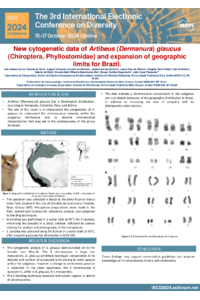
Four species of the subgenus Dermanura, genus Artibeus, are known to occur in Brazil (A. anderseni, A. bogotensis, A. cinereus, and A. gnoma), two of them (A. anderseni and A. gnoma) found in sympatry in the central–western region. Artibeus (Dermanura) glaucus is a small frugivorous bat that predominantly inhabits forested areas and has a neotropical distribution, occurring in Venezuela, Colombia, Peru, and Bolivia. The aim of this study is to characterize the cytogenetics of A. glaucus to understand the chromosomal diversity within the subgenus Dermanura and to observe chromosomal characteristics that may aid in the cytotaxonomy of the group for Brazil. This is important given the overlapping distribution limits of congeneric species and the cryptic nature of the taxon, which make identification a challenging task based solely on morphology. A female specimen of A. glaucus was collected in Parque Estatual Serra Ricardo Franco, municipality of Vila Bela de Santíssima Trindade, state of Mato Grosso, Brazil. The specimen was identified through teeth and external characteristics based on the literature. Chromosomal preparations were obtained from bone marrow cells after in vivo treatment with colchicine and primary culture of fibroblasts. Metaphase cells were analyzed using Giemsa staining and G- and C-banding. We describe for the first time the karyotype of a Brazilian specimen of A. glaucus as 2n=30 and NFa=56. The karyotype showed 14 meta/submetacentric pairs and a metacentric X chromosome. The literature data confirm the same 2n and NFa for a specimen from Peru. Cytogenetic data on Dermanura indicate chromosomal conservatism; however, molecular cytogenetic analysis using repetitive DNA probes may provide useful characteristics for better comparisons among species of the subgenus. These findings may support conservation guidelines and improve knowledge on its evolutionary history and biodiversity.
Keywords
Cytotaxonomy
Dermanura
Fauna distribution.
Poster
Poster João da Silva.pdf
Evaluation of a citizen science project on birdwatching in Germany
The Role of Grey Wolf (Canis lupus) in the Transmission of Sarcocystis spp. in Lithuania