Event submissions
Published
This submission belongs to the session S1. Animal Diversity of the event The 3rd International Electronic Conference on Diversity
Published date
11 Oct, 2024
Academic Editor
'%3e%3cpath%20d='M12.6657%2010.9104C12.4185%2010.325%2012.0599%209.79327%2011.6097%209.34482C11.1609%208.89508%2010.6293%208.5365%2010.0442%208.28888C10.0389%208.28626%2010.0337%208.28495%2010.0285%208.28233C10.8446%207.69279%2011.3752%206.73249%2011.3752%205.64904C11.3752%203.8542%209.92103%202.39999%208.1262%202.39999C6.33136%202.39999%204.87715%203.8542%204.87715%205.64904C4.87715%206.73249%205.40774%207.69279%206.22393%208.28364C6.21869%208.28626%206.21345%208.28757%206.20821%208.29019C5.62129%208.5378%205.09463%208.89284%204.64265%209.34613C4.1929%209.79493%203.83432%2010.3266%203.58671%2010.9117C3.34345%2011.4845%203.21226%2012.0987%203.20023%2012.7209C3.19988%2012.7349%203.20233%2012.7488%203.20744%2012.7619C3.21255%2012.7749%203.22022%2012.7867%203.22998%2012.7968C3.23975%2012.8068%203.25142%2012.8147%203.26431%2012.8202C3.2772%2012.8256%203.29105%2012.8284%203.30504%2012.8284H4.09109C4.14874%2012.8284%204.19459%2012.7825%204.1959%2012.7262C4.2221%2011.7148%204.62823%2010.7676%205.34617%2010.0497C6.08899%209.30683%207.0755%208.89808%208.1262%208.89808C9.17689%208.89808%2010.1634%209.30683%2010.9062%2010.0497C11.6242%2010.7676%2012.0303%2011.7148%2012.0565%2012.7262C12.0578%2012.7838%2012.1037%2012.8284%2012.1613%2012.8284H12.9474C12.9613%2012.8284%2012.9752%2012.8256%2012.9881%2012.8202C13.001%2012.8147%2013.0126%2012.8068%2013.0224%2012.7968C13.0322%2012.7867%2013.0398%2012.7749%2013.0449%2012.7619C13.0501%2012.7488%2013.0525%2012.7349%2013.0522%2012.7209C13.0391%2012.0947%2012.9094%2011.4855%2012.6657%2010.9104ZM8.1262%207.9024C7.52486%207.9024%206.9589%207.6679%206.53312%207.24211C6.10733%206.81633%205.87283%206.25037%205.87283%205.64904C5.87283%205.0477%206.10733%204.48174%206.53312%204.05596C6.9589%203.63018%207.52486%203.39567%208.1262%203.39567C8.72753%203.39567%209.29349%203.63018%209.71927%204.05596C10.1451%204.48174%2010.3796%205.0477%2010.3796%205.64904C10.3796%206.25037%2010.1451%206.81633%209.71927%207.24211C9.29349%207.6679%208.72753%207.9024%208.1262%207.9024Z'%20fill='%235D1EE1'/%3e%3c/g%3e%3c/svg%3e) Luc Legal
Luc LegalCitation
Tamara Kalashnikova, Naglis Gudiškis, Donatas Šneideris, Evelina Juozaitytė-Ngugu, Petras Prakas, Dalius Butkauskas, The Role of Grey Wolf (Canis lupus) in the Transmission of Sarcocystis spp. in Lithuania, in Proceedings of The 3rd International Electronic Conference on Diversity, 15 October–17 October 2024, MDPI: Basel, Switzerland
Share
Email
Facebook
Twitter
LinkedIn
The Role of Grey Wolf (Canis lupus) in the Transmission of Sarcocystis spp. in Lithuania
'%3e%3cpath%20d='M12.6647%2010.9104C12.4176%2010.325%2012.0589%209.7933%2011.6088%209.34485C11.16%208.89511%2010.6283%208.53653%2010.0432%208.28891C10.038%208.28629%2010.0327%208.28498%2010.0275%208.28236C10.8437%207.69282%2011.3743%206.73252%2011.3743%205.64907C11.3743%203.85423%209.92005%202.40002%208.12522%202.40002C6.33038%202.40002%204.87618%203.85423%204.87618%205.64907C4.87618%206.73252%205.40677%207.69282%206.22296%208.28367C6.21772%208.28629%206.21248%208.2876%206.20724%208.29022C5.62031%208.53783%205.09365%208.89287%204.64167%209.34616C4.19192%209.79496%203.83334%2010.3266%203.58573%2010.9117C3.34247%2011.4846%203.21128%2012.0987%203.19925%2012.721C3.1989%2012.735%203.20135%2012.7489%203.20646%2012.7619C3.21157%2012.7749%203.21924%2012.7868%203.22901%2012.7968C3.23877%2012.8068%203.25045%2012.8148%203.26334%2012.8202C3.27623%2012.8256%203.29007%2012.8284%203.30406%2012.8284H4.09012C4.14776%2012.8284%204.19362%2012.7825%204.19493%2012.7262C4.22113%2011.7148%204.62726%2010.7676%205.34519%2010.0497C6.08802%209.30686%207.07452%208.89811%208.12522%208.89811C9.17592%208.89811%2010.1624%209.30686%2010.9052%2010.0497C11.6232%2010.7676%2012.0293%2011.7148%2012.0555%2012.7262C12.0568%2012.7839%2012.1027%2012.8284%2012.1603%2012.8284H12.9464C12.9604%2012.8284%2012.9742%2012.8256%2012.9871%2012.8202C13%2012.8148%2013.0117%2012.8068%2013.0214%2012.7968C13.0312%2012.7868%2013.0389%2012.7749%2013.044%2012.7619C13.0491%2012.7489%2013.0515%2012.735%2013.0512%2012.721C13.0381%2012.0947%2012.9084%2011.4856%2012.6647%2010.9104ZM8.12522%207.90243C7.52388%207.90243%206.95792%207.66793%206.53214%207.24215C6.10636%206.81636%205.87185%206.2504%205.87185%205.64907C5.87185%205.04773%206.10636%204.48177%206.53214%204.05599C6.95792%203.63021%207.52388%203.3957%208.12522%203.3957C8.72655%203.3957%209.29252%203.63021%209.7183%204.05599C10.1441%204.48177%2010.3786%205.04773%2010.3786%205.64907C10.3786%206.2504%2010.1441%206.81636%209.7183%207.24215C9.29252%207.66793%208.72655%207.90243%208.12522%207.90243Z'%20fill='%235D1EE1'/%3e%3c/g%3e%3c/svg%3e)
Tamara Kalashnikova 1
Naglis Gudiškis 1
Donatas Šneideris 1
Evelina Juozaitytė-Ngugu 1

Petras Prakas 1
Dalius Butkauskas 1
1. Nature Research Centre, Vilnius, Lithuania
Abstract
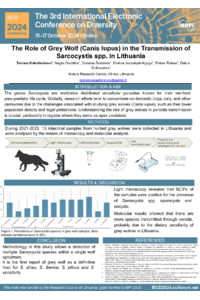
The genus Sarcocystis are worldwide distributed unicellular parasites known for their two-host prey-predator life cycle. Sarcocysts mainly develop in the muscles of the intermediate host (IH). Following ingestion of mature sarcocysts, they undergo sexual reproduction in the small intestines of the definitive host (DH), resulting in the formation of sporocysts which are subsequently excreted into the environment in conjunction with faecal matter. Even though sarcocystosis in the DH is usually asymptomatic, it can result in nausea, diarrhoea or weight loss. Globally, research efforts tend to concentrate on domestic dogs, cats, and other carnivores due to the challenges associated with studying grey wolves (Canis lupus), such as their lower population density and legal protections. Understanding the role of grey wolves in parasite transmission is crucial, particularly in regions where they serve as apex predators.
During 2021-2023, 13 intestinal samples from hunted grey wolves were collected in Lithuania and were analysed by the means of microscopy and molecular analysis. Light microscopy revealed that 92.3 % of the samples were positive for the presence of Sarcocystis spp. sporocysts and oocysts. A nested PCR assay targeting the cox1 gene was performed to confirm the presence of Sarcocystis DNA and identify the specific species involved. Molecular analysis revealed the presence of 12 different Sarcocystis species: S. arieticanis and S. tenella (IH: sheep), S. miescheriana (IH: pig and wild boar), S. capracanis (IH: goat), S.alces, S.capreolicanis, S.gracilis, S. hjorti, S. iberica, S. linearis, S. taeniata, and S. venatoria (IH: Cervidae).
Based on the variety of Sarcocystis species and high percentage of infected animals, the grey wolf plays an important role in transmission of these parasites.
Keywords
Sarcocystis
definitive host
cox1
molecular identification
light microscopy
Poster
IECD poster Tamara Kalashnikova.pptx.pdf
New cytogenetic data of Artibeus (Dermanura) glaucus (Chiroptera, Phyllostomidae) and expansion of geographic limits for Brazil.
Non-invasive methods to determine biodiversity using plant gall volume and insect feces