Event submissions
Published
This submission belongs to the session S1. Animal Diversity of the event The 3rd International Electronic Conference on Diversity
Published date
11 Oct, 2024
Academic Editor
'%3e%3cpath%20d='M12.6657%2010.9104C12.4185%2010.325%2012.0599%209.79327%2011.6097%209.34482C11.1609%208.89508%2010.6293%208.5365%2010.0442%208.28888C10.0389%208.28626%2010.0337%208.28495%2010.0285%208.28233C10.8446%207.69279%2011.3752%206.73249%2011.3752%205.64904C11.3752%203.8542%209.92103%202.39999%208.1262%202.39999C6.33136%202.39999%204.87715%203.8542%204.87715%205.64904C4.87715%206.73249%205.40774%207.69279%206.22393%208.28364C6.21869%208.28626%206.21345%208.28757%206.20821%208.29019C5.62129%208.5378%205.09463%208.89284%204.64265%209.34613C4.1929%209.79493%203.83432%2010.3266%203.58671%2010.9117C3.34345%2011.4845%203.21226%2012.0987%203.20023%2012.7209C3.19988%2012.7349%203.20233%2012.7488%203.20744%2012.7619C3.21255%2012.7749%203.22022%2012.7867%203.22998%2012.7968C3.23975%2012.8068%203.25142%2012.8147%203.26431%2012.8202C3.2772%2012.8256%203.29105%2012.8284%203.30504%2012.8284H4.09109C4.14874%2012.8284%204.19459%2012.7825%204.1959%2012.7262C4.2221%2011.7148%204.62823%2010.7676%205.34617%2010.0497C6.08899%209.30683%207.0755%208.89808%208.1262%208.89808C9.17689%208.89808%2010.1634%209.30683%2010.9062%2010.0497C11.6242%2010.7676%2012.0303%2011.7148%2012.0565%2012.7262C12.0578%2012.7838%2012.1037%2012.8284%2012.1613%2012.8284H12.9474C12.9613%2012.8284%2012.9752%2012.8256%2012.9881%2012.8202C13.001%2012.8147%2013.0126%2012.8068%2013.0224%2012.7968C13.0322%2012.7867%2013.0398%2012.7749%2013.0449%2012.7619C13.0501%2012.7488%2013.0525%2012.7349%2013.0522%2012.7209C13.0391%2012.0947%2012.9094%2011.4855%2012.6657%2010.9104ZM8.1262%207.9024C7.52486%207.9024%206.9589%207.6679%206.53312%207.24211C6.10733%206.81633%205.87283%206.25037%205.87283%205.64904C5.87283%205.0477%206.10733%204.48174%206.53312%204.05596C6.9589%203.63018%207.52486%203.39567%208.1262%203.39567C8.72753%203.39567%209.29349%203.63018%209.71927%204.05596C10.1451%204.48174%2010.3796%205.0477%2010.3796%205.64904C10.3796%206.25037%2010.1451%206.81633%209.71927%207.24211C9.29349%207.6679%208.72753%207.9024%208.1262%207.9024Z'%20fill='%235D1EE1'/%3e%3c/g%3e%3c/svg%3e) Luc Legal
Luc LegalCitation
Maria Naumova, Teodora Marius Teofilova, Tsvetelina Gerasimova, Boyan Vagalinski, Vera Antonova, Sirma Zidarova, Albena Vlasseva, Teodor Trifonov, Ivaylo Georgiev, Simeon Indzhov, Vassil Vassilev, Stela-Teodora Trendafilova, Maya Slavova, Monitoring the impact of global climate change by analyzing animal groups in thermophilic fauna corridors in Bulgaria, in Proceedings of The 3rd International Electronic Conference on Diversity, 15 October–17 October 2024, MDPI: Basel, Switzerland
Share
Email
Facebook
Twitter
LinkedIn
Monitoring the impact of global climate change by analyzing animal groups in thermophilic fauna corridors in Bulgaria
'%3e%3cpath%20d='M12.6647%2010.9104C12.4176%2010.325%2012.0589%209.7933%2011.6088%209.34485C11.16%208.89511%2010.6283%208.53653%2010.0432%208.28891C10.038%208.28629%2010.0327%208.28498%2010.0275%208.28236C10.8437%207.69282%2011.3743%206.73252%2011.3743%205.64907C11.3743%203.85423%209.92005%202.40002%208.12522%202.40002C6.33038%202.40002%204.87618%203.85423%204.87618%205.64907C4.87618%206.73252%205.40677%207.69282%206.22296%208.28367C6.21772%208.28629%206.21248%208.2876%206.20724%208.29022C5.62031%208.53783%205.09365%208.89287%204.64167%209.34616C4.19192%209.79496%203.83334%2010.3266%203.58573%2010.9117C3.34247%2011.4846%203.21128%2012.0987%203.19925%2012.721C3.1989%2012.735%203.20135%2012.7489%203.20646%2012.7619C3.21157%2012.7749%203.21924%2012.7868%203.22901%2012.7968C3.23877%2012.8068%203.25045%2012.8148%203.26334%2012.8202C3.27623%2012.8256%203.29007%2012.8284%203.30406%2012.8284H4.09012C4.14776%2012.8284%204.19362%2012.7825%204.19493%2012.7262C4.22113%2011.7148%204.62726%2010.7676%205.34519%2010.0497C6.08802%209.30686%207.07452%208.89811%208.12522%208.89811C9.17592%208.89811%2010.1624%209.30686%2010.9052%2010.0497C11.6232%2010.7676%2012.0293%2011.7148%2012.0555%2012.7262C12.0568%2012.7839%2012.1027%2012.8284%2012.1603%2012.8284H12.9464C12.9604%2012.8284%2012.9742%2012.8256%2012.9871%2012.8202C13%2012.8148%2013.0117%2012.8068%2013.0214%2012.7968C13.0312%2012.7868%2013.0389%2012.7749%2013.044%2012.7619C13.0491%2012.7489%2013.0515%2012.735%2013.0512%2012.721C13.0381%2012.0947%2012.9084%2011.4856%2012.6647%2010.9104ZM8.12522%207.90243C7.52388%207.90243%206.95792%207.66793%206.53214%207.24215C6.10636%206.81636%205.87185%206.2504%205.87185%205.64907C5.87185%205.04773%206.10636%204.48177%206.53214%204.05599C6.95792%203.63021%207.52388%203.3957%208.12522%203.3957C8.72655%203.3957%209.29252%203.63021%209.7183%204.05599C10.1441%204.48177%2010.3786%205.04773%2010.3786%205.64907C10.3786%206.2504%2010.1441%206.81636%209.7183%207.24215C9.29252%207.66793%208.72655%207.90243%208.12522%207.90243Z'%20fill='%235D1EE1'/%3e%3c/g%3e%3c/svg%3e)
Maria Naumova 1

Teodora Marius Teofilova 1
Tsvetelina Gerasimova 1
Boyan Vagalinski 1
Vera Antonova 1
Sirma Zidarova 1
Albena Vlasseva 1
Teodor Trifonov 1

Ivaylo Georgiev 2
Simeon Indzhov 3
Vassil Vassilev 4
Stela-Teodora Trendafilova 3
Maya Slavova 3
1. Institute of Biodiversity and Ecosystem Research (IBER), Bulgarian Academy of Sciences (BAS), 1 Tsar Osvoboditel Blvd., 1000 Sofia, Bulgaria
2. Technical University, 11 Professor Georgi Bradistilov Str., 1756 Sofia, Bulgaria
3. Faculty of Biology, Sofia University, 8 Dragan Tsankov, 1164 Sofia, Bulgaria
4. GeoPolymorphic Cloud Association, 58 Sitnyakovo Blvd., 1111 Sofia, Bulgaria
Abstract
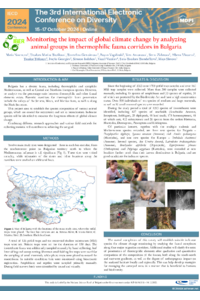
Bulgaria is one of the smaller European countries, but it takes the leading place in faunal diversity, including cosmopolitan animal species and many Bulgarian and Balkan endemics. It is known that thermophilic and xerophilic Mediterranean animal species are found in the country's southern regions and along the Black Sea coast, and in the northern and mountainous areas, there are many species characteristic of Central and Northern Europe. No analysis exists for the percentage ratio between thermophilic and other faunal elements. This necessitates the examination of the routes for the penetration of thermophilic fauna. Some of the most significant potential corridors pass through the valleys of the rivers Struma, Mesta, and Maritsa, as well as along the Black Sea coast, and they are the main object of the research project we are presenting here. In 2022, we started to study these regions monthly—from their southernmost point on the Bulgarian territory to the north, where the Mediterranean influence is confirmed.
This project aims to establish the species composition of various animal groups: arachnids (Arachnida: Araneae, Scorpiones, Solifugae), millipedes (Myriapoda), some insects (Insecta), terrestrial snails (Gastropoda), amphibians (Amphibia: Anura, Caudata), reptiles (Reptilia: Testudines, Squamata), and mammals (Mammalia: Rodentia, Eulipotyphla, Chiroptera), which are cosmopolitan, decisive for functioning ecosystems, and have a proven bioindicator role. During the research, indicator species will be identified from the model groups, which can be used to monitor the long-term effects of global climate change. Combining different research approaches and various field methods for collecting material will contribute to achieving the set goal.
The overall completion of this survey, which takes its first steps, will contribute to assessing the impact of anthropogenic pressure on individual species and species complexes. This can help develop strategies for managing the surveyed areas in a manner that is beneficial to humans and biodiversity.
Keywords
global climate changes
Mediterranean influence
Bulgarian thermophilic fauna
biocorridors
Poster
IECD_poster_Thermophilic-fauna_sciforum--097202.pdf
Investigation of Cotton Fabric Coating using Fungal Mycelium Pleurotus Ostreatus and Beeswax
Diversity of helminths in snow sheep (Ovis nivicola) and muskox (Ovibos moschatus) in Russia