Event submissions
Published
This submission belongs to the session S1. Animal Diversity of the event The 3rd International Electronic Conference on Diversity
Published date
11 Oct, 2024
Academic Editor
'%3e%3cpath%20d='M12.6657%2010.9104C12.4185%2010.325%2012.0599%209.79327%2011.6097%209.34482C11.1609%208.89508%2010.6293%208.5365%2010.0442%208.28888C10.0389%208.28626%2010.0337%208.28495%2010.0285%208.28233C10.8446%207.69279%2011.3752%206.73249%2011.3752%205.64904C11.3752%203.8542%209.92103%202.39999%208.1262%202.39999C6.33136%202.39999%204.87715%203.8542%204.87715%205.64904C4.87715%206.73249%205.40774%207.69279%206.22393%208.28364C6.21869%208.28626%206.21345%208.28757%206.20821%208.29019C5.62129%208.5378%205.09463%208.89284%204.64265%209.34613C4.1929%209.79493%203.83432%2010.3266%203.58671%2010.9117C3.34345%2011.4845%203.21226%2012.0987%203.20023%2012.7209C3.19988%2012.7349%203.20233%2012.7488%203.20744%2012.7619C3.21255%2012.7749%203.22022%2012.7867%203.22998%2012.7968C3.23975%2012.8068%203.25142%2012.8147%203.26431%2012.8202C3.2772%2012.8256%203.29105%2012.8284%203.30504%2012.8284H4.09109C4.14874%2012.8284%204.19459%2012.7825%204.1959%2012.7262C4.2221%2011.7148%204.62823%2010.7676%205.34617%2010.0497C6.08899%209.30683%207.0755%208.89808%208.1262%208.89808C9.17689%208.89808%2010.1634%209.30683%2010.9062%2010.0497C11.6242%2010.7676%2012.0303%2011.7148%2012.0565%2012.7262C12.0578%2012.7838%2012.1037%2012.8284%2012.1613%2012.8284H12.9474C12.9613%2012.8284%2012.9752%2012.8256%2012.9881%2012.8202C13.001%2012.8147%2013.0126%2012.8068%2013.0224%2012.7968C13.0322%2012.7867%2013.0398%2012.7749%2013.0449%2012.7619C13.0501%2012.7488%2013.0525%2012.7349%2013.0522%2012.7209C13.0391%2012.0947%2012.9094%2011.4855%2012.6657%2010.9104ZM8.1262%207.9024C7.52486%207.9024%206.9589%207.6679%206.53312%207.24211C6.10733%206.81633%205.87283%206.25037%205.87283%205.64904C5.87283%205.0477%206.10733%204.48174%206.53312%204.05596C6.9589%203.63018%207.52486%203.39567%208.1262%203.39567C8.72753%203.39567%209.29349%203.63018%209.71927%204.05596C10.1451%204.48174%2010.3796%205.0477%2010.3796%205.64904C10.3796%206.25037%2010.1451%206.81633%209.71927%207.24211C9.29349%207.6679%208.72753%207.9024%208.1262%207.9024Z'%20fill='%235D1EE1'/%3e%3c/g%3e%3c/svg%3e) Luc Legal
Luc LegalCitation
Olga A. Loginova, Iuliia K. Plotnikova, Sofya B. Rozenfeld, Mikhail G. Bondar, Taras P. Sipko, Diversity of helminths in snow sheep (Ovis nivicola) and muskox (Ovibos moschatus) in Russia, in Proceedings of The 3rd International Electronic Conference on Diversity, 15 October–17 October 2024, MDPI: Basel, Switzerland
Share
Email
Facebook
Twitter
LinkedIn
Diversity of helminths in snow sheep (Ovis nivicola) and muskox (Ovibos moschatus) in Russia

Olga A. Loginova 1
'%3e%3cpath%20d='M12.6647%2010.9104C12.4176%2010.325%2012.0589%209.7933%2011.6088%209.34485C11.16%208.89511%2010.6283%208.53653%2010.0432%208.28891C10.038%208.28629%2010.0327%208.28498%2010.0275%208.28236C10.8437%207.69282%2011.3743%206.73252%2011.3743%205.64907C11.3743%203.85423%209.92005%202.40002%208.12522%202.40002C6.33038%202.40002%204.87618%203.85423%204.87618%205.64907C4.87618%206.73252%205.40677%207.69282%206.22296%208.28367C6.21772%208.28629%206.21248%208.2876%206.20724%208.29022C5.62031%208.53783%205.09365%208.89287%204.64167%209.34616C4.19192%209.79496%203.83334%2010.3266%203.58573%2010.9117C3.34247%2011.4846%203.21128%2012.0987%203.19925%2012.721C3.1989%2012.735%203.20135%2012.7489%203.20646%2012.7619C3.21157%2012.7749%203.21924%2012.7868%203.22901%2012.7968C3.23877%2012.8068%203.25045%2012.8148%203.26334%2012.8202C3.27623%2012.8256%203.29007%2012.8284%203.30406%2012.8284H4.09012C4.14776%2012.8284%204.19362%2012.7825%204.19493%2012.7262C4.22113%2011.7148%204.62726%2010.7676%205.34519%2010.0497C6.08802%209.30686%207.07452%208.89811%208.12522%208.89811C9.17592%208.89811%2010.1624%209.30686%2010.9052%2010.0497C11.6232%2010.7676%2012.0293%2011.7148%2012.0555%2012.7262C12.0568%2012.7839%2012.1027%2012.8284%2012.1603%2012.8284H12.9464C12.9604%2012.8284%2012.9742%2012.8256%2012.9871%2012.8202C13%2012.8148%2013.0117%2012.8068%2013.0214%2012.7968C13.0312%2012.7868%2013.0389%2012.7749%2013.044%2012.7619C13.0491%2012.7489%2013.0515%2012.735%2013.0512%2012.721C13.0381%2012.0947%2012.9084%2011.4856%2012.6647%2010.9104ZM8.12522%207.90243C7.52388%207.90243%206.95792%207.66793%206.53214%207.24215C6.10636%206.81636%205.87185%206.2504%205.87185%205.64907C5.87185%205.04773%206.10636%204.48177%206.53214%204.05599C6.95792%203.63021%207.52388%203.3957%208.12522%203.3957C8.72655%203.3957%209.29252%203.63021%209.7183%204.05599C10.1441%204.48177%2010.3786%205.04773%2010.3786%205.64907C10.3786%206.2504%2010.1441%206.81636%209.7183%207.24215C9.29252%207.66793%208.72655%207.90243%208.12522%207.90243Z'%20fill='%235D1EE1'/%3e%3c/g%3e%3c/svg%3e)
Iuliia K. Plotnikova 2

Sofya B. Rozenfeld 2
Mikhail G. Bondar 3
Taras P. Sipko 2
1. Parasitology Center, A. N. Severtsov Intstiture of Ecology and Evolution of the Russian Academy of Sciences, IEE RAS, Moscow 119171, Russia
2. A. N. Severtsov Institute of Ecology and Evolution of the Russian Academy of Sciences (IEE RAS)
3. Joint Directorate of Taimyr Nature Reserves
Abstract
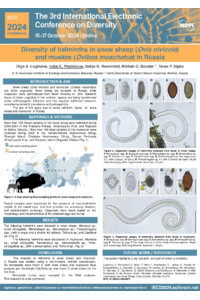
Snow sheep (Ovis nivicola) and muskoxen (Ovibos moschatus) are Arctic ungulates. Snow sheep are endemic to Russia, while muskoxen were reintroduced from North America in 1974. Helminth fauna of these ungulates in the northern regions are being transformed under anthropogenic influence and this requires additional research, considering helminth prevalence and pathogenicity.
More than 100 faecal samples of the snow sheep were collected during 2016-2024 in the Putorana Plateau (Krasnoyarsk Krai) and Republic of Sakha (Yakutia). More than 150 fecal samples of the muskoxen were collected during 2022 in the Yamalo-Nenets Autonomous Okrug, Wrangel Island, Chukotka Autonomous Okrug, Taymyr Peninsula (Krasnoyarsk Krai), and Zavyalov Island (Magadan Oblast).
Faecal samples were examined for the presence of macrohelminths (visible to the naked eye), and then proceed via larvoscopy, flotation, and sedimentation ovoscopy. Diagnoses were made based on the morphology and morphometrics of the obtained eggs and larvae.
The following helminths were detected in snow sheep: Moniezia sp.; small strongylids; Marshallagia sp.; Nematodirus sp.; Protostrongylus spp., (with a longer and a shorter tail spikes); Trichuris sp.; and Capillaria sp. The following helminths were discovered in muskoxen: Moniezia sp.; small strongylids; Nematodirus sp.; Nematodirella sp.; Protostrongylidae sp., (with a dorsal spine); and Trichuris sp.
Capillaria sp. was found in show sheep for the first time. Nematode larvae were sampled for the DNA analyses. This research is to be continued.
Keywords
helminths
Ovis nivicola
Ovibos moschatus
Russia
Poster
sciforum-097209 Loginova et al - IECD poster.pdf
Monitoring the impact of global climate change by analyzing animal groups in thermophilic fauna corridors in Bulgaria
Multi-Scale Comparison of the Shapes and Drivers of Stream Fish Species–Area Relationships in a Regional Aquatic Biodiversity Hotspot