Event submissions
Published
This submission belongs to the session S1. Animal Diversity of the event The 3rd International Electronic Conference on Diversity
Published date
11 Oct, 2024
Academic Editor
'%3e%3cpath%20d='M12.6657%2010.9104C12.4185%2010.325%2012.0599%209.79327%2011.6097%209.34482C11.1609%208.89508%2010.6293%208.5365%2010.0442%208.28888C10.0389%208.28626%2010.0337%208.28495%2010.0285%208.28233C10.8446%207.69279%2011.3752%206.73249%2011.3752%205.64904C11.3752%203.8542%209.92103%202.39999%208.1262%202.39999C6.33136%202.39999%204.87715%203.8542%204.87715%205.64904C4.87715%206.73249%205.40774%207.69279%206.22393%208.28364C6.21869%208.28626%206.21345%208.28757%206.20821%208.29019C5.62129%208.5378%205.09463%208.89284%204.64265%209.34613C4.1929%209.79493%203.83432%2010.3266%203.58671%2010.9117C3.34345%2011.4845%203.21226%2012.0987%203.20023%2012.7209C3.19988%2012.7349%203.20233%2012.7488%203.20744%2012.7619C3.21255%2012.7749%203.22022%2012.7867%203.22998%2012.7968C3.23975%2012.8068%203.25142%2012.8147%203.26431%2012.8202C3.2772%2012.8256%203.29105%2012.8284%203.30504%2012.8284H4.09109C4.14874%2012.8284%204.19459%2012.7825%204.1959%2012.7262C4.2221%2011.7148%204.62823%2010.7676%205.34617%2010.0497C6.08899%209.30683%207.0755%208.89808%208.1262%208.89808C9.17689%208.89808%2010.1634%209.30683%2010.9062%2010.0497C11.6242%2010.7676%2012.0303%2011.7148%2012.0565%2012.7262C12.0578%2012.7838%2012.1037%2012.8284%2012.1613%2012.8284H12.9474C12.9613%2012.8284%2012.9752%2012.8256%2012.9881%2012.8202C13.001%2012.8147%2013.0126%2012.8068%2013.0224%2012.7968C13.0322%2012.7867%2013.0398%2012.7749%2013.0449%2012.7619C13.0501%2012.7488%2013.0525%2012.7349%2013.0522%2012.7209C13.0391%2012.0947%2012.9094%2011.4855%2012.6657%2010.9104ZM8.1262%207.9024C7.52486%207.9024%206.9589%207.6679%206.53312%207.24211C6.10733%206.81633%205.87283%206.25037%205.87283%205.64904C5.87283%205.0477%206.10733%204.48174%206.53312%204.05596C6.9589%203.63018%207.52486%203.39567%208.1262%203.39567C8.72753%203.39567%209.29349%203.63018%209.71927%204.05596C10.1451%204.48174%2010.3796%205.0477%2010.3796%205.64904C10.3796%206.25037%2010.1451%206.81633%209.71927%207.24211C9.29349%207.6679%208.72753%207.9024%208.1262%207.9024Z'%20fill='%235D1EE1'/%3e%3c/g%3e%3c/svg%3e) Satita Tansukkasem
Satita TansukkasemCitation
Naglis Gudiškis, Donatas Šneideris, Evelina Juozaitytė-Ngugu, Petras Prakas, Dalius Butkauskas, The Role of Red Fox (Vulpes vulpes) and Raccoon Dog (Nyctereutes procyonoides) in the Transmission of Sarcocystis Species from Farm Animals and Wild Cervids, in Proceedings of The 3rd International Electronic Conference on Diversity, 15 October–17 October 2024, MDPI: Basel, Switzerland
Share
Email
Facebook
Twitter
LinkedIn
The Role of Red Fox (Vulpes vulpes) and Raccoon Dog (Nyctereutes procyonoides) in the Transmission of Sarcocystis Species from Farm Animals and Wild Cervids
'%3e%3cpath%20d='M12.6647%2010.9104C12.4176%2010.325%2012.0589%209.7933%2011.6088%209.34485C11.16%208.89511%2010.6283%208.53653%2010.0432%208.28891C10.038%208.28629%2010.0327%208.28498%2010.0275%208.28236C10.8437%207.69282%2011.3743%206.73252%2011.3743%205.64907C11.3743%203.85423%209.92005%202.40002%208.12522%202.40002C6.33038%202.40002%204.87618%203.85423%204.87618%205.64907C4.87618%206.73252%205.40677%207.69282%206.22296%208.28367C6.21772%208.28629%206.21248%208.2876%206.20724%208.29022C5.62031%208.53783%205.09365%208.89287%204.64167%209.34616C4.19192%209.79496%203.83334%2010.3266%203.58573%2010.9117C3.34247%2011.4846%203.21128%2012.0987%203.19925%2012.721C3.1989%2012.735%203.20135%2012.7489%203.20646%2012.7619C3.21157%2012.7749%203.21924%2012.7868%203.22901%2012.7968C3.23877%2012.8068%203.25045%2012.8148%203.26334%2012.8202C3.27623%2012.8256%203.29007%2012.8284%203.30406%2012.8284H4.09012C4.14776%2012.8284%204.19362%2012.7825%204.19493%2012.7262C4.22113%2011.7148%204.62726%2010.7676%205.34519%2010.0497C6.08802%209.30686%207.07452%208.89811%208.12522%208.89811C9.17592%208.89811%2010.1624%209.30686%2010.9052%2010.0497C11.6232%2010.7676%2012.0293%2011.7148%2012.0555%2012.7262C12.0568%2012.7839%2012.1027%2012.8284%2012.1603%2012.8284H12.9464C12.9604%2012.8284%2012.9742%2012.8256%2012.9871%2012.8202C13%2012.8148%2013.0117%2012.8068%2013.0214%2012.7968C13.0312%2012.7868%2013.0389%2012.7749%2013.044%2012.7619C13.0491%2012.7489%2013.0515%2012.735%2013.0512%2012.721C13.0381%2012.0947%2012.9084%2011.4856%2012.6647%2010.9104ZM8.12522%207.90243C7.52388%207.90243%206.95792%207.66793%206.53214%207.24215C6.10636%206.81636%205.87185%206.2504%205.87185%205.64907C5.87185%205.04773%206.10636%204.48177%206.53214%204.05599C6.95792%203.63021%207.52388%203.3957%208.12522%203.3957C8.72655%203.3957%209.29252%203.63021%209.7183%204.05599C10.1441%204.48177%2010.3786%205.04773%2010.3786%205.64907C10.3786%206.2504%2010.1441%206.81636%209.7183%207.24215C9.29252%207.66793%208.72655%207.90243%208.12522%207.90243Z'%20fill='%235D1EE1'/%3e%3c/g%3e%3c/svg%3e)
Naglis Gudiškis 1
Donatas Šneideris 1
Evelina Juozaitytė-Ngugu 1

Petras Prakas 1
Dalius Butkauskas 1
1. Nature Research Centre, Vilnius, Lithuania
Abstract
The Role of Red Fox (Vulpes vulpes) and Raccoon Dog (Nyctereutes procyonoides) in the Transmission of Sarcocystis Species from Farm Animals and Wild Cervids
Naglis Gudiškis1, Donatas Šneideris1, Evelina Juozaitytė-Ngugu1, Petras Prakas1, Dalius Butkauskas1
1Nature Research Centre, Vilnius, Lithuania
naglis.gudiskis@gmail.com
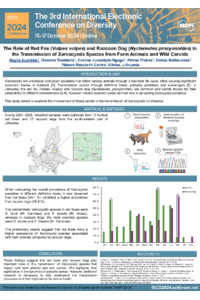
Sarcocystis are unicellular protozoan parasites that infect various animals through a two-host life cycle. They develop sarcocysts in different tissues of their intermediate hosts (IH), which can lead to significant economic losses when these hosts are farm animals. The parasites are transmitted by definitive hosts (DHs), usually predators and scavengers. In Lithuania, the red fox (Vulpes vulpes) and the raccoon dog (Nyctereutes procyonoides) are among the most common wild canids, noted for their adaptability to various environmental conditions. These predatory mammals, along with other members of the Canidae and Felidae families, play a key role in spreading various parasites. Limited data exist on the role of these canids in transmitting Sarcocystis parasites, thus this study examined their involvement in Lithuania.
During 2021–2023, intestinal samples of 13 hunted red foxes and 12 raccoon dogs were collected and subjected to molecular analysis using a nested PCR and sequencing of the cox1 gene. Based on the results, 14 different Sarcocystis species were identified: S. arieticanis and S. tenella (IH: sheep), S. bertrami (IH: horses), S. capracanis (IH: goats), S. miescheriana (IH: pigs and wild boars), S. alces, S. capreolicanis, S. gracilis, S. hjorti, S. iberica, S. linearis, S. morae, S. taeniata, and S. venatoria (IH: Cervidae). The preliminary results indicate that red fox is more common in the distribution of Sarcocystis species whose IHs are farm animals compared to raccoon dog. These findings indicate that both the red fox and raccoon dog are significant in the spread of Sarcocystis species, whose IHs are farm animals and wild cervids.
Keywords
red fox
raccoon dog
molecular characterization
Sarcocystis
life cycle
Poster
Poster presentation_Gudiškis.pdf
Phylogenetic Insights and Species Delimitation of Eutyphoeus Earthworms in India Using Integrative taxonomy
Chalcid wasps (Hymenoptera: Chalcidoidea) associated with plant galls in India