Event submissions
Published
This submission belongs to the session S5. Numerical and Experimental Methods, Data Analyses, Digital Twin, IoT Machine Learning and AI in Water Sciences of the event The 8th International Electronic Conference on Water Sciences
Published date
11 Oct, 2024
Academic Editor
'%3e%3cpath%20d='M12.6657%2010.9104C12.4185%2010.325%2012.0599%209.79327%2011.6097%209.34482C11.1609%208.89508%2010.6293%208.5365%2010.0442%208.28888C10.0389%208.28626%2010.0337%208.28495%2010.0285%208.28233C10.8446%207.69279%2011.3752%206.73249%2011.3752%205.64904C11.3752%203.8542%209.92103%202.39999%208.1262%202.39999C6.33136%202.39999%204.87715%203.8542%204.87715%205.64904C4.87715%206.73249%205.40774%207.69279%206.22393%208.28364C6.21869%208.28626%206.21345%208.28757%206.20821%208.29019C5.62129%208.5378%205.09463%208.89284%204.64265%209.34613C4.1929%209.79493%203.83432%2010.3266%203.58671%2010.9117C3.34345%2011.4845%203.21226%2012.0987%203.20023%2012.7209C3.19988%2012.7349%203.20233%2012.7488%203.20744%2012.7619C3.21255%2012.7749%203.22022%2012.7867%203.22998%2012.7968C3.23975%2012.8068%203.25142%2012.8147%203.26431%2012.8202C3.2772%2012.8256%203.29105%2012.8284%203.30504%2012.8284H4.09109C4.14874%2012.8284%204.19459%2012.7825%204.1959%2012.7262C4.2221%2011.7148%204.62823%2010.7676%205.34617%2010.0497C6.08899%209.30683%207.0755%208.89808%208.1262%208.89808C9.17689%208.89808%2010.1634%209.30683%2010.9062%2010.0497C11.6242%2010.7676%2012.0303%2011.7148%2012.0565%2012.7262C12.0578%2012.7838%2012.1037%2012.8284%2012.1613%2012.8284H12.9474C12.9613%2012.8284%2012.9752%2012.8256%2012.9881%2012.8202C13.001%2012.8147%2013.0126%2012.8068%2013.0224%2012.7968C13.0322%2012.7867%2013.0398%2012.7749%2013.0449%2012.7619C13.0501%2012.7488%2013.0525%2012.7349%2013.0522%2012.7209C13.0391%2012.0947%2012.9094%2011.4855%2012.6657%2010.9104ZM8.1262%207.9024C7.52486%207.9024%206.9589%207.6679%206.53312%207.24211C6.10733%206.81633%205.87283%206.25037%205.87283%205.64904C5.87283%205.0477%206.10733%204.48174%206.53312%204.05596C6.9589%203.63018%207.52486%203.39567%208.1262%203.39567C8.72753%203.39567%209.29349%203.63018%209.71927%204.05596C10.1451%204.48174%2010.3796%205.0477%2010.3796%205.64904C10.3796%206.25037%2010.1451%206.81633%209.71927%207.24211C9.29349%207.6679%208.72753%207.9024%208.1262%207.9024Z'%20fill='%235D1EE1'/%3e%3c/g%3e%3c/svg%3e) Junye Wang
Junye WangCitation
David Beltrán-Vargas, Fernando García-Páez, Manuel Martínez-Morales, Sergio Arturo Rentería-Guevara, Numerical Models for Groundwater Flows: Key in Construction, in Proceedings of The 8th International Electronic Conference on Water Sciences, 14 October–16 October 2024, MDPI: Basel, Switzerland
Share
Email
Facebook
Twitter
LinkedIn
Numerical Models for Groundwater Flows: Key in Construction

David Beltrán-Vargas 1
'%3e%3cpath%20d='M12.6647%2010.9104C12.4176%2010.325%2012.0589%209.7933%2011.6088%209.34485C11.16%208.89511%2010.6283%208.53653%2010.0432%208.28891C10.038%208.28629%2010.0327%208.28498%2010.0275%208.28236C10.8437%207.69282%2011.3743%206.73252%2011.3743%205.64907C11.3743%203.85423%209.92005%202.40002%208.12522%202.40002C6.33038%202.40002%204.87618%203.85423%204.87618%205.64907C4.87618%206.73252%205.40677%207.69282%206.22296%208.28367C6.21772%208.28629%206.21248%208.2876%206.20724%208.29022C5.62031%208.53783%205.09365%208.89287%204.64167%209.34616C4.19192%209.79496%203.83334%2010.3266%203.58573%2010.9117C3.34247%2011.4846%203.21128%2012.0987%203.19925%2012.721C3.1989%2012.735%203.20135%2012.7489%203.20646%2012.7619C3.21157%2012.7749%203.21924%2012.7868%203.22901%2012.7968C3.23877%2012.8068%203.25045%2012.8148%203.26334%2012.8202C3.27623%2012.8256%203.29007%2012.8284%203.30406%2012.8284H4.09012C4.14776%2012.8284%204.19362%2012.7825%204.19493%2012.7262C4.22113%2011.7148%204.62726%2010.7676%205.34519%2010.0497C6.08802%209.30686%207.07452%208.89811%208.12522%208.89811C9.17592%208.89811%2010.1624%209.30686%2010.9052%2010.0497C11.6232%2010.7676%2012.0293%2011.7148%2012.0555%2012.7262C12.0568%2012.7839%2012.1027%2012.8284%2012.1603%2012.8284H12.9464C12.9604%2012.8284%2012.9742%2012.8256%2012.9871%2012.8202C13%2012.8148%2013.0117%2012.8068%2013.0214%2012.7968C13.0312%2012.7868%2013.0389%2012.7749%2013.044%2012.7619C13.0491%2012.7489%2013.0515%2012.735%2013.0512%2012.721C13.0381%2012.0947%2012.9084%2011.4856%2012.6647%2010.9104ZM8.12522%207.90243C7.52388%207.90243%206.95792%207.66793%206.53214%207.24215C6.10636%206.81636%205.87185%206.2504%205.87185%205.64907C5.87185%205.04773%206.10636%204.48177%206.53214%204.05599C6.95792%203.63021%207.52388%203.3957%208.12522%203.3957C8.72655%203.3957%209.29252%203.63021%209.7183%204.05599C10.1441%204.48177%2010.3786%205.04773%2010.3786%205.64907C10.3786%206.2504%2010.1441%206.81636%209.7183%207.24215C9.29252%207.66793%208.72655%207.90243%208.12522%207.90243Z'%20fill='%235D1EE1'/%3e%3c/g%3e%3c/svg%3e)
Fernando García-Páez 1
Manuel Martínez-Morales 2
Sergio Arturo Rentería-Guevara 1
1. Department of Civil Engineering, Autonomous University of Sinaloa, 80013, Culiacán, Sinaloa, México
2. Groundwater Hydrology Division, Mexican Institute of Water Technology, 62550, Jiutepec Morelos, Mexico
Abstract
The presence of groundwater flow in a construction project affects the construction process, resulting in issues ranging from excavation stability to the redesign of foundations and infrastructure, leading to project delays and major revisions. Groundwater level drawdown, a controlled technique in Civil Engineering, mitigates this effect. Understanding the aquifer is important to ensure accurate representation in the model and to plan the appropriate dewatering technique. In Mexico, the regulation of these procedures related to laws, norms, and regulations lacks a specific bibliography. Additionally, the availability of databases with piezometric information is insufficient and limited. Methodologies for analysis have evolved worldwide to capture the system's complexity, employing numerical models to assess its behaviour. First, it was necessary to characterize the area, considering the water-table level. Subsequently, a numerical model was developed using ModFlow and its ModelMuse interface, both developed by the United States Geological Survey (USGS). This allowed the evaluation of different scenarios in response to proposed dewatering techniques and the anticipation of potential impacts, thereby avoiding the trial and error practice. Analyses of “Torre Tres Ríos”, a building in Sinaloa, Mexico, were conducted to assess water-table behaviour in the area. In July, the water-table was at 33 meters above sea level (masl). By October, it had risen to 35.74 masl, attributed to the recharge due to the rainy season and the influence of the Tamazula River. By November, it had dropped to 35.20 masl, indicating a discharge process. The steady-state model initially represented with piezometric levels close to 33 masl in July. Subsequent transient-state model outputs for October and November reported water-table elevations at 35.676 and 35.438 masl, respectively. Calibration results revealed a mean absolute error of 0.15 meters and a standard deviation of 0.174 meters, approving the model results. This information is important for informed decision-making in dewatering processes, enabling precise adjustments in pumping.
Keywords
Numerical models
dewatering
groundwater
water-table
hydrology.
Poster
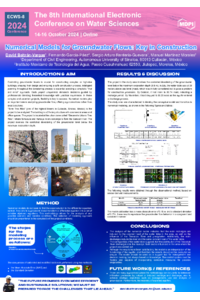
POSTER DAVID MDPI.pdf
Water Quality Classification in terms of WQI using Machine Learning Algorithms in Keenjhar Lake, Pakistan
A PHYSICO-CHEMICAL ANALYSIS OF GROUNDWATER IN THE CASE OF THE RURAL AREA KOSON IN UZBEKISTAN